|
Explore The Magical World of Electric Irons Scene from: Tarzan vs. KaKi, Universal, 1938 (l. to. r.: Vanessa Brown, Denise Darcel, Henry Forstner, Italo Calvino (with iron),Lex Barker, Ira Eaker, and Billy Rubin) KaKi, Goddess of Mindless Tasks after the famous statue in Bhutol attributed to Chauvitupuras, c 1320 | |||||||
| Hi Lindy
Hoppers!!! Exciting things are hiding in the laundry room... | |||||||
Let's Take a Trip Inside Your Electric Iron!

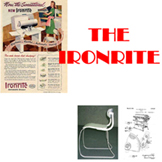
Why Are We Doing This?Why would a grown man make a web page devoted solely to ironing? No doubt, ironing occupies an important place in our society --- go to a job interview without a pressed shirt if you want a practical demonstration. But, there is actually a sociological reason for our ironing page. It all goes back to LIFE Magazine... ...particularly the November 25,1946 issue, which also marked the magazine's tenth anniversary. It seems that consumers were just a little bit antsy because Industry was taking a bit too long converting from war production to consumer goods. So, the folks at Life did a little piece on "The American Dream" that took the form of a two page photo showing a typical family (2.2 children...) posing with some of the consumer goods that were most desired. Most of these desiderata are fairly mundane -- a dishwasher ($299), washing machine ($241), electric range ($266), and freezer chest ($200). A floor model radio/phonograph/television (at $1,795) represents American dreaming about home entertainment. [prices in 1946 dollars] The background shows a upper scale suburban home, stone veneer, bay window, one car garage. The property line is apparently delineated with a split rail fence. Examples of this can be found in great numbers in the near suburbs, particularly in the Falls Church area. The only item of the 1946 American Dream that has even approached immortality is the car: a 1946 Chrysler Town and Country convertible ($2,890 then, $150,000 now) is shown. This model, an extremely rare and expensive antique now, is distinguished by its use of wood trim --- it is not a wood-body car like older station wagons. Rather, it is a streamlined modern car with real wood trim. They are truly beautiful machines; click on the link to see for yourself! So, the bottom line on the Life picture is that the average American in the mid-Forties could have been bought off with less than $25,000 in consumer goods... Given these modest expectations, it is no wonder the Democrats managed to hang on to power for so long... SO WHAT DOES THIS HAVE TO DO WITH !#&$*## IRONING? One of the appliances pictured in the 1946 article is an IronRite ironer... known generally to the population as a "Mangle". (You can see why the Iron-Rite corporation is so emphatic about calling it an Ironer.) So, here is an up close look at a small piece of the American Dream ![]() The IronRite Ironer Freedom from the Dry Cleaner! ![]() The IronRite Ironer The Attractive cabinet The unraveling of why Ironing should be wrapped up in The American Dream has led me to write this page. The fact that I found one of these Iron-Rite machines at a yard-sale also helps. We have an elaborate discussion of the Ironrite and all its competitors below, but if you keep on scrolling, we have a lot of information on all kinds of irons that will help explain why an ironing machine was part of the American Dream. So, for better or worse, here is a summary of Ironing in America. Along the way, we'll discover that it has roots in female emancipation, the growth of the consumer economy and even touches upon corporate scandal and the mass exporting of American jobs abroad. And you only thought that it was a tiresome household chore... In the BeginningIroning works by loosening the bonds between the long-chain polymer molecules in the fibers of the material. While the molecules are hot, the fibers are straightened by the weight of the iron, and they hold their new shape as they cool. Some fabrics, such as cotton, require the addition of water to loosen the intermolecular bonds. Many modern fabrics (developed in or after the mid-twentieth century) are advertised as needing little or no ironing because their molecules have been designed to remain stable. David Woodcock, Assistant Curator of Domestic Technology at the Science Museum of London, traced pressing back to the Egyptians and Romans who did not use heat, relying on weight and pressure alone to smooth cloth. "Hot Ironing" is a relatively new idea that apparently came from the Mysterious East. Among the methods of pressing that do not involve heat are:
Somewhere around the 12th Century, East met West through trade. Fashion became heavily influenced by the possibilities of starching and pressing. Of note, people began to wear ruffled and fluted collars that demanded both Heat and Pressure. Among the earliest devices were:
By the 18th Century, irons had evolved to their current shape and size. The smoothly pointed shape facillitates the ironing of pleats, collars and small details. The notch in the nose allows you to iron around buttons. The weight is a compromise between heat retention and heft. A big, heavy iron will hold heat for a long time, but it will kill your arm if you use it for very long. In general, 2,000 years of trial and error gave us a device that is immediately recognized as an "iron." Below is a group of irons from a variety of countries and time periods. They all look the same. This illustrates the dictum "Form Follows Function" Irons from England, Germany, France, Turkey, and Japan Early irons had to be heated with fire of some sort. Wood and coal fires were often used, but an intermediary device was required because the iron itself could not be exposed to the flame lest it be covered with soot or ashes and thereby dirty the clean clothes it was supposed to press. Most of the time, a stove made of steel or cast-iron was used to contain the fire, and the ironing implement rested on it. In some cases, the iron was made hollow and a hot "slug" of metal (that could be heated in an open fire) was inserted into it. Later, the "self-heating" iron came to include variations that used charcoal, kerosene, or white gas. Some of these are shown below: Self-Heating Irons (l. to r.: Kerosene, White Gas, Charcoal) Please check out this website for an exhaustive collection of irons from all countries and historical periods. This is a marvelous collection and it is presented very well. We have also seen irons that have a connection for a natural gas tap, and others that received live steam from a boiler. These types of irons were generally used in commercial applications and could be very dangerous. However, the efficacy of the steam pressing technique led to the development of safe home steam-irons. Until the 1980s, the Coleman corporation made irons, fueled with white gas, that were very useful in situations where electricity was not available. For all of these irons, the appropriate temperature for ironing was judged by the user. Thermostatic controls would have to wait for a long while... Dimensions of Ironing TechnologyThis brief review of History shows that four factors are important to ironing technology. The evolution of this technology will be viewed through representative inventions that address each of the factors:
The evolution of ironing technology has involved removing the judgemental aspects of each factor and replacing them with automated decision-making. This opened ironing to the masses. Once the door was opened, people decided that it was a whole lot of work and social trends moved to doing away with ironing altogether through a combination of fabric treatments that reduced wrinkling and/or acceptance of unpressed garments Mrs. Potts and the Sad IronIn general, up to the middle of the 1800s, iron design was generally between the blacksmith and the consumer. There were a number of "flatirons" available commercially, but the process of improvement through invention was slow to take hold. All of this got a fairly rude jolt in 1871 when Mrs. Mary Florence Potts patented an improvement on the "Sad Iron." [remamber that sad means "heavy" in this context] The handle on her invention was removable allowing the user to have many iron bodies heating on the stove. When one cooled, all you had to do was remove the handle and attach it to a fully heated iron. The legendary Mrs. Potts and Her Invention This is noteworthy for several reasons: First, it is a darned clever idea. Second, it is a major consumer product invented and patented by a woman (at the time, women could not vote...) Third, it reflects the growing mass-market for appliances. Mrs. Potts became famous because she advertised broadly. The Potts Patent Iron became one of the very earliest commercial successes in the growing post-Civil War economy. Mrs. Potts directed the company and was considered to be a very able executive. ![]() Mrs. Potts' Patent Drawing Click here if you want to learn how to get Patent Drawings Robert Caro provides a wonderful chapter on the difficulties faced in the process of pre-electric ironing in his chapter on "The Sad Iron" in the first volume of his monumental biography of Lyndon Johnson (Lyndon Johnson: The Path To Power); in this chapter, Mr. Caro provides an appraisal of life before and after the Rural Electrification Administration brought cheap power to the farmers of the Hill Country in Texas. President (then Congressman) Johnson was one of the prime movers in this government program.
...Three to six irons, each rubbed with beeswax and wiped before each use, stayed hot on a piece of sheet iron set on a hearth free from cinder or ashes, and later on the stove. Every iron fresh from the fire had to be tried on a piece of paper or spare cloth to be sure that it would not scorch the cloth. Large articles were ironed on tables, covered with a woolen ironing blanket and then a linen or cotton ironing sheet... The "One Size Fits All" handle enabled the user to select the iron that met the needs of the task (i.e a large iron for flats or a small iron for cuffs). The user could rapidly switch between irons as they cooled and were heated. However, the Potts invention did not address the problems of heat regulation and moisture -- factors that were left to the judgement of the user. In novices, these could have disastrous results such as scorches, burns, and fires. For the time being, ironing remained a boring and dangerous job, Mrs. Potts notwithstanding. The bright side was that you could do a whole lot more of this boring and dangerous task in the same amount of time. The American Beauty IronThe Electric Iron marks the beginning of a consumer revolution that lessened the burden (somewhat) on the American housewife who was largely responsible for the drudgery of laundry. For this discussion, we are going to focus on the American Beauty Iron as a representative of a whole class of electric irons. The American Beauty Iron The American Beauty was NOT the first electric iron. On June 6, 1882 by Henry W. Seely of NYC patented the "electric flatiron" and used a carbon arc to create heat --- a thoroughly unsafe technology. ![]() Mr. Seely's Patent Click here if you want to learn how to get Patent Drawings The Seely iron weighed 15 pounds and took a very long time to warm up. It is of some note that Mr. Seely assigned his patent to Samuel Insull the utility tycoon who would later be indicted for major fraud in selling securities in the electricity industry. In 1892, hand irons using much safer electrical resistance technology were introduced by Crompton and Co. and the General Electric Company, and this has been the standard ever since. This iron had an electric heating element in the base and a somewhat traditional hand-held chunk of metal on the top. Later "irons" would have the heating elements built in to the hand-held tool. The adavantage was that the thing always stayed hot. The disadvantage was the cord. However, the two-piece irons like the "Boudoir" had a definite advantage over the older method --- electric heat kept the iron clean. If you heated your iron on a wood stove, it could easily get dirty and ruin the clothes that were being pressed. This iron is particularly valuable because the collector has retained the original box! This probably dates from the World War I era. However, the Underwriter's Laboratory [see below] considers the American Beauty Iron to be "the first mass consumer electric appliance..." The American Beauty iron is a symbol of the decline of American Manufacturing. The irons were manufactured in Detroit from about 1912 to 1995. The architecture of the factory was quite noteworthy and was the study of an award-winning film called American Beauty Ltd. made by the German director, Dieter Moeller. (This should not be confused with a film with similar title starring Kevin Spacey) Here is a photo of the American Beauty Factory. It is as difficult to conceive of a manufacturer today building such richly appointed factories. The abandoned American Beauty Electric Irons factory sits on Woodward just south of Grand Boulevard in Detroit. Behind it can be seen the tower of the Fisher Building and part of the former General Motors headquarters, long abandoned, reaffirming the thesis that today the only things that Americans make are lawsuits and hamburgers. The American Beauty Factory The American Beauty is NOT the most beautiful iron ever made, either. For that honor, I would nominate the Silver Streak made out of Pyrex glass by the Corning Company. The Ultra-rare Silver Streak Glass "Irons" Because they were made out of glass, these implements are extremely rare (to say the least...) Others, including our friends "40s Phil" and "Acme Ron" would lean to the winged "Pettipoint Iron" as the most distinctive iron of the period: ![]() A Pair of Winged Pettipoint Irons Ron has the following to say about these irons: "... If you hold them sideways, you can see straight through the 'cooling fins'. The point at the back was for pleats. ..." The Pettipoint Iron was designed by Clifford B. Stevens and Edward Schreyer in about 1941: ![]() Stevens and Schreyer's Patent for the Pettipoint Iron Click here if you want to learn how to get Patent Drawings Back to the American Beauty Iron... On the other hand, the American Beauty has its share of admirers. Both the Baltimore Art Museum and the Museum of Modern Art include the American Beauty Iron in their collection of exemplars of the best in 20th Century Design. Of note is the fact that a very large number have survived intact, something that cannot be said for their graceful Pyrex competitors. In addition to the fact that it is historic, attractive, and durable, I have chosen the American Beauty Iron because I own two of them. I actually use these irons on a weekly basis and they still work perfectly. Not only that, I have all the patent drawings for them so I can illustrate how the various components work. The concepts used in the American Beauty are completely transferable to almost every other iron. Last week a friend's Rowenta Iron (c. 2003) broke down; I was able to disassemble it and fix it within short order because it is exactly the same inside as the American Beauty! To add to my traditional ironing center, I found the "Wil-Stan" Iron holder at a yard sale. As shown in the second photo, this was new old stock, and included its original labels. My guess is that the thing comes from before the 1940s, because the addresses do not have postal zones. Basically, it is an aluminum frame with an asbestos pad. It hangs on the wall and you can store an iron there. As shown in the third photo, the cord wraps around the stanchion at the top. Thanks to the asbestos pad, you can even put your iron away when it is hot Here are some Hints on Ironing offered by the American Beauty company. Thanks very much to our friend Karen for sending these images.
![]() Instructons for the American Beauty Iron Click on the image to make it bigger Thanks again, Karen! The last leg of this triangle came when I found a kit for a fold-away ironing board suitable for small apartments; my guess is that this comes from the mid 1940s because the addresses have postal zones, but not ZIP codes. The last two photos show all items in-place, Ironing Board, the "Wil-Stan," and the American Beauty Iron. It works VERY WELL! ![]() The American Beauty Irons ![]() The Wil Stan Iron Holder ![]() The Wil Stan Iron Holder holding the American Beauty Iron ![]() The Ironing Center (open) ![]() The Ironing Center (closed) Recently, we got this note from one of our readers: ... Hello Jitterbuzz, OK Now, let's look inside the American Beauty Iron The Handle of the IronAs you can see in the photos below, the handle is a very distinctive feature of the American Beauty Iron. The clear lucite center was very distinctive. Red and Amber variations were offered. Distinctive Amber and Red Handles Not only is the design of the handle distinctive, it is also patented. Frank Kuhn and Laurence H. Thomas are the creators of this marvelous gem, and received Design Patents 121,163 and 121,164 for this particular variation in June of 1940.
Exterior Design of the Handle Click here if you want to learn how to get Patent Drawings However, the design is functional as well as attractive, as shown below. ![]() Interior of the Handle Click here if you want to learn how to get Patent Drawings There are three parts to the handle:
The trickiest part of repairing an American Beauty is getting the back-plate off without cracking the Bakelite. I suggest using a small screwdriver to pry, emplacing it at the center of the back-plate at the bottom, while you push inward and upward with a thumb at the top. Be very careful and gentle. This is probably the only design flaw in the American Beauty Iron. The use of a press-fitting gives the iron a sleek, streamlined feel with no screws showing. However, over time, it is a virtual certainty that the cord will wear out, and hence there will come a time when the back plate has to come off. The American Beauty company never changed this design. Here are some photos of a steam iron manufactured in the 1990s and they clearly show that the Kuhn and Thomas design has been kept, although the expensive lucite handhold has been replaced. And, you still have to pry on the back-plate to change the cord... ![]() The Design Did Not Change from 1940-1990 Most Iron handles work this way. The Rowenta iron had a screw to hold the back plate on. Some irons do without the "forward" portion, using a cantilever design. Other irons have moved the thermostat control from the iron base to the forward portion of the handle. Underneath, all these things work the same way. The Iron's Thermostatic ControlsThe Thermostat looks complicated but is actually quite simple. It is based on the principle of the bimetallic strip -- the "sandwich" of metals with different thermal expansion properties (like Nickel, Manganese and copper). Because the two metals expand at different rates, the strip will curl or warp -- effectively translating heat into mechanical motion. In turn, the change in position due to the warping may be used to make or break a circuit. Research has developed bimetallic strips that warp in a linear fashion with temperature. Thermostatic control is achieved by setting the switch to reflect this warping. In the American Beauty (and most other irons), this is achieved by the mechanism shown below. There are two contact points ("K", " K' ") that are made of spring steel. Normally, they are in contact at point "Q". As the bimetallic strip "H" heats up, it warps downward, eventually pulling " K' " away from "K", breaking the circuit and causing the current to stopr flowing to the resistance heater. The Thermostat Knob is connected to a Cam ("S") that varies the distance between "K" and " K'", short distances for low temperatures and long distances for high temperatures. Thus, when a hot temmperature is desired, the bimetallic strip "H" must warp a lot more than when a low heat is desired. The iron will automatically be shut down when the contact points are separated. However, as soon as the iron cools, the bimetallic strip will "uncurl" and spring steel contacts will come together and the iron will start to heat again. This process will assure that the iron remains in the proper temperature range. The precise alloys used in the bimetallic strip determine the precsion with which the temperature may be maintained. For the American Beauty Iron, the variance is about 20 degrees Fahrenheit.
![]() The American Beauty Thermostat Click here if you want to learn how to get Patent Drawings The American Beauty Iron is unique in that it has a thermometer that shows the temperature of the sole plate. ![]() ![]() The Unique Thermometer Click here if you want to learn how to get Patent Drawings There was a time when automobiles had gauges that told you important things like the temperature of the cooling water and the oil pressure. These have been replaced by "idiot lights" that only come on when it is too late to do anything. Modern irons allow you to set the thermostat for various fabric types, but they don't have a thermometer, a sacrifice to cost-control in the same way that your job has been sacrificed to a far-away dictatorship. We leave our treatment of "normal" electric irons with a look at this Durabilt Travel Iron, Model FB. This is a small thermostatically controlled iron with a folding handle that could be easily packed for keeping clothes pressed while on the road. From the late 1920s through the 1940s, these irons were made by a succession of companies, beginning with Beardsley and Wolcott, then by the Winstead Hardware Manufacturing Company, then by the Durabilt Company and finally by the Singer Company -- the same folks who made sewing machines. My iron was made by the Singer company and probably dates from the mid 1940s. ![]() The Durabilt Iron Model FB, Manufactured by Singer ![]() An Earlier Version Made by the Winstead Company ![]() Illustration of the Thermostat and Latch for Handle ![]() The Original Box ![]() Model 189B with a Thermometer The basic design was first patented in 1931 by Edward D. Perry (Patent 2,045,284) but did not have the thermostatic control. The complete folding travel iron with thermostat was patented by Ludvig Reichold in 1937.
![]() Ludvig Reichold's Patents for the Durabilt Folding Iron Click here if you want to learn how to get Free Patent Drawings Steam IronsWe remember that both heat and moisture are required for proper ironing. Ironing was usually done the day after washday. First the clothes had to be dampened by sprinkling with water, rolled and left to sit from one to 12 hours so that they would have just enough moisture for proper ironing. The needs of commerce led to the use of steam in the ironing process to shorten the soaking period. In most cases, live steam was fed through the sole plate of the iron from an external boiler. This was an expensive proposition that was only feasible for large scale commercial applications. It was also quite dangerous, foming the basis for considerable black humor in physical comedy (e.g. The Three Stooges). The technology of bringing steam to the home was not available until the 1930s. However, it should be noted that in the case of home ironing, "steam" refers to vaporized water in which tiny water droplets are distributed, and not water in which the entire liquid phase has been converted to gas. "Ironing Steam" is more like "condensing steam" and provides more moisture for the chemical reaction while having lower pressure and consequently less danger. Among the very first home steam irons to be successfully marketed was the Steemelectric. It was basically a kettle with a polished, flat base. Water was boiled inside to produce the steam which was emited through the sole plate. There was no thermostatic control and it could not be used for dry ironing. The "Steemelectric" Iron, c. 1936 The first thermostaically controlled steam iron was the Steam-O-Matic model A-300, introduced in about 1941. The mechanical design was the work of Edward P.Schreyer; following this, a streamlined model B-300 with exterior designed by Brook Stevens was introduced to great success. The Schreyer design has largely been the basis for all subsequent steam irons. The "Steam-O-Matic" Iron, c. 1941
In order to emit "steam" onto the fabric to be ironed, an evaporation chamber is placed in contact with the heatable sole plate. A supply conduit conveys water from a tank to the evaporation chamber. The steam produced in the evaporation chamber exits the iron through openings in the ironing surface of the sole plate. In this early version, the steam jets were concentrated in the nose of the iron.
![]() The Schreyer Steam Iron design Click here if you want to learn how to get Patent Drawings During the 1950s, there was a period of intense competition among manufacturers that was known as the "Holey Wars". Proctor began with an advertising campaign that touted the efficiency of its 15 steam jets. Eventually some manufacturers featured over 100 steam vents. The industry standard has evolved to be about 22 holes spaced evenly around the perimeter of the sole plate. One of the problems associated with early steam irons was weight. The self-contained steam iron had to have a water tank which led to an increase in size and weight. Also, early steam irons could not be used for "dry" ironing. Other problems revolved around filling the water tank and getting it high enough to assure flow to the evaporation chamber. Many early steam irons used an external water reservoir that could be removed. Here are two examples: These wonderful photos were sent by our friend 40s Phil out there in Indiana. "...This is a Betty Crocker Iron from the late 40s. General Mills decided to jump into the lucrative appliance market right after WWII and came up with a line of about 5 or 6 appliances. This unique Steam/dry iron is a two piece outfit ...... just click the iron into the attachment and you've got a steam iron. GM got out of the appliance business just 5 or 6 years later so these Betty Crocker appliances aren't that easy to come by. I got this iron with the original box and all the papers and booklets...." ![]() ![]() The Betty Crocker Convertible Steam Iron ![]() Paper Materials for the Betty Crocker Iron ![]() Back cover of the Saturday Evening Post, 12-05-53 I found this iron at an estate sale just before Christmas, 2002. Indeed, Santa came early, because this never-been-used beauty was hiding in the attic in its original box just waiting for me at tossaway prices because it was the final hours of the sale. It's a General Electric Portable Steam Iron, Model F-29 (Catalogue 17F29). The detachable water container adds a very nice note to the little iron. I tested it and it works very well. This is a nostalgic memento from an era when you could actually pack an iron and not expect to be strip-searched by security. ![]() The General Electric Model F-29 in its Original Box ![]() The GE F-29 Portable Steam Iron (unpacked) The little plastic cone is the water reservoir ![]() ![]() Instructions for the General Electric Model F-29 ![]() Warranty for the General Electric Model F-29 Ironing MachinesIt was a wonderful day in December, 1999 when I walked into a yard sale in Fairfax. There was a beautiful IronRite Model 85 (i.e from the late 1940s) in immaculate shape. Better yet, the folks at the yard sale had NO IDEA WHATSOEVER of what it was. They said that I could have the thing if I would haul it away. And that I did. I RAN to the computer and sent fellow collector Chris B. a note. She was kind enough to send me an owners' manual. When I opened the book, I was stunned to find a little anthropomorphic representation of my machine that had morphed into a "French Maid" -- a head with a little dust cap growing out of the top roll and arms coming out of the sides and a short skirt apron and stockings -- stockings, mind you -- growing out of the bottom, possibly suggesting that your ironing machine may be wearing a garter belt... or one of those waist-cinchers... See what you think: ![]() Penny Iron-Rite Roll Over, Dr. Freud! This effectively targets both the Men (who would have had to pay for the thing back then) and the Women (who forsee a bit of added leisure). It sure sells the thing better than calling it a "mangle". Even though I got it for free, I was very willing to welcome Penny Ironrite into my home. Any of our readers who just happen to have a maid's uniform would also be quite welcome, by the way.... The IronriteThe following ad shows that increased leisure time was a very big factor in selling the Iron Rite. The lady of the house could fulfil her duties in a much shorter amount of time while offering her family much more in the way of laundered goods. It is almost inconceivable today in 2005 that women actually though that way in 1948... ![]() Ironrite Ad from 1948 Rhythmic, Restful, Automatic Ironing There is actually an entire website devoted to the Iron Rite! They have testimonials, history and a buy and sell column. Check out ironrite.com for more details... [do not type in the "www", just "ironrite.com"] Alas, this informative site may have vanished from the internet. ![]() Ironrite Ad with Santa Claus Getting it down the chimney will be a problem... The "ironrite.com" website has a detailed history of the Iron Rite company that I reccommend. Briefly, the company was founded by Herman A. Sperlich and Johannes M. Uhlig in the early part of the 20th Century. They started in Detroit and eventually moved to Mt. Clemens, Michigan where they became a mainstay of the local economy, providing about 400 jobs until the factory closed in the late 1950s. I received this interesting note and photograph from reader Joe in Michigan: "... I have always been told that the house I bought was owned by a man who owned an 'Iron company'. (Coming from Detroit, I thought they meant something like Great Lakes Steel.) But the local Mt. Clemens, MI Secretary has a picture of the Ironrite company and I believe that my house was the residence of the president. I have not heard a whole lot about him other than a story that he liked his dogs very much. He built a fence around the property and made more room in the back yard by moving the maid's quarters to a lot on the other side of the street. The house is turning 101 this year ..." ![]() Mr. Sperlich's Residence, sans fence Penny can Walk Across the Street Mr. Sperlich was certainly a busy fellow when he wasn't playing with his dogs behind that high fence. He amassed over 14 patents on the IronRite alone. Here are the critical drawings for the models issued in the 1940s through the 1950s. Although we have scanned a copy of the Service Manual, if you are repairing or restoring an IronRite, you should get the full-sized patent drawings from the US Patent and Trademark Website by following these simple instructions (all you have to do is enter the patent number..)
![]()
![]() Mr. Sperlich's Definitive 1944 Patent No. 2,349,014 Click here if you want to learn how to get Free Patent Drawings Here are all the other patents that I have found.
You can patent the exterior appearance of an object as well -- these patents are always prefaced by the letter "D". During the 1950s, a "design patent" for a fairly cheesy cabinet for the Iron Rite was issued. (c.f. the blue arrow in the ad reproduced above) I don't like this nearly as much as the Art Deco styled cabinets of the 1940s and 1950s. See for yourself: ![]() Ironrite Ad from the late 1950s Blue arrow marks the cheesy "modern" cabinet (see below)
![]() Left: Patent D-95,552, Right: Patent D-179,520 Left: 1935 Patent of Messrs Sperlich and Mr. Ulich Right: 1957 Patent of Mr. Mollhagen Sperlich, Ulich, Mollhagen... The Sauerkraut Franchise in Mt. Clemens Must have Done Land-Office Business Click here if you want to learn how to get Free Patent Drawings Here are some pictures of the somewhat rarer Ironrite Model 88, which is the basic machine in a wood-tone cabinet. [Some were actually made in genuine Mahogany!] It resembles a waterfall chest-of drawers. This did not sell particularly well, possible because the antiseptic white porcelain case seems much more aesthetically suited to the laundry -- and was most likely easier to clean!
![]() The Wood-tone Ironrite Model 88 Here is the Ironrite Model 95, the ironer for the Space Age. It has all the elements of the Model 85 but came in this wonderful beige color with "up-to-date" typography for those Fabulous Fifties!
![]() The Space-Age Ironrite Model 95 Apparently, it was possible to buy an Ironrite without the cabinet. here are some photos of such a machine that were sent in by one of our readers
![]() The "Naked" Ironrite -- note the special plastic cover Apparently, in Mt. Clements, the family that wrote patents together, stayed together... ![]() Helene Uhlig's Patent for the Roller I wonder if the dogs patented anything... Click here if you want to learn how to get Patent Drawings After some practice, I have mastered the machine to the point where I can iron formal shirts with pleats on the front. This machine is absolutely wonderful --- it puts a knife-sharp crease in trousers and does wonders on sheets, pillowcases, etc,etc. This is a real advantage in my war with the evil Dry Cleaners. My advice is: look for an IronRite and grab it if you can. It is MUCH easier than using a flatiron and a board. You will never regret it! Drop us a line if you need a copy of the owner's manual! Here's what Marion (one of our readers) has to say about her Ironrite: I remember many happy hours with that mangle - when I was a kid my Mom taught me how to use it and I got good enough to do shirts. We would be in the sewing room doing the ironing - some with the iron, some with the mangle and talking away. My Mom who is now 83 moved in with me this summer because she can no longer live alone. In cleaning out her house my brother and I both put dibs on the mangle - he wanted to turn it into a rotisserie! Imagine! I do tons of sewing - I design professionally for collectable doll companies and I also do the costuming for a folk dance group - the mangle will be a wonderful tool for me. Mom is really happy to see it put to good use and I will have it rolling away much faster due to your speedy reply... Remember -- this is an Ironer, not a "mangle" About that "Special Ironrite Oil""...Many of my readers have asked about the "Special Ironrite Oil" that is discussed in the manual. Indeed, Ironrite sold oil in a can that looked like this:
![]() A Can of IronRite Special Oil Just SAE50 Gear Oil This is about the size of an orange juice concentrate can The product is not "special" at all - it is simply a lightweight gear oil (SAE50) that was packaged for Ironrite by the Gulf Oil Company. Any good lightweight oil will work just fine. It is important that the gear housing on the Ironrite have good oil to maintain correct lubrication of the gears inside. After many years, the oil becomes sludge in the bottom of the machine. If you have never replaced the oil on your ironer, it is probably due. However, a machine that does not leak will only require an oil change once every two or three years. It is important to clean the housing as best you can prior to replacing the oil. I use some throwaway cloth rags in the bottom to soak up what does not come out of the drain hole, which is at the lower right side on most machines, but above the table. The Ironrite takes only 6 ounces of oil. More can cause splashed oil to leak into the motor housing. The Ironrite likes a light weight oil. The automotive oils are normally too heavy. I recommend a jack or hydraulic oil. For those with exotic tastes, Royal Purple, available at hot rod shops is the premier oil, while "Three-in-One, available at supermarkets, will work just fine. The paper over the gears (gasket), under the top cover, is supposed to be there, so make sure you put it back. It is a splash shield. Speaking of leakage, the gear case oil will also leak out into the motor when the machine is tipped on it's side. This normally occurs when moving the machine. It makes quite a mess. The Ironrite must be kept upright when loading and unloading, or else the gear oil must be drained for moving. Fixing Some Electrical Problems...Electrical Cords - if your circuit breaker flips or any other strange electrical things happen:
If either of these things happen, replace the cord immediately. Put on a grounded cord. The ground lead, (green wire), can attach to the bottom of the casting somewhere near where the cord goes into the machine. All About MotorsThe motor in the Ironrite is known in the trade as a split-phase induction motor. It has two separate coils (windings of wire.)
The winding selection (starting vs running) is done by a small electric switch contained within the motor and mounted on the front (gear box) end of the armature (rotating part of the motor). This switch has two small weights which are forced outward by centrifigal force as the motor comes up to operating speed. When stopped, the centrifugal switch contacts connect to the starting winding and when the motor reaches operating speed (in less than 1 second The starting switch connects the starting winding in parallel with the run winding until the motor comes up to speed at which time the centrifugal mechanism disconnects the start winding. The start winding (which is wound of fewer turns of finer wire) will quickly overheat and burn out if left on too long. The contacts of the starting switch are affixed to the motor end frame on the gearbox end. The centrifugal weight mechanism rotates with the rotor. The Smoking Motor If this centrifugal switch sticks for any reason, the contacts will stay connected to the starting coils. Recall that they use a great deal of electric current; that is they get hot very quickly. This is the source of the heat which causes the smoke. If you let the motor run in this position, it will quickly overheat the coils, destroy the insulation on the wire, short out the coil, and ruin the motor. The cure when smoke is noticed, is to disassemble the motor and clean the switch mechanism of old oil and lint. Any commercial electronic contact cleaner may be used for this; a cotton swab can also be helpful. Most aerosol contact cleaning solvents or electric motor cleaning solvents (available at auto parts stores) are not flammable. Simply clean the contacts and the centrifugal mechanism with the solvent, being careful not to get any into the motor's bearings. While you're at it, clean the rest of the motor's interior, including the windings. Then, if desired, lightly lubricate the centrifugal mechanism with a DRY SILICONE lubricant. Don't use oil-it will attract and trap lint and dust-and DON'T USE GRAPHITE because it conducts electricity and will short out the motor. The Ironrite Health Chair![]() The IronRite Health Chair (Before) ![]() The IronRite Health Chair (After) An Abolutely lucky find... About a month after I found the IronRite machine, I was at an estate sale in Bethesda. Off in the corner was a beat-up molded plywood chair. Upon examination, I was STUNNED to find that this was an IronRite Health Chair, the official chair that goes with my machine. Not only that, it is the appropriate chair for the Model 85! (The later model [95] featured a chair with a reinforcing splat between the legs...) As you can see, a considerable amount of work was required to get this back in shape. Lord knows what the odds against repeating this feat are.. Well, good things come to those who search. The Health Chair should have the authentic Ironrite Decal on the back. Here is a closeup of what it looks like. Unfortunately, the decal is placed right in the center of the back, right where you would hold the chair; in many cases the decal is worn away ![]() The Official decal from the Ironrite Health Chair Like everything else, the Health Chair was invented by Mr. Sperlich. Here is his design patent for the chair, issued in December of 1938. ![]() Mr. Sperlich's Design Patent D-112,453 for the Health Chair Click here if you want to learn how to get Free Patent Drawings Here is an ad in which a Mrs. Belmont Morgan (sounds ritzy, doesn't it...) got rid of her backache by using the Ironrite and its Health Chair. It probably gave her more time for tennis... ![]() Ironrite Ad from 1952 Note that the lovely Mrs. Morgan is using a Model 85 Health Chair FRAUD WARNINGRecently, the onlline auctions have been offering the Ironrite Health Chair as if it were an art object! One ad offered an "Authentic Herman Sperlich Health Chair" and wanted something like $500 for it. I think that the intention was to confuse you with Herman Miller a company that actually does make art furniture. One online auction was particularly outrageous when it linked the name of the inventive, dog-loving Mr. Sperlich with that of Marcel Breuer who has been described variously as a "genius" or a "crank": ![]() Marcel Breuer One of the Founders of the Internationalist Style I really don't want to get into a discussion of the merits of the International Style other than the fact that it was developed by Communists in pre-WWII Germany but became the dominant genre for 1960s Corporate America. The Wassily Chair (below) was found ubiquitously in the lobby of PanAm, AT&T and other behemoths that have long been extinct. I think that the appeal of this chair for lobbies is that it is uncomfortable and you can't sit in it for very long. I have no idea how this is derived from Marxist doctrine other than a clever very-long-range Bolshie Plot to make Capitalists uncomfortable...
![]() (l.) The Wassilly Chair (r.) The Robin Day Polyprop Chair You can't sit in either for very long! The Ironrite Health Chair is actually quite comfortable. However, it isn't "high art" and it isn't worth a whole lot of money. Mr. Sperlich was a brilliant engineer, but he is just a normal guy as far as "art" is concerned. Ironrite Promotional IncentivesWhen the Ironrite Corporation wasn't using status-envy to sell these machines, they used some rather expensive premiums. Here is a Ironrite Charm Bracelet that was given away to prospective customers: ![]() Ironrite Promotional Charm Bracelet
The charm bracelet is approximately 7 inches long and seems to be very well made. Here is another Ironrite premium -- it is a very nice (and heavy) glass paperweight ![]() Ironrite Promotional Paperweight In today's dollars, an Ironrite would cost about $3,000. Salesmen probably found it worthwhile to give away an expensive premium to induce someone to make such a large purchase. Here is yet another Ironrite Novelty -- this time, a pair of plastic salt shakers. These were probably given to the casual customers that were not as good a prospect as those deemed worthy of the paperweight or the charm bracelet:
![]() Ironrite Promotional Saltshakers Here is an original "Hang-Tag" that was attached to an Ironrite cord to inform the prospective buyer of all the wonderful features of this device. ![]() Ironrite Hang Tag Changing the Muslin or the PadThe covers get scorched after about 6-10 months of use. In the old days, people were expected to "make their own" replacement covers. I have never seen a "new" or "factory-made" cover. In general, the "cover" has two parts:
The muslin attaches with a drawstring at the end. To take it off, you must fish out the ends (they are usually tucked in), and untie the drawstring. You may now unroll the muslin. Next, unroll the burlap. The burlap should be "freshened" by shaken and aired. DON'T WASH THE BURLAP. If it is damaged, simply buy more burlap at a fabric store and cut it to match. Buy unbleached muslin and duplicate the muslin cover that came with your machine (it is just a rectangle with a hem to hold the drawstring...) > The fun part is putting it back on...
My friend Chris B selflessly gave me a copy of her Ironrite Owners Manual. Recently, Mike Twomey sent me a copy of the Ironrite Service Manual. I have decided to return the favor by making them available to all my readers. The Owners Manual teaches you how to use the machine and the Service Manual tells you how to fix things that may go wrong. If you are struggling with a balky IronRite, here are the chapters in the Service Manual:
I made a PDF of both manuals, but they are fairly large, the reason why it is not available directly on the website.
The website Archive.Otg has a lot of interesting Retro movies that can be played (streaming video) or downloaded. There are three Ironrite Films that should be of great interest to you:
All three films are replete with marvelous retro images and filmed in glorious Technicolor. If you combine the two "Make aNew Day" films with the Owner's Manual, you can get to be pretty good at using the IronRite Our reader Ray sent in the following pictures of an Ironrite that had been built-in. As shown, the machine appears to be an innocuous group of cabinets. However, like one of those Japanese monsters, the thing magically transforms into an Ironrite station. Note the little half-moon in front of the forming board that allows the Health Chair to be hidden along with the machine. This is a very clever installation!
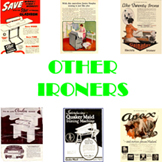
The Built-in Ironrite Numerous companies made ironers --- Maytag, Westinghouse and GE were major mass market players. there were also small regional outfits like the Conlon company which made a very attractive ironer that stronly resembles the Iron Rite. The major difference is that the heated "iron" is on top of the roll rather than beneath it. I know very little of this company and I am thrilled that one of our readers sent these photos to us. If any of our other viewers know more about this company, please Contact Me.
![]() Closed and Open, it looks like the Iron Rite ![]() With Work Surfaces Extended
![]() The Iron moves, not the Roll
![]() The controls are more complex and the motor is exposed ![]() ![]() ![]() Pages from the Instruction manual ![]() Business Card of the Distributor ![]() An Advertisement for the Conlon Ironer Here are some more Conlon pictures sent in to us by our friend Bob in Oxnard, California. He writes: " What a surprise to find your web site. I was searching for a Conlon Ironer corporation web site to obtain if possible a Conlon Ironer Manual. I did not find it but I found your web site and imagine my surprise when you had a photo of exactly my Conlon Ironer. I am attaching a photo of my Conlon Ironer. For what it's worth. My wife died about 2 years ago and last week I pulled our old Conlon Ironer out of storage in my garage. I cleaned it up and plugged it in and to my amazement it worked. We bought our Conlon Ironer in the late 1950's in Topeka, Kansas. My wife really loved it and would never think of getting rid of it even though she had not used it in years. As you indicated, everything was ironed back then. My wife, Betty, always ironed a white shirt each day for me to go to work. (I was an engineer in an office.) She was the greatest of wives. We were married for just over 50 years. Now I think that I will use it to iron some of my good trousers and a sheet and pillowcase or two just for old times sake. I live in Oxnard, California and would like to locate a manual for the Conlon Ironer since I cannot find ours even if it is still around someplace. If you know anyone who has one or an idea where I can get one, please let me know. I loved your web site. The music of the '40's and '50's were the best ever and has never been equaled. Long live 'Your Hit Parade'." ![]() Bob's Conlon Ironer We got a note from a reader who actually found a Brand New Conlon Ironer -- it had been given to a relative as a present and was never used! ![]() ![]() ![]() The Brand New Conlon Ironer The Altorfer Brothers Company (ABC) of Peoria, Illinois made a large number of laundry products -- including washers, dryers and ironers. They seem to have made products of reasonable quality, but they never attained anything larger than a small market share in the Midwest. Their ironer has a lot in common with the Conlon. The Ironrite is the only machine in which the roll moves and the iron is fixed. ![]() ![]() ![]() The ABC Ironer We'd like to report that J. Robert Oppenheimer made the detonator for the Hiroshima bomb out of parts from an ABC ironer. Exciting as that might be, it would be false. BUT, the ABC Ironer did play a critical part in the Manhattan Project. Specifically, we found the following photo of the laundry room at the Los Alamos facility. Here you see the wives of the scientists pressing forward keeping the shirts, tablecloths and sheets well-ironed. The do not, however, have the benefits of an ergonomic "Health Chair"as afforded owners of the Ironrite. Some sacrifices were necessary during wartime. ![]() The ABC Ironer at War! If you would like to see more photos of day-to-day life of real people who worked on the Manhattan Project, check out the website of the Manhattan Project Heritage Preservation Association. Here is another Ironer called the Gladiron. Note that this is a clever play on Mrs. Potts' "Sadiron", above. (These were sent to us by our friend Gayle in Frankfort, Kentucky). The ads seem to mirror the general cultural theme of the 1940s that a woman could win increased affection from her spouse by performing household chores well. ![]() Kudos to Gayle in Frankfort ![]() ![]() The Gladiron -- $134 then is over $1,000 today ![]() The Gladiron was manufactured by the THOR Co. that also made washers This machine was collapsible and might be targeted at folks suffering from the postwar housing crunch where new couples were often squeezed into very small spaces. On this machine, the shoe moves onto the roller, so it is more like the Conlon than the Iron-Rite. This is what the Gladiron looked like when it came out of the box! ![]() ![]() ![]() ![]() ![]() It Folded to Fit in the Closet The Gladiron was sold on the basis of space conservation and ease of use:
![]() Let Your Children Do the Ironing The Gladiron appears to have been the creation of Arthur H. Gerhardt, Arthur P. Schulz, and Hugh M. Rumbaugh, dating back to 1940. Mr. Gerhardt seems to have done the principal design work, particularly the exterior while Messrs. Schulz and Rumbaugh were involved with the mechanicals. The principal patents for the Gladiron are:
If you are restoring a Gladiron, your best bet is Reissue Patent RE22720 -- it has 12 very detailed drawings of the machine's inner workings. You may obtain this by following the proceedures outlined on our Patent Drawings page. Here are some samples: ![]() Messrs. Gerhardt and Schulz's Design for the Exterior of the Gladiron ![]() Power Transmission to the Arm ![]() Inner Gear Mechanisms Click here if you want to learn how to get Free Patent Drawings Thanks to Rita, one of our readers, we have a manual for the Gladiron. It is a ".pdf" that is about 6.6 MB; please contact us if you want a free copy of the Gladiron Manual. Patent RE22,720 has 24 pages -- and that can be a hassle to download. contact us if you want a 3.8MB zip file containing images of all 24 pages. There are 12 pages of drawings and 12 pages of explanatory text. As usual, we are always interested in stories, pictures and data which would help us understand this marque of Ironer It looks like the Simplex Ironer has been around for a LONG time. Here is an ad for a version that dates from the 1920s: ![]() Here are photos of another "Simplex". They were sent in by our friend Sharon from West Virginia! ![]() ![]() ![]() ![]() ![]() ![]() The Simplex Ironer The Simplex Ironer was made by The American Ironing Machine Company of Algonquin, Illinois. In 1905, the Peter Brothers Manufacturing Company was formed, specializing in the production of laundry ironers. The Company employed 200 people and produced 2,500 ironers per month. In 1920 Peter Brothers Manufacturing changed their name to American Ironing Machine Company. Thanks to our friend and reader Don H. of Palm Desert, California, we have a complete Simpex operator's manual. Write Us and we'll be glad to send you a ".pdf" of the manual for FREE. Here are photos of another type of ironer made by General Electric ![]() ![]() ![]() The General Electric Ironer These photos were sent to us by our friend Lorena. She has a "Universal" ironer that seems to have survived fairly well. "Universal" was the name used for products made by Landers, Frary and Clark of Connecticut, and we have a detailed history of that company on our Coffee Page, largely because LF&C was catapulted to fame by manufacturing the first percolator. ![]() ![]() ![]() ![]() The Universal Ironer These photos were sent to us by our friend Anna. She has a "Speed Queen" ironer that seems to have come to her new and unused! She writes: HELLO HERE OF SOME PICTURES OF MY SPEED QUEEN MANGLER THAT WORKS ABSOLUTELY PERFECT AND HAS NEVER BEEN USED!!!...IT HAS AN ORIGINAL GENERAL MOTORS PACKARD MOTOR THAT RUNS SILENT AND LIKE NEW AS WELL .....THIS MANGLE IS ALL ORIGINAL!!!.....I PURCHASED THIS ITEM FOR $1.00 AT THE LOCAL GOODWILL.... ![]() ![]() ![]() ![]() ![]() ![]() The Speed Queen Ironer The FutureProbably the most reliable forecast of the future is that "ironing" as we know it will go away due to fabric treatments that eliminate wrinkles. We owe most of this technology to Ruth Benerito (born 1916) helped win the war on wrinkles with her invention of wash-and-wear cotton fabrics while working at the U.S. Department of Agriculture laboratories in New Orleans in the 1950s. Before this innovation, women spent hours and hours every week ironing clothes for their families. Benerito found a way to chemically treat the surface of cotton that led not only to wrinkle-resistant fabric, but also to stain- and flame-resistant fabrics. The Remarkable Ms. Benerito, Goddess of Perma-Prest Not everything is perfect, however. Ms. Benerito's technique uses formaldehyde-based reagents that have caused world-wide concern about their impact on human health and the environment. Previously, one of the more effective formaldehyde replacements was an organic acid called butanetetracarboxylic acid (BTCA). But the exceedingly high cost of BCTA prevented its applications on a commercial scale. Drawing on the BCTA technology, Dr. C.Q. Yang of the University of Georgia found that citric acid, while not effective itself, could be combined with two different polymers of maleic acid in a manner that would efficiently cross-link the cellulose fibers in cotton fabrics. The results of this synergistic action,is a cotton fabric with demonstrated superior durable press performance, good laundering durability, and high fabric strength retention. Because this new finish system is cost effective, it has become attractive as a formaldehyde replacement and is now under commercial development For those items outside the scope of Perma-Prest, Jonathan Nwabueze from Guildford, England (UK) offers a novel solution. He got so fed up with ironing and being delayed in the morning because of last minute ironing that he invented an iron that works without the need for a board by using a heated vacuum to remove the creases from clothes. The 30-year old entrepreneur said "it can even smooth out wrinkled clothes while they are being worn, though its not recommended for obvious reasons and at the user’s discretion!" Garments and other fabrics can be ironed whilst they are hanging or free-standing. It could also offer greater flexibility to the task of ironing, for instance in travel, outdoors or for large area fabrics. Called the Jen Turbo Boardless Iron, it uses a small fan powered by an electric motor which draws the cloth towards its heated base, through a combination of direct suction and the lowering of air pressure between fabric and plate. Steam is generated in a chamber above the plate, which is blown onto and through the fabric by the internal fan to remove the creases. The steam is then re-cycled back into the body of the iron by the fan. Here is a modern approach that combines Housework with Working at Home ![]() Iron all your virtual clothes... Underwriters Laboratory (UL) Standards for IronsJust in case you wondered, here are the standards set by the Underwriters Laboratories for Irons.
Starch - The Old-Fashioned WaySome of you vintage nuts may have dress shirts or detachable collars that require starching. You may have found that the lame stuff that comes out of spray cans doesn't do the job at all. If you want your shirts to look right, you have to get hold of Argo Gloss Laundry Starch (It is packaged in a distinctive maroon box with white edging/lettering). Inside this package, you will find a fine white powder that lloks like (duh?) cornstarch or flour. [Does anyone under the age of 40 know what either cornstarch or flour look like???] Add about 3/4 a cup of cold water to 1/4 cup of this white powdered laundry starch, (mix with the tips of your fingers in a saucepan to remove any lumps), and then quickly pour on about a kettleful of BOILING water until you see the color change from white to opaque. Take it to your washer and add it to your rinse water. When the clothes have spun out, hang them to dry (Do NOT use the clothes dryer). Sprinkle the clothes lightly with water to activate the starch and then iron when barely damp. This will produce medium to moderately heavy starch in dress shirts, napkins, etc. The nice part about adding the starch mixture during the rinse cycle is that it distributes itself evenly in each layer of fabric --- thus, things that need to be heavily starched like collars and cuffs get a double dose because they are two layers thick. Try this at least once to get an idea of what laundry was like in the 1940s. Michelle ,one of our faithfil readers has this suggestion: "... If anyone ever boils starch for heavy hand starching, grate a little paraffin into it. It will make for easier ironing. This tip comes from Brittany (France) where they still starch their lace headgear, it was supposedly used by the nuns. I remember how stiff and shiny their coiffes were. ..." Etymology of the Dreaded "M" WordThe Oxford English Dictionary defines a "Mangle" as a device that uses rollers for pressing or extracting water from clothes. It gives the origin of the word as Dutch, mangelstok. I believe that current usage feeds on a myth that people could do serious damage to their hands if they were caught in the rolls. Every modern ironer that I have seen has a foolproof mechanical disengagement device. When I got my ironrite, it was set to balk at four layers of denim. I suspect that folks who were suspicious of the machines (or jealous of their owners...) preferred the old word "Mangle" rather than "Ironer." On the other hand, it appears that none other than Herman A. Sperlich used the dreaded "M" word in his 1928 patent for the original Iron Rite. This was probably before he got a Public Relations Department... ![]() Mr. Sperlich's 1928 Patent No. 1,670,387 The Dreaded "M" Word as Sanctioned by Uncle Sam, Himself! | |||||||
| |||||||
Home | About Lindy | 1940s Collectibles | Upcoming Events | Vintage Clothing The Guide - Establishments - Travel - Accessories Music | Links | Photo Gallery | Extras | Contact | |||||||