
Coffee Paraphernalia
For your daily caffeine fix...

Join Us on Facebook
This page is devoted to showing interesting examples of coffee makers. We have a Technical Page that deals with the Theory and Technology of Coffee Brewing for those of you with techinical questions like "What's the optimum water temperature?" (it's about 201 degrees F). So, to aid you with your special requests, here are some navigational tools
- Brief History of Coffee in the Western world, with side trips to Motorcycle Reality Shows, Heavy Cavalry, Pastry, and Mozart
- Very Brief summary of Coffee Chemistry and Technology
- Are You Trying to Fix a C30A with the top half stuck to the bottom?
- Are you interested in the History of the Landers, Frary and Clark Company?
- The Silex Hostess Set and the genius of Frank Woolcott
- Brief Survey of Commercial Coffee Brewers
- The Filtron Coffee Extractor?
- The General Electric Model 129P8?
- The Napoletana Fliptop Coffee Brewer?
- The Empress Ware Percolator?
- The Chase Art Metal Coronet Coffee Service?
- The Manning-Bowman Harmony Coffee Service?
- The Chemex Coffee System (or James Bond)?
- The the West bend Kwik-Drip Coffee maker?
- Wearever Coffee Makers?
- Silex Coffee Makers?
- Sunbeam Coffee Makers?
- Are you having trouble getting the top and bottom of the C30 separated?
- Westinghouse Coffee Makers?
- ABCO Coffee Makers?
- Vesuvio Coffee Makers?
- The Armstrong "Perc-O-Toaster" Combination
- Pyrex Glass Percolators?
- The Farberware Coffee Robot?
- LaBelle Coffee Makers?
- The Konditori Valand (Stockholm, Sweden)?
- Dulane Coffyryte?
- United Metal Goods Coffee Makers?
- The DuraLux Coffee Maker?
- Replacement Cords for Appliances
- Click here to visit another fine collection of coffee paraphernalia.
- Sunbeam Coffee Makers?
In addition to coffee makers, we have a Calendar of Swing Dancing in DC, a Directory of Vintage Clothing Stores and a Guide to 1940s Collectibles. Thanks for tuning in! Feel free to Contact Me if you have questions or want to share photographs and chat over coffee with the rest of the readers.
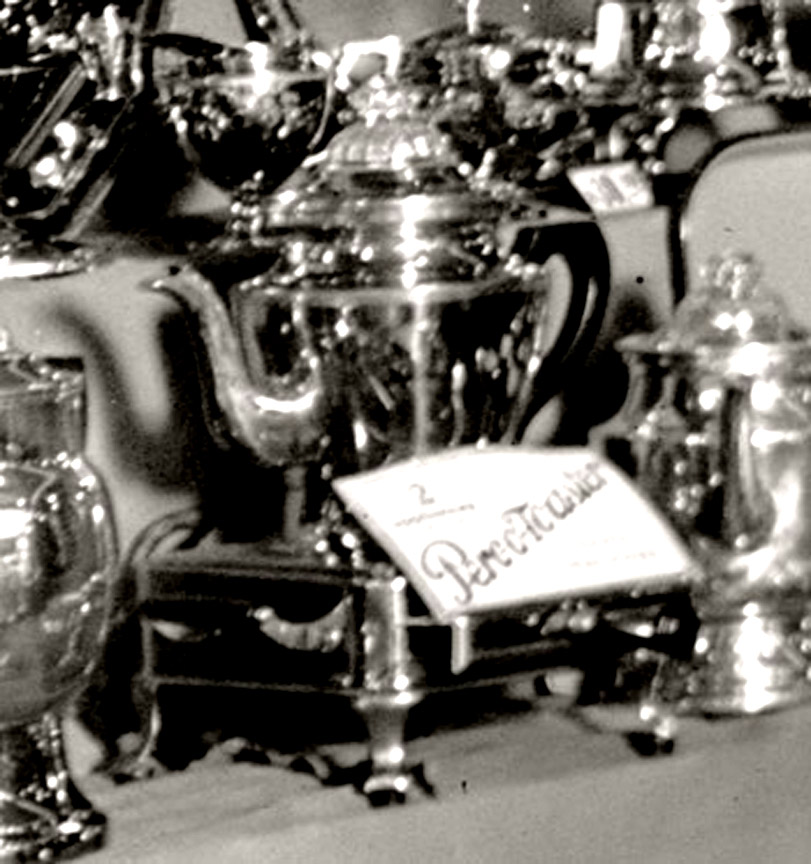
Here is a wonderful photograph from the mid 1940s showing a display of appliances at a Sears store in Chicago. Many of the Coffee makers are described below and the toasters can be found on our Mechanics of Toast Page.
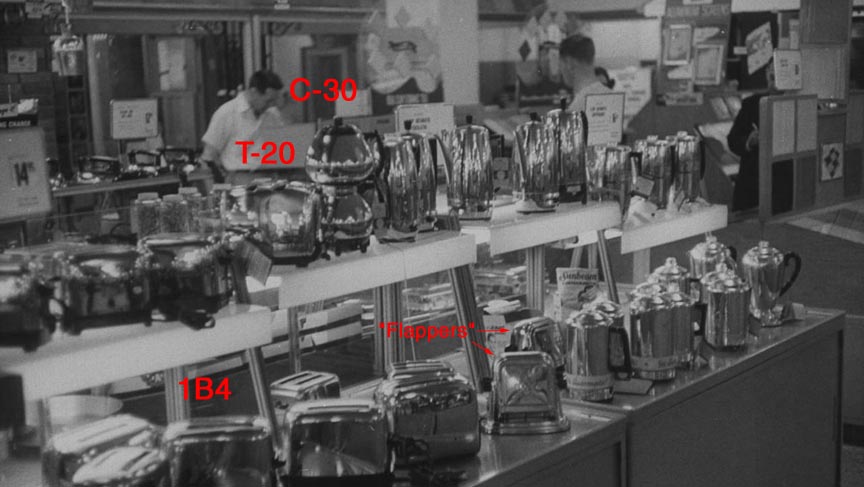
Toasters and Coffee Makers Galore at Sears, c. 1946
Click Photo to Enlarge It
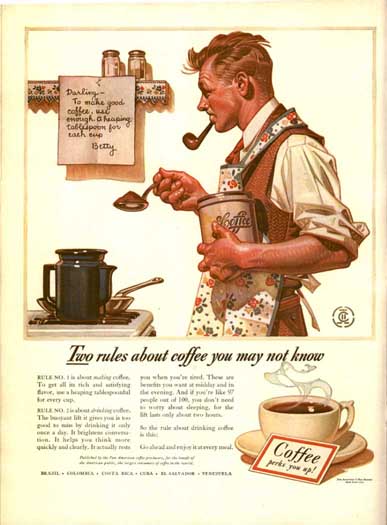
Use Enough Coffee!
..at least according to the trade association...
From LIFE Magazine, March 24, 1941
Coffee and the Winged Horsemen People have been drinking coffee for almost a thousand years. The practice started in the Near East and for some time was generally limited to Turkey, Arabia and Persia. European (and American) use of coffee is much more recent. One legend is particularly interesting because it gives me a chance to write not only about Coffee, but also Motorcycles, Pastry, Mozart, and Heavy Cavalry. I am also going to use this opportunity for a shameless plug for Keith Rocco, my favorite artist. To wit, please let me introduce the Polish Hussaria:
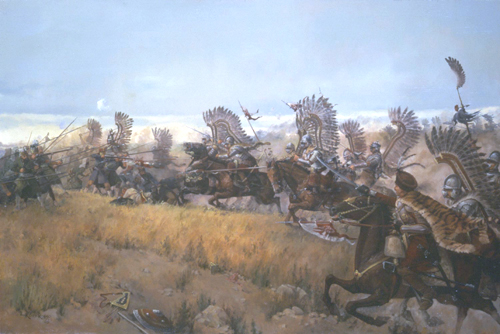
Polish Hussaria Breaking the Siege of Vienna, 1683
"The Avenging Angels", painted by Keith Rocco
Yes, they are wearing Wings and Tiger Skins
Genrally, men will not admit that they have artistic or domestic interests other than the personalization of objects that project force or express masculinity. (Painting flames on Hot Rods, Nose Art on B-17s, Low Riders, Zoot Suits, etc, etc). If you haven't had enough masculine art on the Motorcycle and Hot Rod "reality" shows, you might want to look at the very Ultimate Expression of Testosterone Art. In brief, the Polish Hussaria or Heavy Cavalry rode into battle on giant horses with jeweled tack, wearing heavy armor using a whole tiger (or leopard) skin as a cape -- and (get this) WINGS! Put them on TV today and these guys would IMMEDIATELY command the respect of mild-mannered scientists who work in offices as well as hardhats, mob guys, street thugs, long-term convicts, and bicycle messengers...
And now to link between the Hussaria and Coffee: In 1683, a small force of them completely annihilated the Turks who were besieging Vienna -- ending forever Islamic conquest in Europe. The surprise was so quick and the devastation so complete that many coffee-pots and bags of coffee were left in-place, ready to serve the Turks. The Hussaria celebrated the event by drinking the Turks' coffee and adopting it as their own beverage. Captured coffee service of the Sultan was sent to the Pope who also became a coffee devotee. Military forces all over Europe came to imitate the Hussaria and coffee became part of their rituals as well. The crescent roll (croissant), taken with coffee, is said to memorialize the end of the Turkish threat to Europe (that is, by eating the roll, one symbolically consumes the Turkish flag...)
Keith's painting depicts the Hussaria smiting down the Janissaries, the cream of the Sulan's armies. In turn, they have an interesting history: they were special troops made up entirely of Christian children abducted as infants and raised to serve the Sultan. Those of you who are familiar with Mozart's Abduction From the Seraglio may recognize the Janissary Chorus.
On a minor note, a reader sent this in: "... the Mongols used a kind of "lasso" against armored cavalry; a defence against the lasso was a frame that would require a lot more height to capture the rider. In many cases, the "wings" were attached to the saddle and they served the same function as a motorcycle "sissy bar," especially when the cavalryman rammed his 20 foot lance into an infantry square at full gallop...." I was somewhat saddened to find functionality in this expression of sheer bravado..
Our reader Duane tempered our enthusiasm for the Hussaria and gave us a new insight into another Breakfast Pastry: "... It was a combined army of Bavarian, Saxon and Poles under John Sobieski II who relieved Vienna. Sure the famed Hussaria did make impact but actually it was a combined charge by Hussaria, Pancerni ( more lightly armed Polish cavalry) and collective German horse, mostly pistol armed, that broke the Jannisaries. The rest is correct. Another legend holds that the bagel was invented at that time to represent a stirup and thus comemorate the Hussaria charge..."
So there you have it -- The History of Coffee, Motorcycle Reality Shows, Heavy Cavalry, Pastry, and Mozart.
Coffee has a very complex Chemistry: There are many, many separate organic compounds in brewed coffee. For the chemistry of aroma, alone the number is well over 800 and as analytical methods become more precise more will be uncovered. Various research groups have identified 150 aliphatic compounds including 56 carbonyl compounds and 9 sulfur containing compounds; 20 alicyclic compounds, including 10 ketones; 60 aromatic benzenoid compounds, including 16 phenols; 300 heterocyclic compounds, including 74 furans, 10 hydrofurans, 37 pyrroles, 9 pyridines, 2 quinolines, 70 pyrazines, 10 quinoxalines, 3 indoles, 23 thiophens, 3 thiophenones, 28 thiazoles, and 28 oxazoles (34).
Without going into a complex chemistry lecture, (Click Here if you want one...) the secret to a great cup of coffee is hot but not boiling pure water. Distilled water is best. If the water temperature exceeds 201 deg F (94 C), highly objectionable organic acids will form, creating a bitter taste. Any contact between coffee and metal will also form organic acids which detract from the taste. The actual type of coffee being brewed is quite secondary to water purity and temperature. If your apparatus is clean and you use pure water at 94 C, you can get a MUCH better cup with generic supermarket coffee than you can get from very expensive boutique coffee in a dirty machine.
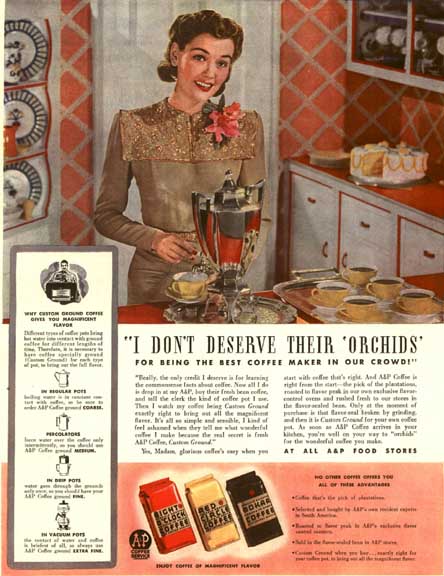
If Your Heart and Water Are Pure You Can Make Fantastic Coffee
BOKAR is still my all-time favorite!
A&P Markets have now mutated to Fresh Fields
Below, you will find a summary of the methods that have been devised over the ages to solve the key problems of (1) heating the water and (2) bringing the water into contact with the grounds. Hyperlinks will bring you to our very detailed (and profusely illustrated) page on coffee technology
- Boiled Coffee is made by placing ground beans in a container and boiling the mixture. A variety of schemes are used to clear the grounds from the brew. This is most associated with cowboys on the trail or soldiers in the field. With lots of care, it is possible to make a decent cup of coffee this way.
- Drip Coffee Makers require an external source of hot water. Ground coffee is placed in the top unit; water is poured into the grounds, creating the brew which drains through a filter into the serving pot. The filter can either be paper or a porous metal screen. Drip makers generally make the highest quality brew because the coffee itself never boils. However, until the "Mr. Coffee" type machines came along, there was no way to brew drip coffee automatically.
- Percolators are an attempt to integrate the functions of water heating and brewing. The grounds are placed in a small chamber at the top and plain water goes into the bottom. The water is heated; as it boils, it travels up a small tube and sprays out over the grounds. Brewed coffee drains downward into the bottom chamber. A glass top lets you see how dark the brew is (and turn the thing off). The source of heat can be a stove or a built-in resistance coil. This is probably the least desirable method of brewing because the coffee can be boiled -- increasing the formation of organic acids which taste bitter.
- Vacuum Coffee Makers also integrate the heating and brewing functions. Coffee grounds are placed in the clear glass vessel on the top. Water is heated in the bottom component. Air, heated in conjunction with the water expand s and forces hot water upward in the tube and contacts the grounds, brewing the coffee in the upper chamber. The water in the upper chamber never exceeds 201 degrees farenheit, so the ideal temperature is maintained. The brewed liquid remains in the top chamber until the unit is removed from the heat; the temperature change induces the vacuum between the lower and upper chambers, which draws the brewed coffee back downward into the lower pot. The vacuum seal is not broken until all of the coffee has been drawn back down naturally, and the last gush of air is heard to gurgle (which is caused because evaporation and absorption of water by the grounds produced slightly less water volume in the lower chamber than when brewing first started). After the gush of air and gurgling, the vacuum seal no longer exists. The heated water is allowed to mix with the grounds freely in the chamber; however once the vacuum has started, the grounds become tightly compressed into the bottom of the upper chamber, acting as their own filter. The force of the vacuum pulling the water down through the grounds at a high pressure helps to express the coffee, similar to the espresso brewing. It's much different than a drip method, which is done as water drains through the grounds by gravity. On the other hand, The drip method produces bitter oils; however, part of what makes vac pot coffee taste so good is the limited amount of time that the water is allowed to be in contact with the coffee grounds (like with espresso). With drip coffee, the longer exposure time allows more bitter oils to seep out. Yet, vacuum brewing is extremely complex and subject to numerous mechanical problems. The advantage is that the process assures that water never exceeds the optimum temperature. All glass versions assure that there is never any coffee-metal contact. These machines are blindingly complicated.
- Vesuvio Systems In general, "espresso" the term refers to any method for brewing coffee with pressure and stepped down steam (rather than heated-up water.) The most common home mechanism is the "Vesuvio" type which has two chambers. The bottom chamber holds water and the upper chamber is empty. A small cup filled with coffee grounds separates the two. Water is heated in the sealed bottom chamber; when it becomes steam, a it passes through the coffee. In one sense the process is like percolation save for a clever design that keeps the brew from being constantly re-heated.
- True Espresso In a restaurant, the Espresso machine has a large steam reservoir (usually a big brass tank surmounted with an eagle...); the coffee is inserted in a small container and water condensed from steam is passed through it, under high mechanical pressure to brew the coffee. The machine has other steam taps for frothing milk for cappucino. In Italian, the word "espresso" means "individualized" (as in "Made expressly for John Jones") -- however, mixed in with this is the connotation of steam trains with special schedules (as in the "Wabash Express") So, Espresso is coffee brewed with steam and pressure, made one serving at a time. Toot! Toot!
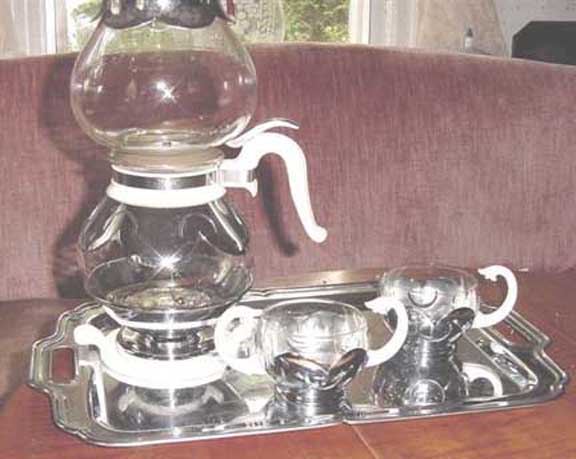
Silex "Hostess" Coffee Service
The Stylistic Genius of Frank Woolcott
Click to Enlarge
This is a very nice matched coffee service that uses the Vacuum Process. This set dates from the mid 1930s and features lots of very moderne details. The set was designed by Frank Woolcott and patented in 1934.
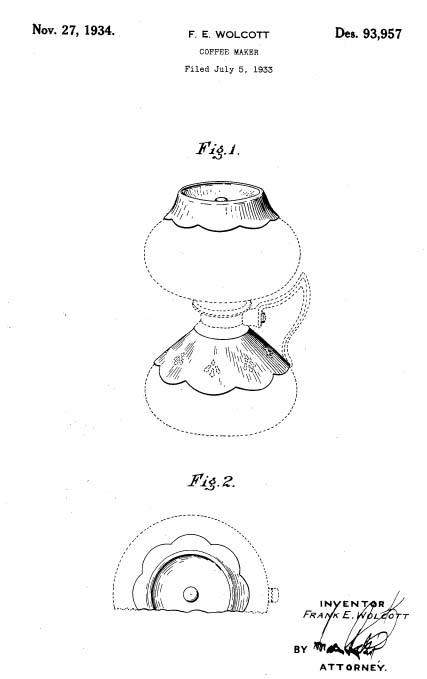
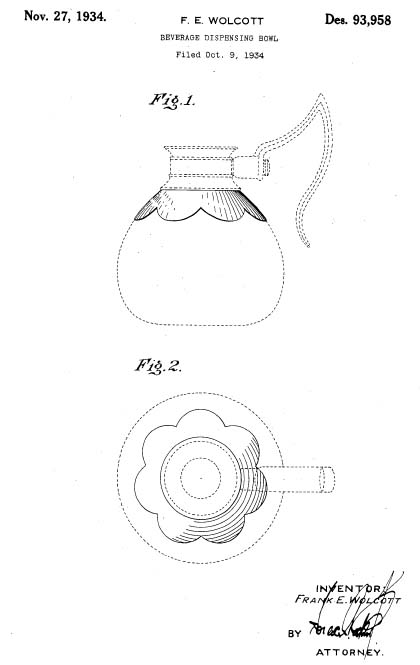
Frank Woolcott's Design Patents D-93,957 and D-93,958
Click to Enlarge
Here is a closeup of the cream and sugar bowls as well as the "stove" with the electric heating element

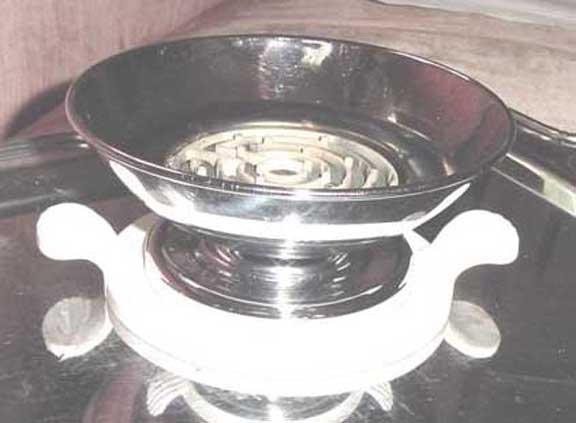
Details of the Silex Hostess Set
(left)The Creamer and Sugar Bowl (Bakelite Handles)
(right) The "Stove" for Heating the Water

More Details
(left)Woolcott's Patent 1,983,210 for the Stove
(right) Closeup of the Server
Click to Enlarge
Click Here to learn how to get free Patent Drawings
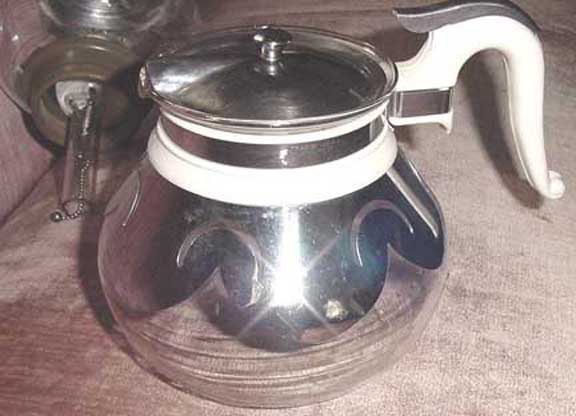
This variant uses a cheesecloth filter that is kept in place by a spring. Like all appliances of the time, the cord was detachable. This version uses a cord with a resistance device (the ANYHEET control) in the cord to regulate the heat applied to the water. Since many remote communities only had Direct Current (DC), the manufacturer's nameplate makes it quite clear that only Alternating Current (AC) is to be used.
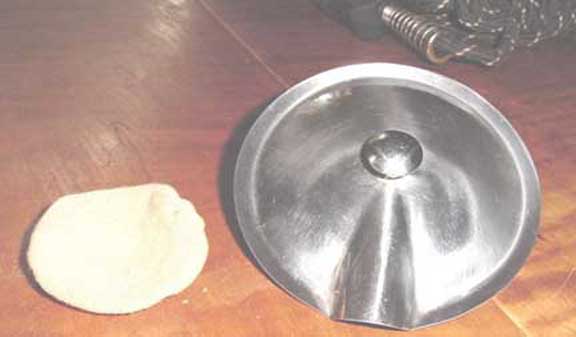
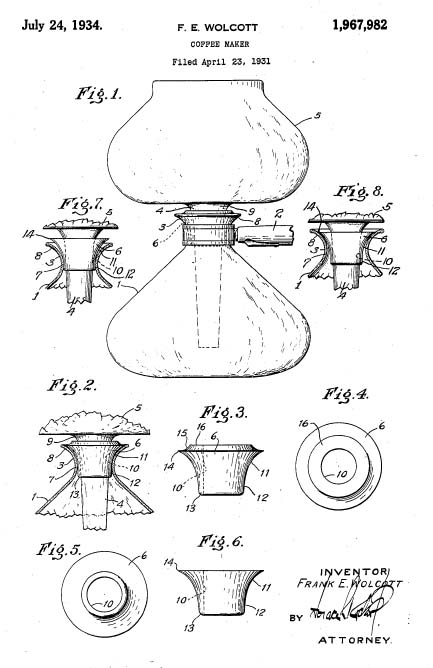
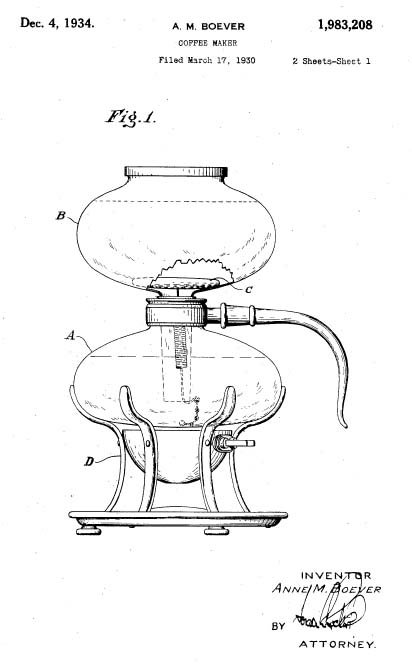
The Filter
(left) The Cheesecloth Filter and Metal Cover for the Server
(middle) Woolcott's Patent 1,967,982 for the Filter mechanism
(right) Anne Boever's improvement on Woolcott's design
Click to Enlarge
Click Here to learn how to get free Patent Drawings
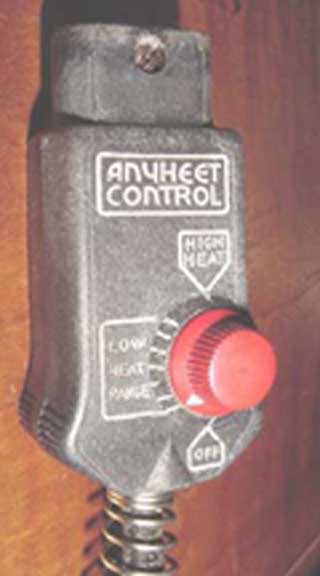
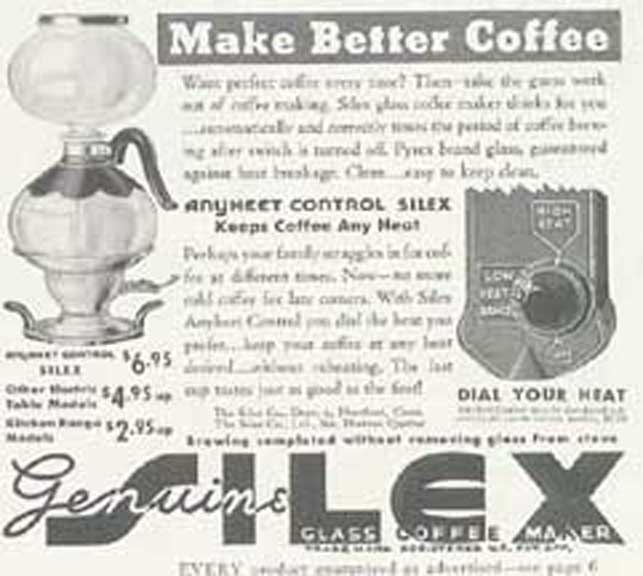
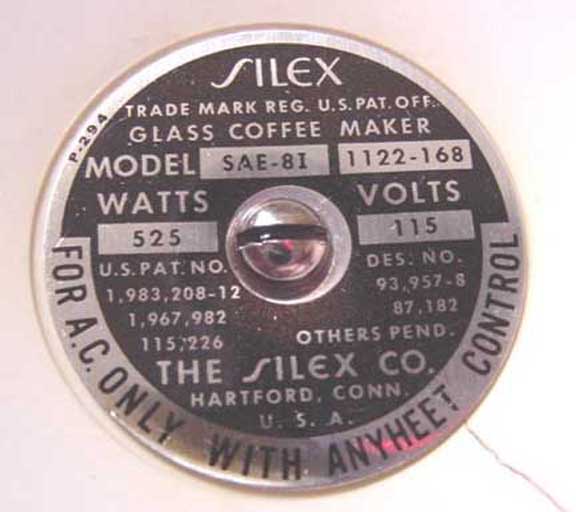
The Heat Control
(left) The ANYHEET Control
(middle) An Ad for The ANYHEET Control from 1935
(right) The Manufacturer's Nameplate
Click to Enlarge
The reader who sent us these photos tells us:
"..The Silex Hostess set was purchased (for $240.00) by the Connecticut State Historical Society. In the spring [of 2006] it will become part of a long term exhibit in the Old State House in Hartford, CT where it was made..."
Contact Us if you can help us know more about this fascinating object.
Here are some photos of a very lovely Silex vacuum coffee brewer sent in by our reader Kevin. He did a good job with the photos and even scanned in the brochure!
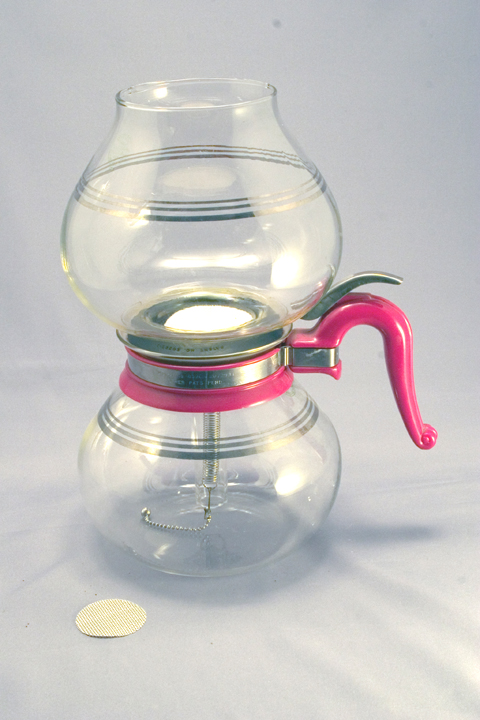
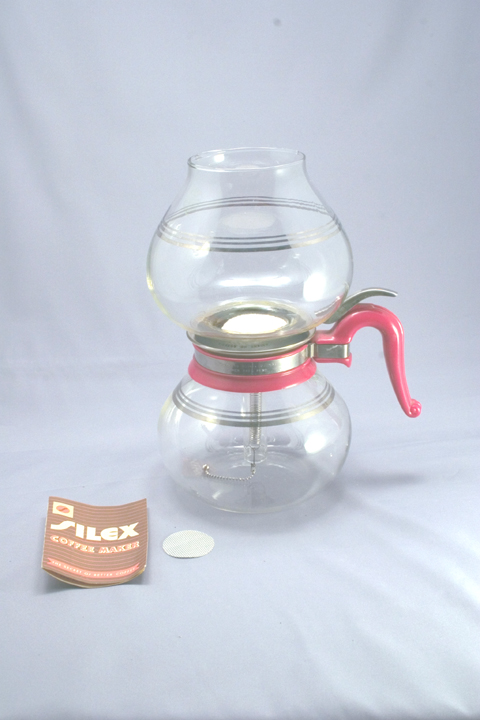
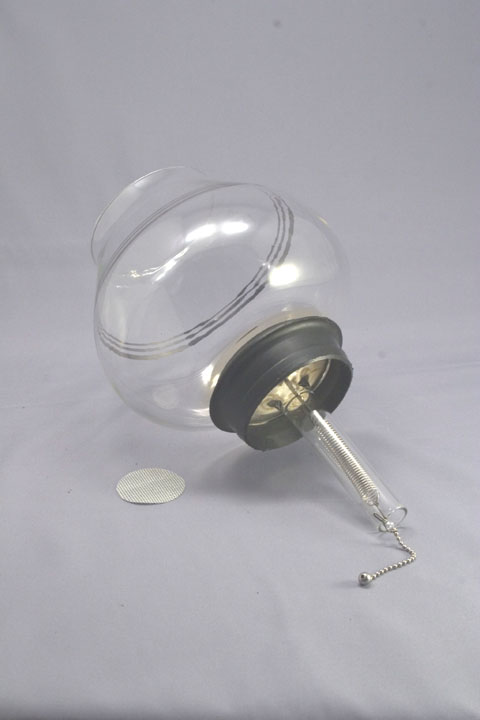
Overview of Kevin's Silex Brewer
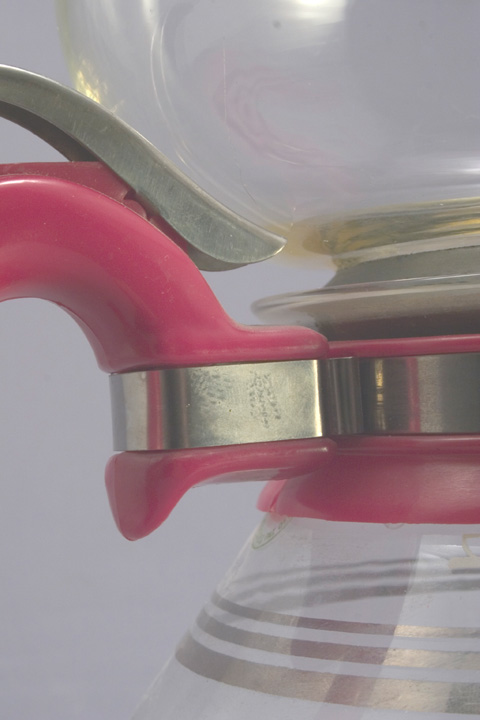
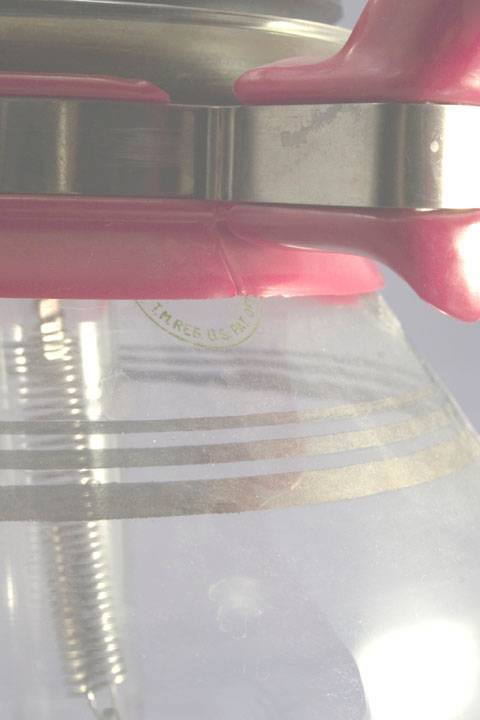
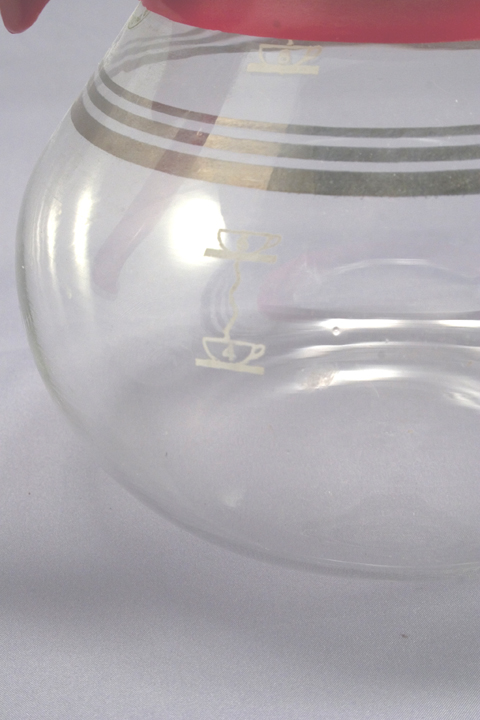
Details of the Silex
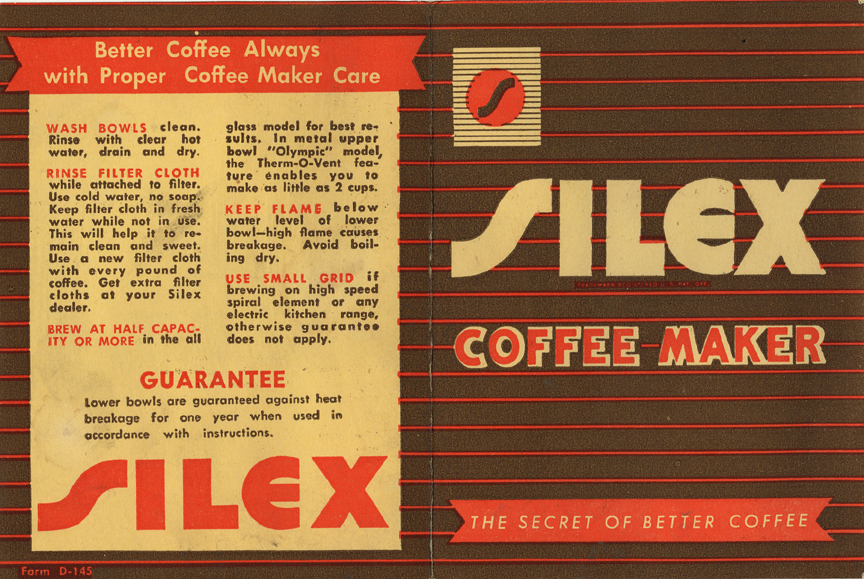
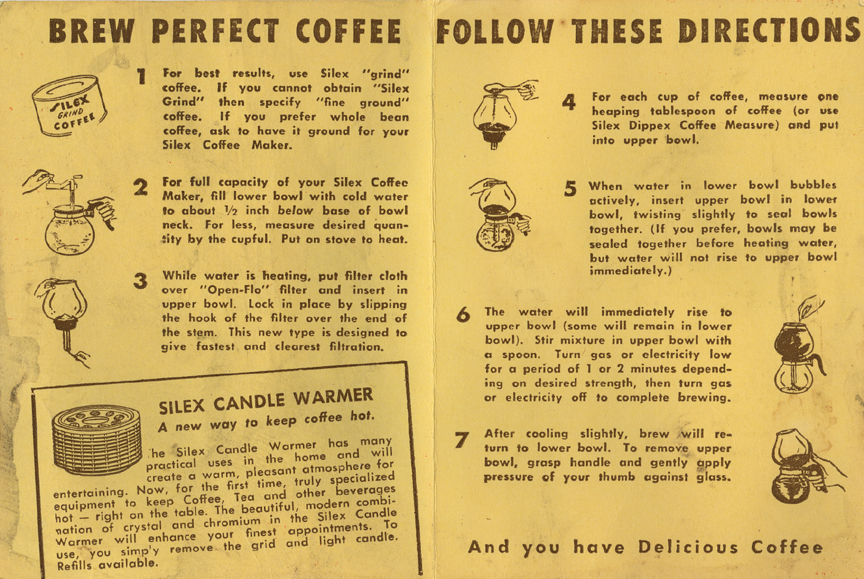
The Brochure
We have reproduced the instruction booklet with high resolution
Click to Enlarge
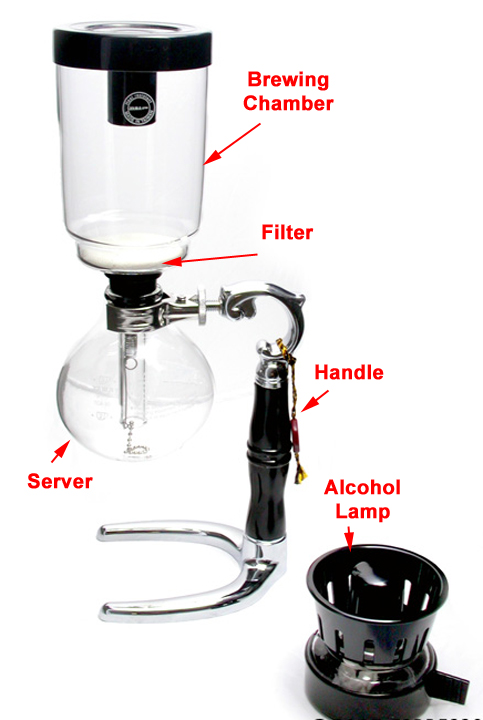
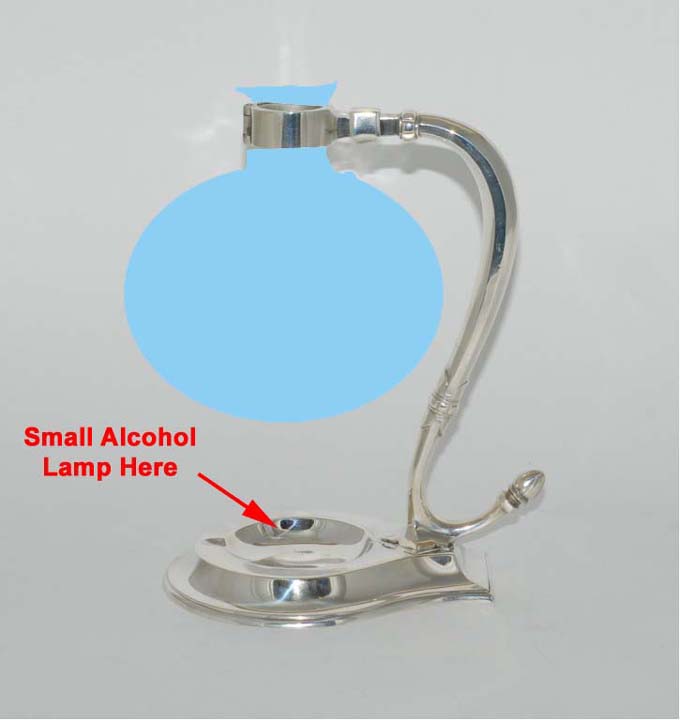
Here is an interesting "fragment" of a Silex set that was sent to us by our reader Adam in London. It is an elegant silver handle that once held the server (and brewing chamber) for a Silex Vacuum brewer. Since the glass was likely to break, the silver handle can be opened to replace the server. Also, the server can be removed for cleaning without exposing the handle to tarnishing soaps. This is a very clever device that has its roots in 17th century "Syphon" brewers that use the vacuum principle. For this, an alcohol lamp provides the heat source. Currently, the "Yama Syphon Brewer" is being sold as a working replica of the antique "syphons". I have one and it is always an entertainment to make coffee at the table with it. I can see a rig like the Yama using the silver handle being used to make demi-tasse at a fancy dinner.

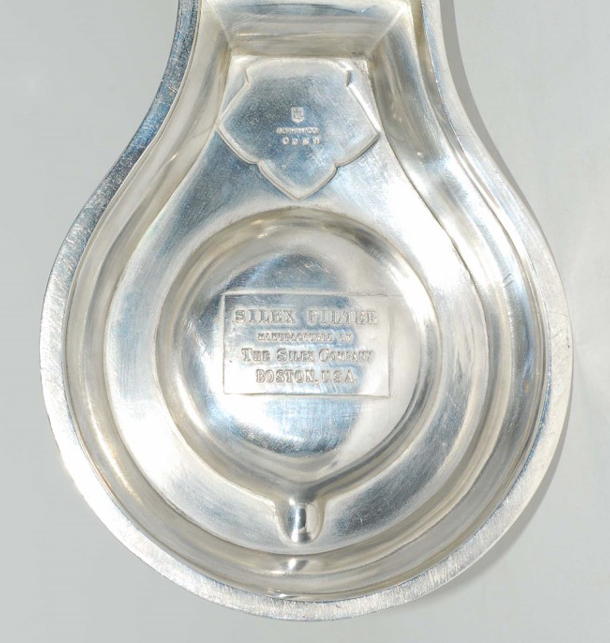
Silex "Silver Handle"
(Left to Right)
The silver handle, side view (the top opens)
The silver handle (top view)
The Yama Syphon Brewer
"Reconstructed" use of the Silver Handl e
Click to Enlarge
Silex Commercial Coffee Service
Silex Company of Hartford, Connecticut
Click to Enlarge
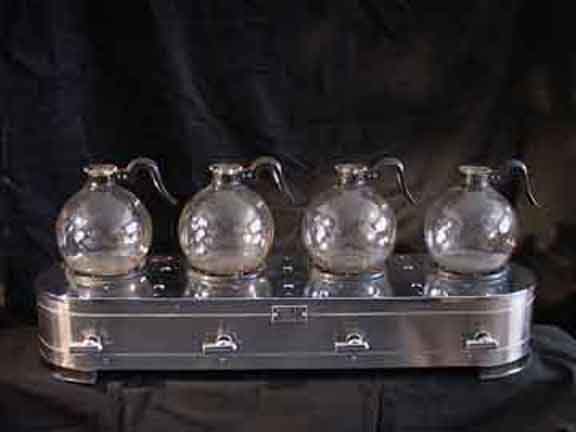
These photos were sent in by our friend Al in New York. Neither Al nor I know very much about this artifact which appears to be a four burner coffe warmer for service in a restaurant. Here's what Al says:
"...Could you help me identify this silex coffee maker? It was originally purchased for a coffee shop my grandfather had in lower Manhattan around 1930 and never used. It's a gas four burner made of chrome with four glass coffee pots on top..."
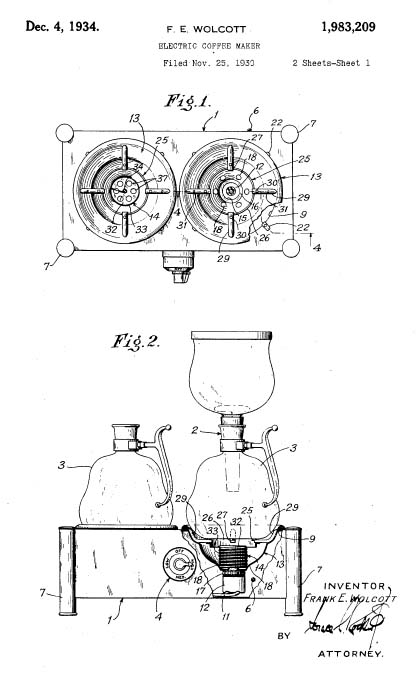
This system for brewing coffee was also invented by Frank Woolcott. Here are some additional pictures:
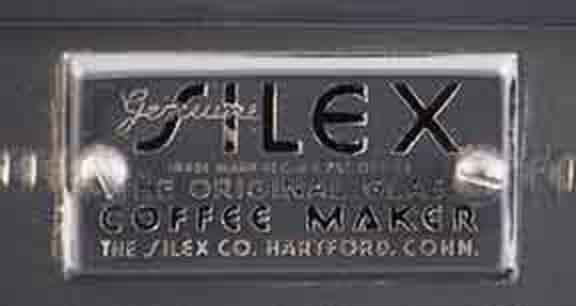
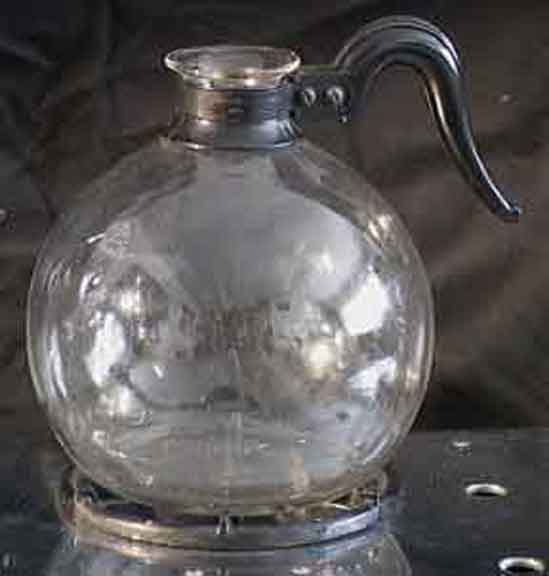
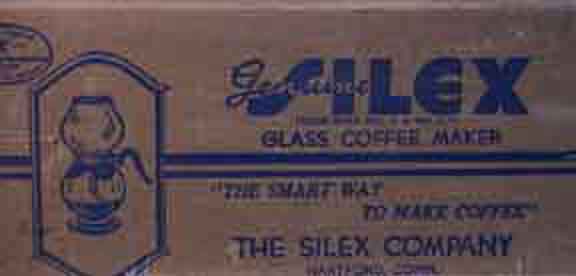
Details of the Silex Commercial Service
(left) Manufacturer's Plate
(middle) Closeup of one Server
(right) The Original Box!!!
Woolcott's Patent 1,983,209 for the Silex CommercialSystem
Click to Enlarge and Rotate
Click Here to learn how to get free Patent Drawings
Here is a picture of a three burner Silex set that was sent in by our reader John. He writes that it is still in service at Kortman's Restaurant, located in Rogers City a small town in Michigan.
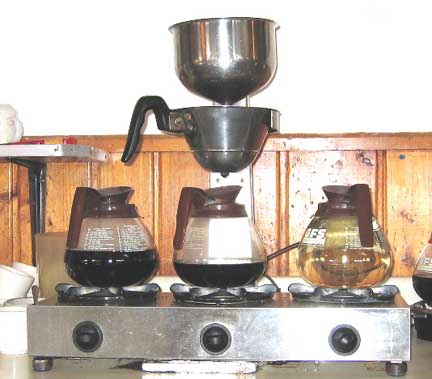
The 3 Burner Silex at Kortmans
While we are looking at commercial coffee-makers, you should see some of the beauties that have been restored by our friend Eric:
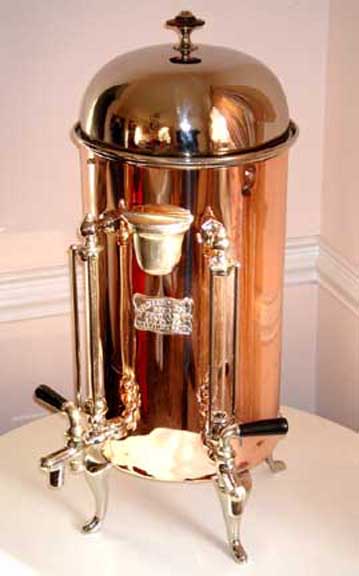
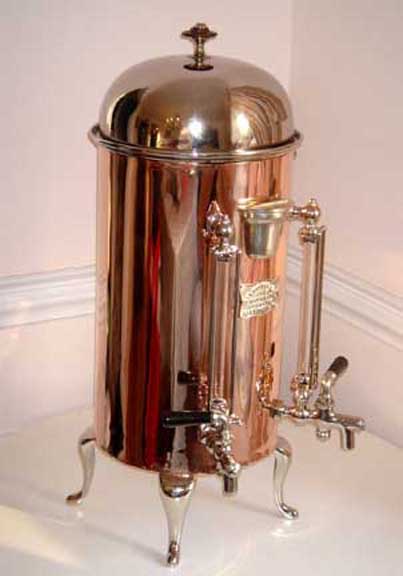
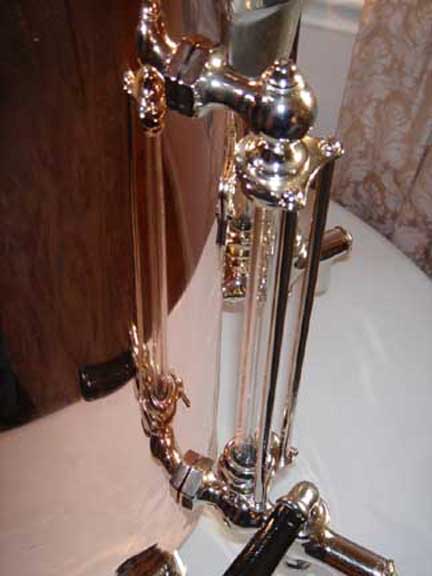
The Taft-Warren &Taft Commercial Coffee Urn
Click to Enlarge
Eric writes:
"... I've attached a few images of a Taft, Warren, & Taft coffee urn that was produced in the early 1900s. Taft, Warren & Taft was a Baltimore-based firm, long since defunct, that supplied Baltimore and Washington, DC hotels with restaurant supplies, including coffee urns, beginning around 1912. (That is when they showed up in the State of Maryland's Comptroller's tax records.) The urn shown is one from my private collection and is slated to show in a proposed exhibit onBaltimore wares at the Baltimore Museum of Industry. All of these urns wereoriginally nickel-plated top-to-bottom. Now you see them only as copper and brass as the nickel wore over time, and owners opted to have the remainderremoved. I fully refinish my urns, plating all of the hardware, thoughleaving the copper chassis unplated. I happen to like the two-tone,three-tone look. Several of our urns get used for family functionsincluding tailgate parties, clean-up well, and are always the subject of attention by coffee lovers. ..."
In conjunction with Eric's note, we also received a photo of thus brass beauty, sent to us by John, one of our readers. He says that he picked this up in the Phillipines and that the only markings on it indicate that it was made in Osaka, Japan during the period when the United States occupied that country after World War II. John says,
"...Brass that might have ended up in shell casings and steel that might have been part of a "Zero" have been re-fashioned into a very beautiful and elegant object, hopefully a metaphor for our times...
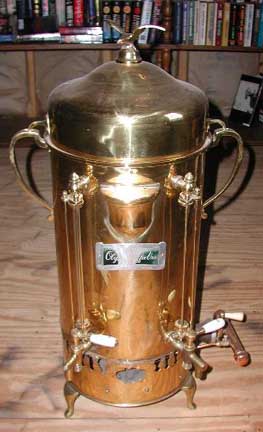
Coffee Urn Manufactured in Occupied Japan
Unfortunately, Eric, the Urn expert has this to say:
:...Now, regarding the coffee urn that one of your readers indicated was made in occupied Japan (O-J), I do have to take exception. It is an interesting story, however, I don't believe it is correct. There were a number of U.S. manufacturers of coffee urns that were in production between 1885-1935 that produced this style of coffee urn (i.e., gas heated, ceramic insert for coffee, copper water jacket for heated water). Such urns ranged from 11-12" diameter to as large as 20-22" diameter (over 4 feet tall!). (I have one of the large ones in my basement, and my contractors often mistake it as an old water heater!) Now, regarding the O-J urn, I believe that the two wire handles on the sides were a later embellishment, as was the eagle on the top (to mimic an Italian espresso machine of the 1930s). Additionally, post-WII urns had moved largely to aluminum in construction. It is possible that the urn ended up in the Philippines in a nice hotel, however, I am almost certain that it was shipped from the U.S. pre-WWII. Additionally, I recognize the chassis of the urn and will try to identify the manufacturer at a later date. Likely it came from either New York or Chicago. ..."
Our reader Alyse sent us a picture of this beauty:
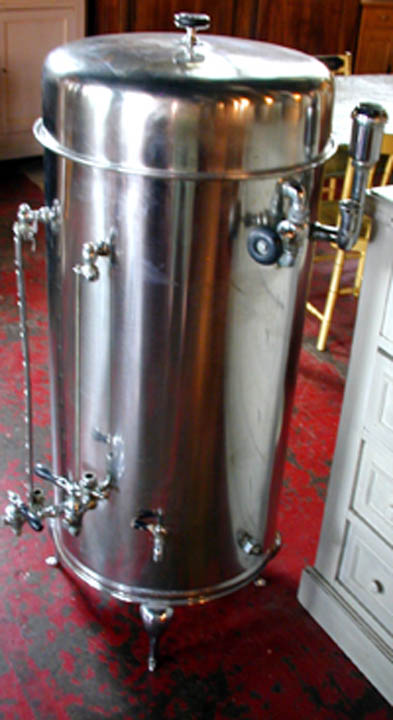
The Filtrator Coffee Urn
Thanks to our Reader Alyse
Click on the Photo to Enlarge it
Alyse writes:
... I purchased this in rural Indiana a few years ago. It is in very good shape and clean inside out The plate inside says FILTRATOR COFFEE APPARATUS CO.INC N.Y. CITY I think it can brew 50 gallons ...
On the subject of commercial brewers, you might want to look at our page on Diner Talk, since a whole lot of the coded communications between waitstaff and the kitchen involves coffee.
feel free to Contact Us if you can help us know more about either of these fascinating objects.
Click here to look at another type of collectible, or keep on scrolling for more Coffee devices.

Landers Frary and Clark Coffee Service
From New Britain, Connecticut
Click to Enlarge
Landers, Frary & Clark traces its start to the time George Landers, age sixteen, arrived in New Britain, Connecticut in 1829 looking for a job. He soon went to work for Josiah Dewey who, seven years earlier, had started a small foundry making cupboard latches and other hardware. After Dewey's death, it became Landers & Smith Manufacturing Company in 1853. As president, Landers' salary was seven hundred dollars a year.
In 1862 the small but prosperous company made another of the many acquisitions that were to mark its history and growth in future years. It acquired the firm of Frary, Clark & Company, of Meriden Connecticut, the company name changed to Landers, Frary & Clark, which it retained for the next full century of its existence.
Probably the most important item introduced around this period was a household scale, "the first product designed particularly for the American housewife." The company's productline continued to grow, adding meat choppers and sausage stuffers, screw eyes and strap hooks, door handles and floor scrapers, molasses gates and faucets, meat hooks and harness hooks, cast iron match boxes and curry combs, fancy brass hat hooks and eyes with porcelain knob ends--and even toys.
In 1870, George Landers, having turned fifty-seven, decided to retire from active management, but to stay on as vice-president and director. His son was now secretary of the company.
In the 1890s the trade name "Universal" was adopted for the company's products. And it was in the same period that it introduced a series of quite revolutionary household products that were to help establish it as a leader in the housewares field. One of these, was the "Universal" bread maker in which dough was prepared in the evening, left in the machine to rise overnight, ready for baking in the morning. This product quickly became one of one of the mainstays of the company.
The second product to become a household necessity was the "Universal" food chopper. Choppers were not new, but this one ground not merely meats but vegetables as well....Odds and ends could be turned into hashes and casseroles with ease....The identical model food chopper first produced in 1897 was an active item in their line nearly 100 years later.
The third, and to us, the most important product introduced during this period was the "Universal" coffee percolator (first produced in 1905), offering a new method of brewing coffee without boiling it, with resultant improvement in clarity and flavor. For most of the period from 1900 to 1980, percolators outsold other types of coffee makers. This percolator of the nineties was a simple one, heated on the stove. The day of electricity was only dawning.
A stock clerk named Charles F. Smith had gone to work for Landers in 1882, and in 1900 on the death of Charles Landers, son of the founder, he was elected president. Until his death in 1938, Smith was responsible for the tremendous growth of the company. Beginning with a patent it received in 1908 for the development of an electrical unit to be used on percolators, the company moved head-on into the appliance field.
The first "Universal" appliance appeared in 1912 when a "thermo cell" electric iron was introduced. Percolators, toasters and ranges soon followed. By 1915 it was already making electric ranges. Then came World War I when all production was devoted to military needs.
After the war the company greatly intensified its entry into electrical household products, an era Richard White referred to as the second or "electrical phase" of its development. "Today [1925], while Landers is manufacturing many non-electrical products for the home, its principal products are in the electrical field," he said.
It is noteworthy that in the early 1920s Landers, in order to exercise more complete quality control over its appliances, adopted a policy of making all its own parts as far as possible. At the time it claimed that six out of every ten homes in the country had at least one "Universal" product. Its capitalization in 1923 had reached $10.5 million and it employed over three thousand people.
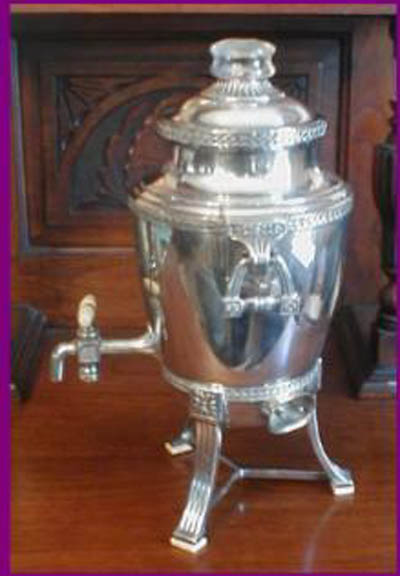
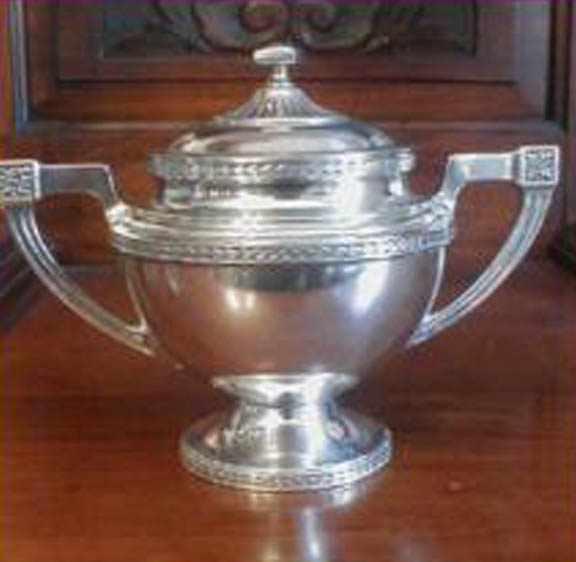
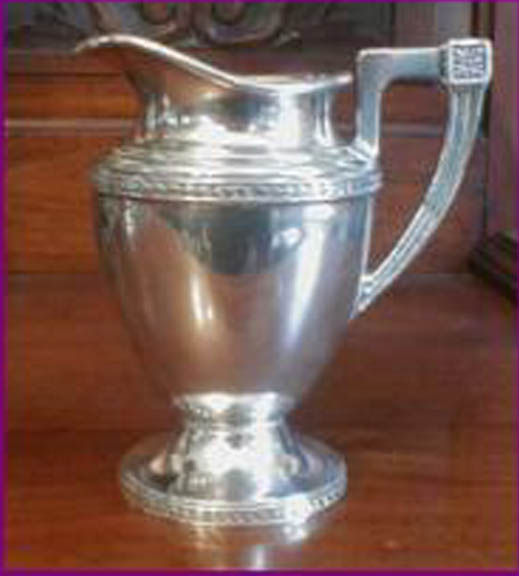
Details of the Landers Frary and Clark Coffee Service
Click to Enlarge
The company also grew by acquiring other organizations: In 1919 the Barnes & Kovell Company was purchased. In 1920, the Columbia Heating Pad Company and in 1940, the O-Pan-Top Manufacturing Company, producers of a top-opening carpet sweeper, joined the "Universal" line.
Throughout the many years of its growth Landers had developed a conservative, intensely quality-minded image; here, it seemed, was a company so solidly rooted "it'll go on forever." So in 1950, when it announced the discontinuance of its cutlery division after eighty-four years of operation, the trade was shocked. Landers, they would tell you, acquired businesses--it didn't drop them.
Alas, Landers, Frary and Clark went out of business in 1965, a victim of cheap and cheesy imports. However, LF&C did not go down without a fight -- at the height of the Cold War, they began manufacturing geiger counters for the US Civil Defense program.
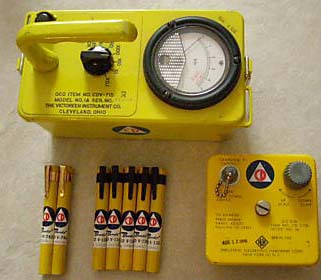
Landers Frary and Clark Model V-715 Raidation Detector
No ZIP Codes in the Manual, so it was made before 1963
During the 1950s and 1960s, the US Government stockpiled a variety of radiation detection devices to be used in times of Nuclear Emergency.
I was in Roanoke over the 2008 Labor Day weekend, and stumbled upon an auction of "Surplus Federal Property" Apparently, the local FBI office was moving and shedding excess baggage. Among the items were confiscated "pornography" (actually cheesecake pictures that are tame by Victoria's Secret Catalogue standards) priced by the pound, lots of file cabinets, chairs, etc, and the aforementioned radiological instruments. For a grand total of $6, I came back with a pound of ill-focused photos of not-so-attractive women in underwear and a "Radiological Survey Meter, OCD Item No. V-715, Model 1-A" -- new in box with two very old Eveready D Cells -- accompanied by seven dosimeter pens and their charger.
Check out this website for a more detailed discussion of the Civil Defense Radiation Detection Devices. Click Here to download a free copy of the V-715 Operator's Manual.
It turns out that the V-715 is an ion chamber that doesn't even begin to register until the Geiger Counter is off the scale, possibly for use by the cockroaches after everyone else had died...
Contact Us if you can help us know more about this fascinating object.
Click here to look at another type of collectible, or keep on scrolling for more Coffee devices.
We recently heard from our reader Linda. She writes:
I just purchased a coffee pot that is made of aluminum,. The bottom of the pot is marked "Columbia, L. F. & C ". The percolator basket is marked in large type "Columbia Landers Frary". Under thisin smaller type is "Bte S.G.duG No.369482-D.R.G.M. NO.271,098 No.159 PAT'D. MAY 22, 06. JULY 16,07. JAN 28,13." I am attaching pictures. Do you know anything about this particular coffee pot? I have looked and the only LF&C brand I can find is "Universal" with no mention of "Columbia" only Universal. Any information you can give me to find out how old this is would be appreciated.
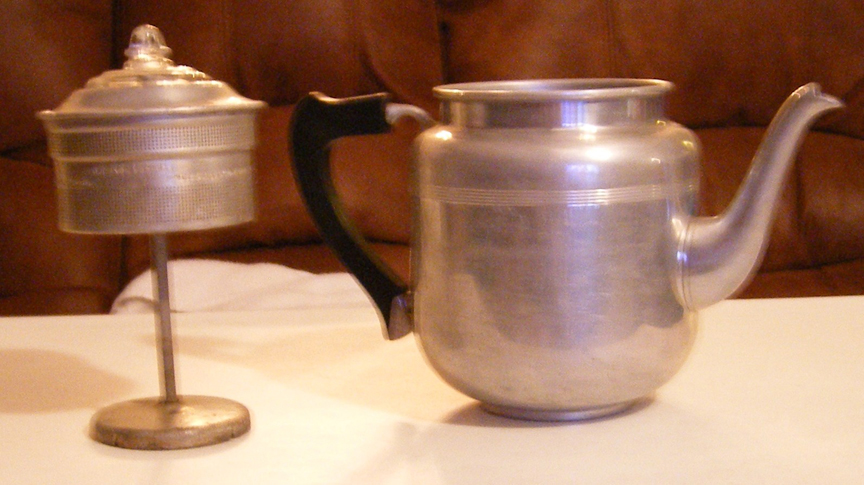
Linda's Columbia/LF&C Percolator
Click to Enlarge
Landers, Frary and Clark (LF&C) was founded in 1882, when Landers and Smith Co. acquired Frary & Clark, a well-known manufacturer of housewares and hardware. Columbia was an early brand name used by Landers, Frary & Clark. As noted above, the very first LF&C Columbia product was a kitchen scale. :
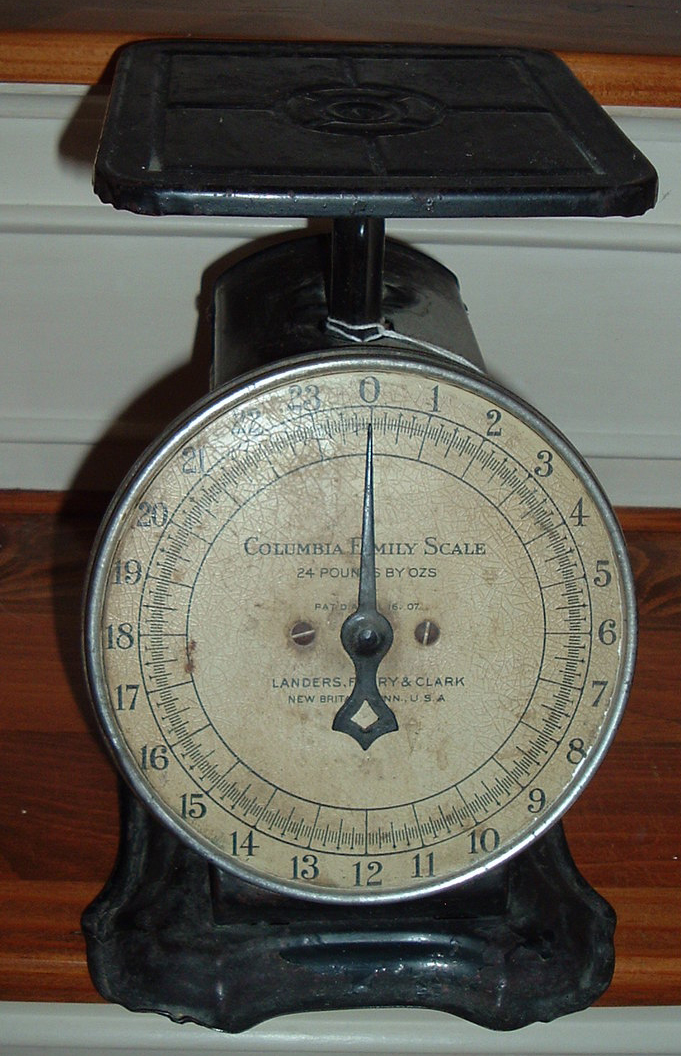
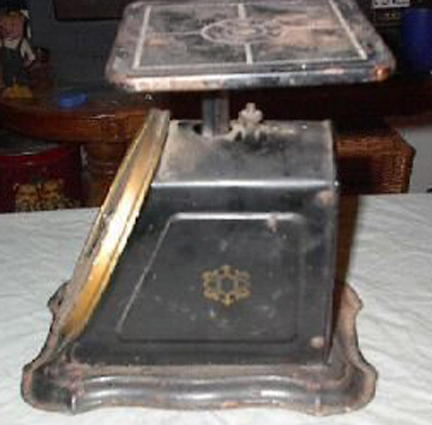
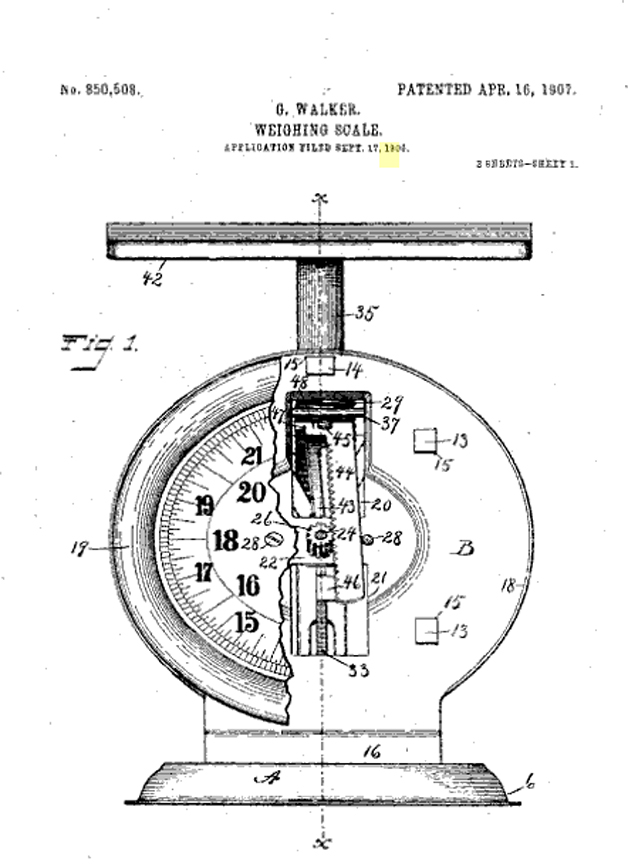
The Columbia Family Scale
Landers Frary and Clark Patent No. 850,508
Click to Enlarge
According to the Patent office, the "Universal" trademark dates from 1890, although your piece had to have been made after 1913. I did some patent searching and discovered that LF&C had designed an electric percolator by 1912, and had an improved percolator basket by 1916.
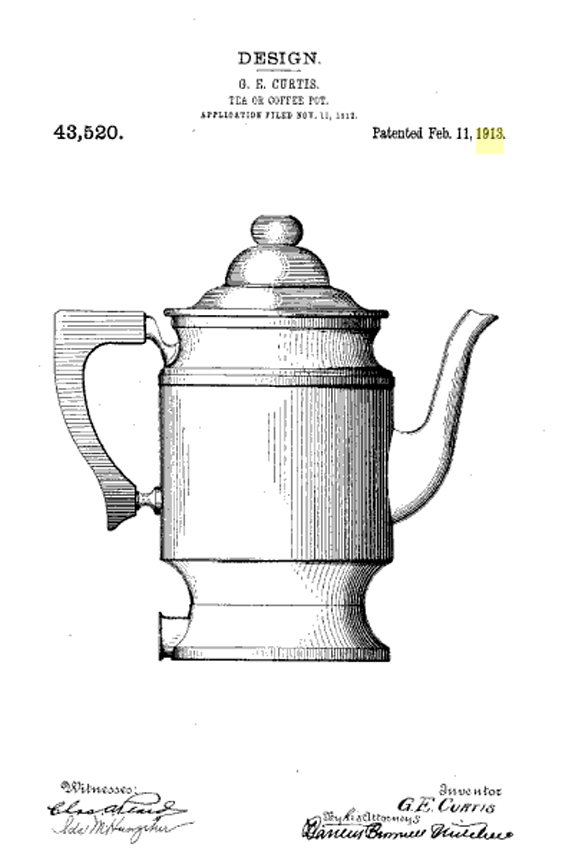
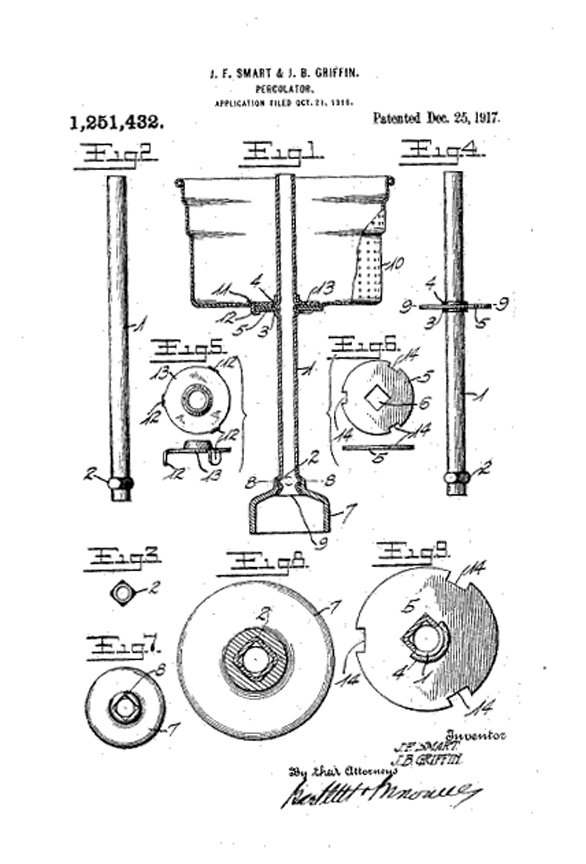
Landers Frary and Clark Coffee Patents
Electric Percolator Design Patent D-43,520
Improved Percolator Basket Patent No. 1,251,432
Click to Enlarge
My best guess at this time is that the coffee pot dates from the time of World War I. (maybe 1914-1916). It looks like LF&C may have marketed some items under the "Columbia" name before branding all its goods as "Universal". That's only a guess and I invite comment from knowledgeable readers on this subject.
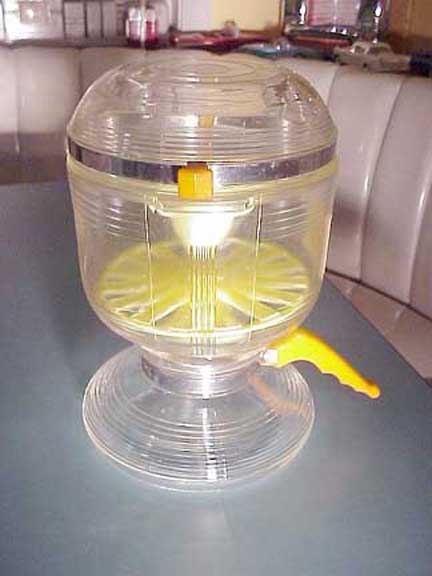
The Filtron Coffee Extractor
Instant Coffee during the Swing Era
Click to Enlarge
This photo was sent in by the noted 40s Phil of central Indiana. Phil writes: "Here's how you made instant coffee in the old days if you didn't care for Instant-Postum. It's the Filtron cold water coffee extractor, it works like this:
- Put a pound of ground coffee in the large middle bowl
- Fill the upper chamber with cold water
- Invert the upper chamber over the coffee chamber
- Water drips slowly (overnight recommended) through the coffee grounds
- An Extract ends up in the lower pot (that closely resembles a coffee server)
- Add the highly concentrated extract (1 ounce) to a cup of hot water..
- Voilla! you have instant coffee
If stored in a sealed glass jar this extract will last a month or more, according to the instruction book. The price of the Filtron was $19.50. "
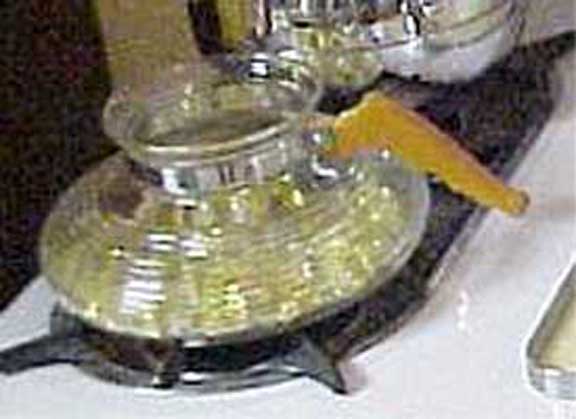
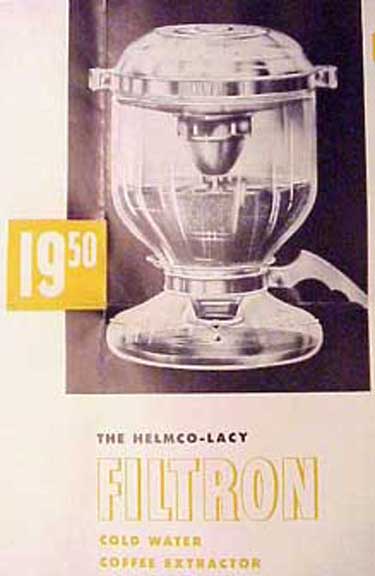
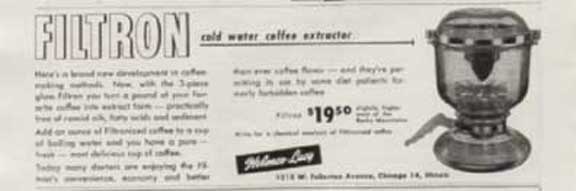
Details of the Filtron Coffee Extractor
(left) Closeup of the Filtron Server
(middle) Brochure for the Filtron
(right) Advertisement for the FiltronBR> Click to Enlarge and Rotate
They STILL MAKE THEM!!!
They're not as classy as their deco ancestor, but you can have one by writing to:
Prince Castle, Inc.
355 East Kehoe
Carol Stream, Illinois 60166
Thanks, so much, Phil!
Click here to look at another type of collectible, or keep on scrolling for more Coffee devices.
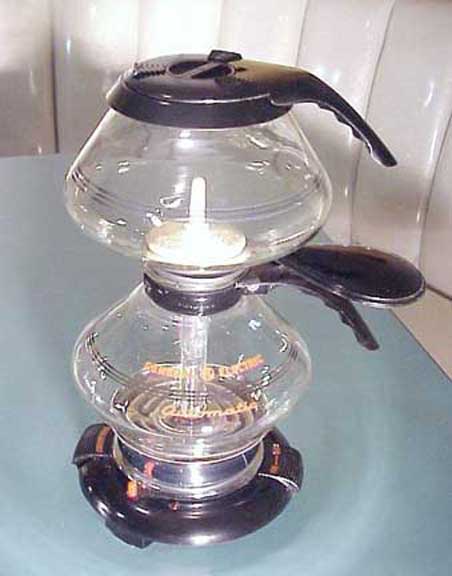
General Electric Model 129P8
Their top of the line coffee maker
VACUUM PROCESS
Click to Enlarge
This photo was sent in by the noted 40s Phil of central Indiana. Phil writes: "This is a 1940 G.E. top of the line coffee maker Cat. No. 129P8. It's a vacuum type machine. What an incredible mixture of glass, chrome, and bakelite. This one is in mint condition "

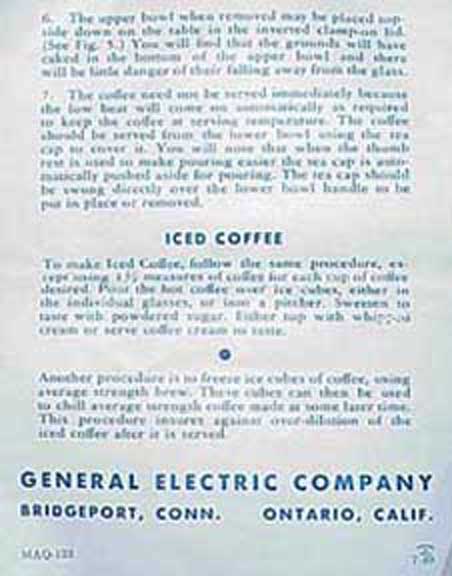
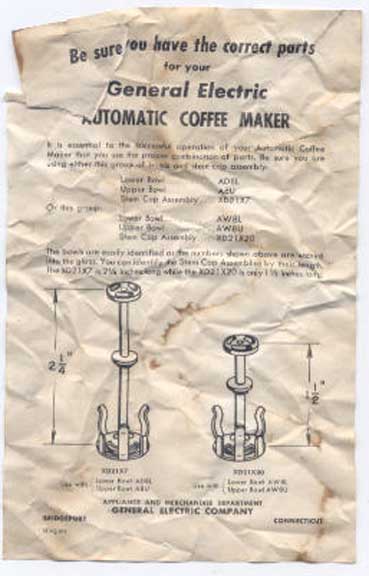
Instructions for the GE Vacuum Coffee Maker
Click to Enlarge
We have had some exchange of comments with our readers about problems with the GE 129P8. Here's what Phil has to say:
"...[I think] that the GE 129P8 is the coolest glass vacuum coffee maker ever. I have two of them and they are both in "like new" condition. After [discussing this with a reader] I got the hankerin' to make some coffee with one of my 129P8s. I discovered that neither one of them works. When plugged in, the pilot light comes on but when the red button is pushed the pilot light stays on and nothing happens. I have a feeling that the magnetic trigger in these coffee makers did not last long. That explains why my GEs are in such excellent condition ... they quit working early in their lives so were not used much. I have an extra stove (heating unit) for a GE 129P18 (that is the post WW II GE model which is a face-lifted 129P8). That stove does not work correctly either. I did get it to go on 'Hi' heat by holding the button down with my finger. I ran it through a coffee making cycle (using just water - no coffee) and discovered another good reason not to use these GEs for making coffee. The boiling water and steam in the upper bowl caused the bakelite lid to give off a burnt bakelite odor and that odor was present in the cloth coffee filter when I cleaned the coffeemaker after the experiment. Also, one of the rubber feet on the upper bowl lid stuck to the inside of the bowl during the test run. If you do get your 129P8 working, I would recommend that you leave the lid off while making coffee. I'm going to try to dis-assemble one of the 129P8 stoves to see if I can get it working properly. ..."
Thanks, so much, Phil!
Here are some photos of another high-style GE Vacuum coffee maker sent in by our friend Leon
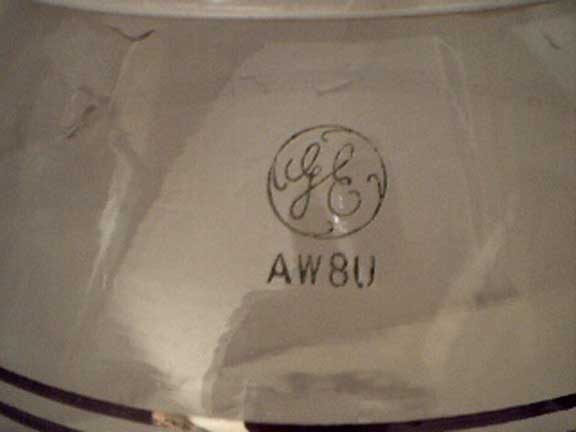
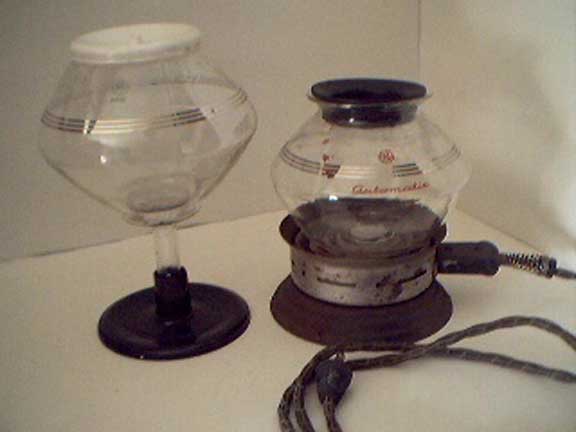
Leon's GE Model 129P8
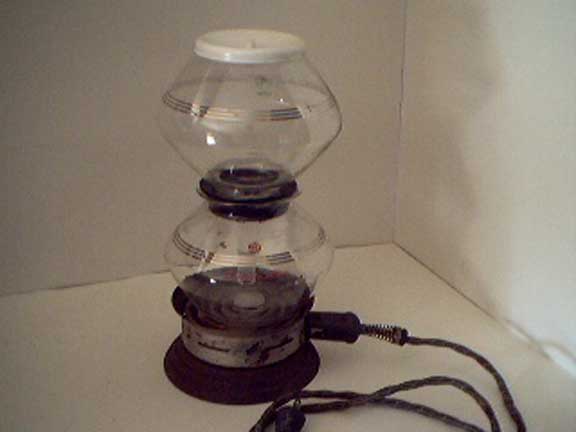
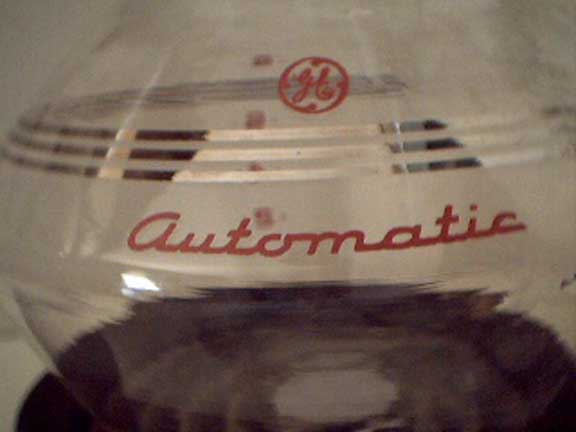
More details of Leon's Coffeee Maker
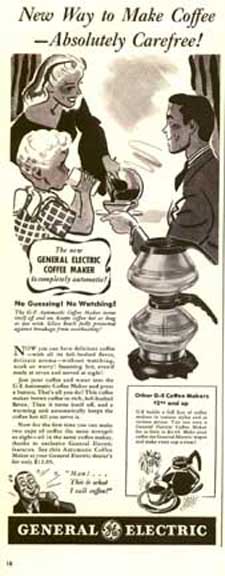
Ads for the GE Model 129P8
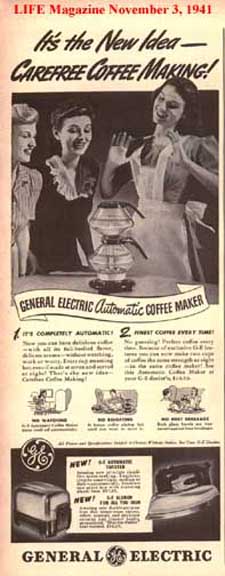
GE Coffee-Maker Ads
(left) From LIFE Nov 3, 1941
(right) From LIFE Oct 6, 1941 Click to Enlarge
Check out our Toaster Page for a discussion of the Toaster in the Ad
Click here to look at another type of collectible, or keep on scrolling for more Coffee devices.
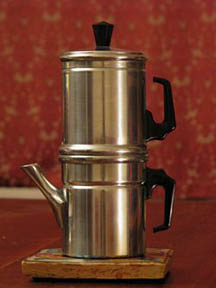
Flip-Tops
Also Known as "Over/Under" Brewers
The Neapolitan flip coffee pot, or Napoletana, is a drip brew coffee maker for the stovetop. It consists of a bottom section filled with water, a filter section in the middle filled with coarsely ground coffee, and an upside-down pot placed on the top. When the water boils, the entire three-part coffee maker is flipped over to let the water filter through the coffee grounds. Once the water has dripped through the grounds, the water-boiling and filter sections are removed, and the coffee is served from the remaining pot. Because of the coarse grounds, the coffee is brewed quite mildly. Using a very dark, finely ground roast, in the "Neapolitan" style, this method can produce a coffee that has a stronger flavor than an automatic drip maker.
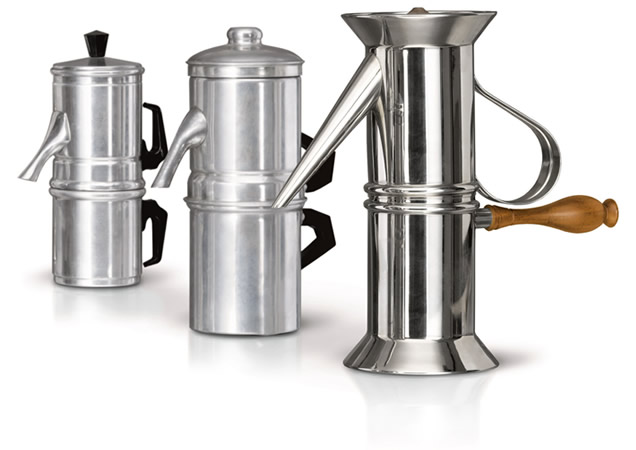
They Come in Various Sizes
Some authorities assert that the Neapolitan flip pot is actually of French origin. On this topic, we recently heard from our reader Wade, who writes:
"... I found this coffee maker from Italy and I need some advice on how to use it..."
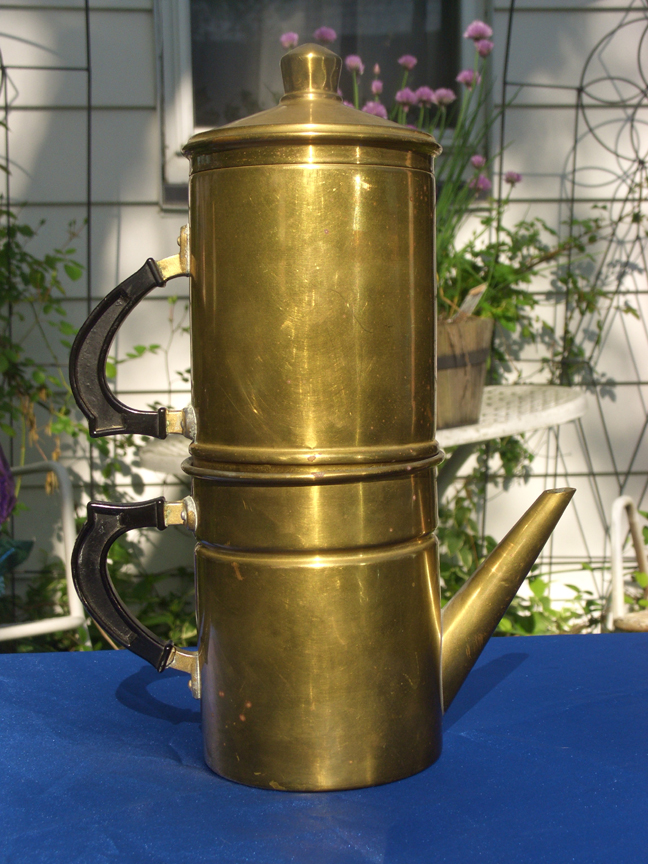
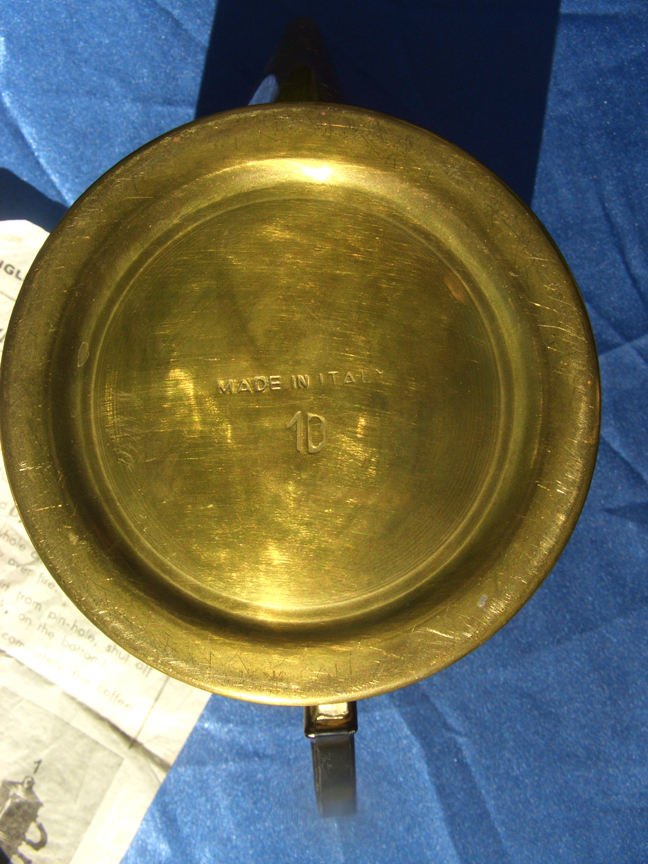
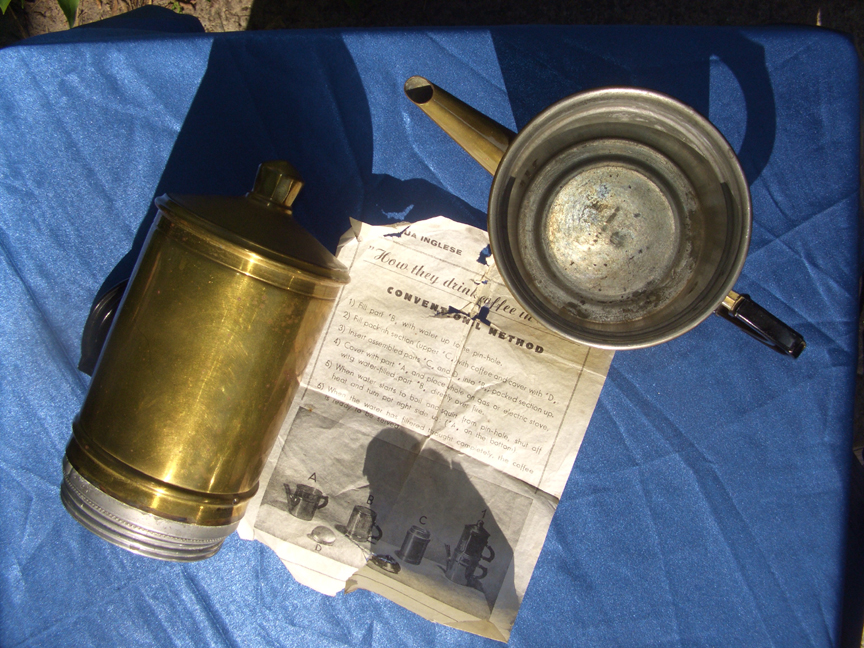
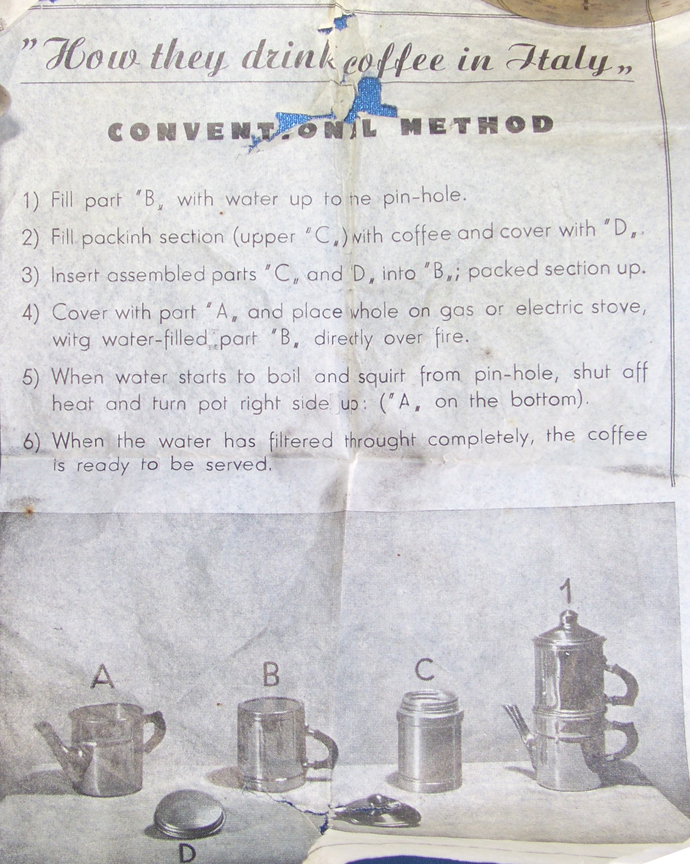
Wade's Napoletana Fliptop
Click to Enlarge
Click Here for instructions on how to use the Napoletana.
Click here to look at another type of collectible, or keep on scrolling for more Coffee devices.
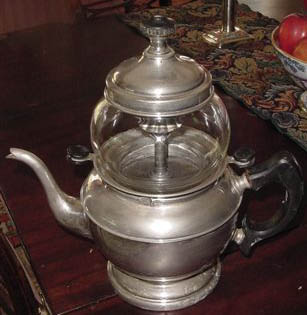
The Empress Ware Percolator
This is a nice (if complicated) percolator that was made in Brooklyn. Here's how it works:
FIRST: Water in the server drains into a small well at the bottom. A heat source (e.g. alcohol lamp) is applied to boil the water in the well. The wood handle indicates that this was probably not used on the stovetop.
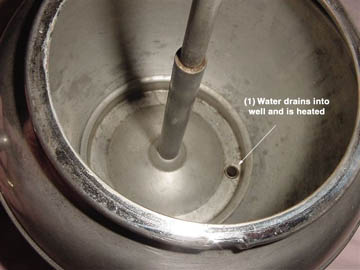
Inside the Server
SECOND: hot water passes through the support tube and is carried upward into the brewing chamber.
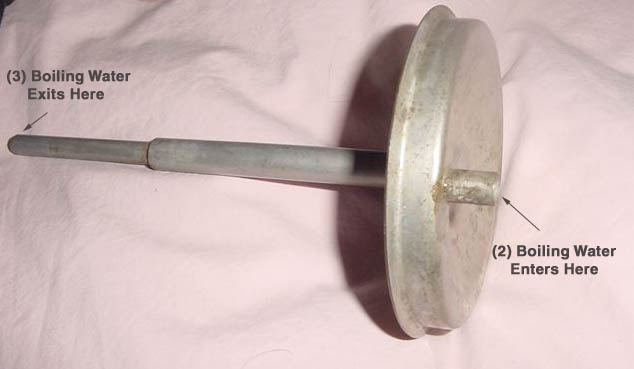
The Brew Tube
THIRD: hot water emerges and is directed at the coffee grounds by the umbrella-shaped deflector
FIFTH: hot water contacts the grounds, creating brewed coffee which drains through the filter back into the server
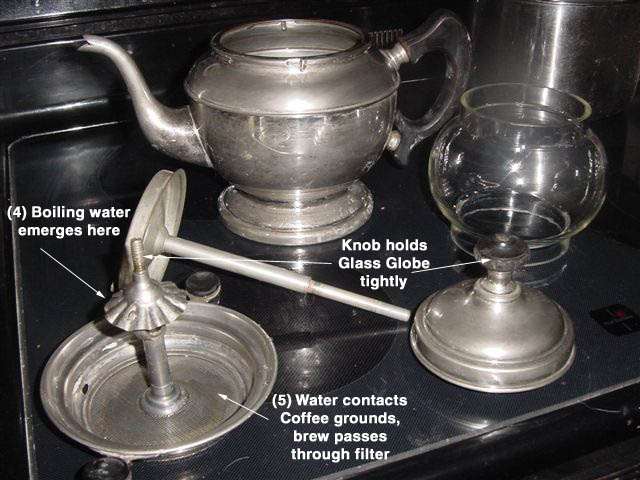
The Empress Ware Flip Top Parts
For reference, here is what the Empress Ware hallmark looks like:
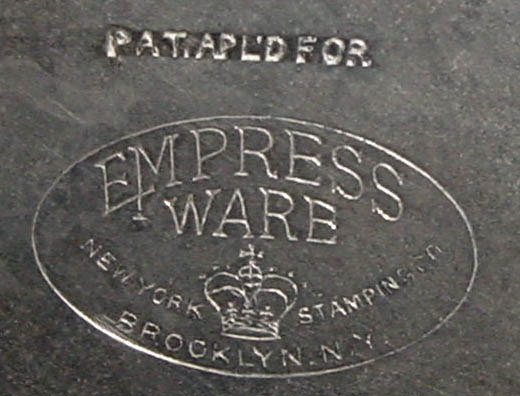
The Empress Ware Hallmark
These photos were sent in by our friend Pru, who seems to find al lot of coffee oddities. Thanks, so much, Pru!
Click here to look at another type of collectible, or keep on scrolling for more Coffee devices.
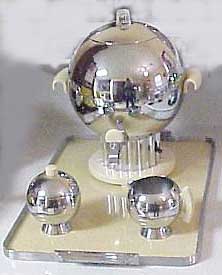
Coronet Coffee Service
From the Chase Art Metal Company
This is the Chase "Coronet Coffee Urn Service", designed by Walter von Nessen and introduced in 1938. The set includes the "Coronet Coffee Urn" (No. 17088), the Sugar and Creamer (No. 17089 and the "Festivity" Tray (No. 09018). The set sold for $28.95 in 1941, and now has a value in excess of $700. More about this may be found in Art Deco Chrome by Jim Linz (Schiffer Books, ISBN 0-7643-07444-4) P 118
This photo was sent in by the noted 40s Phil of central Indiana. Thanks, so much, Phil!
Click here to look at another type of collectible, or keep on scrolling for more Coffee devices.
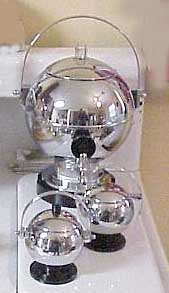
The "Harmony" Coffee Service
Manning-Bowman & Company of Middletown, Connecticut
Mannning-Bowman was the Cadillac of giftware! Their slogan was "M-B Means Best". This is the "Harmony" coffee service, which appeared at least a year before Chase introduced the "Coronet" service. The 1937 Manning-Bowman catalogue notes that "...the spherical design of the 'Harmony' sets it apart as the smartest coffee service..." The set, with crystal catalin trimmings consisted of the Urn (No 492/12), the gold-lined sugar and creamer (No 1152). A tray was also available. More about this may be found in Art Deco Chrome by Jim Linz (Schiffer Books, ISBN 0-7643-07444-4) P 118
Of all things, Manning-Bowman is not as collectible as Chase --- this set only has a value of about $300!
This photo was sent in by the noted 40s Phil of central Indiana. Thanks, so much, Phil!
Click here to look at another type of collectible, or keep on scrolling for more Coffee devices.
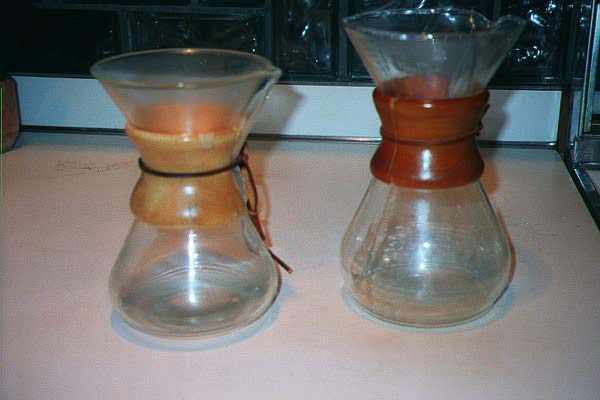
Chemex Coffee Makers
6 Cup and 8 Cup
DRIP METHOD NOT Automatic
Click to Enlarge
The Chemex is a beautiful object --- a hand-blown double cone of glass that serves as both coffee brewer and server. The upper cone holds a filter; ground coffee is placed in the filter and hot water poured therein. The brewed coffee drips down into the lower cone. The filter is removed and the device may be used to serve the coffee. Because the glass gets very hot, there is a wood grip, made of two curved pieces held together with a leather thong. A wooden ball/toggle is used to cinch the pieces together, but it can be loosened to remove the grips so that the device may be cleaned.
The Chemex has touched my life in several ways...
Before my family moved to the Suburbs, my dad would only drink espresso and it had to be made very precisely --- every day, on the way home from work, he walked by the Nicholas Coffee warehouse and came home with a small bagful of fresh roasted beans. After dinner, he would grind these with a hand mill and make espresso on a Vesuvio stove-top apparatus. Although we were dirt poor, we enjoyed very good coffee.
When we moved to the Suburbs --- the most singularly traumatic event in my life --- coffee began to come from cans. (Fortunately, we did not move far enough into the Suburbs for coffee to come from jars....) In 1956 or 1957, we received a package from California sent by Uncle Tony. (Those of you who read the website regularly know that Uncle Tony was a professional musician, zoot suiter, and general black sheep of the family). Inside this package was a Chemex coffee maker, much like the ones pictured above. Anything from Uncle Tony was suspect, and more so since it came from California ("The Land of Fruits and Nuts" as my Dad was fond of saying) In suburban Pittsburgh, this glass object with the strangely primitive wood grip held by a leather thong was truly exotic. Mom placed it over the refrigerator and it served as a conversation piece for a few months. ("What's that?")
After that, the Chemex was sentenced six years in the back of a cupboard for being inscrutable to suburban housewives. Then, I visited the Museum of Modern Art in New York which has a small exhibit of the great design innovations of the 20th Century --- among them is a Chemex coffee maker, a dead ringer for the one above our stove. When I got home, I was able to rescue the Chemex and take it back with me to College --- a Museum Piece. I treasured this object, my very tenacious link with the fashionable people who frequented the Museum of Modern Art.
When it was learned that President Kennedy fancied Ian Fleming, I immediately acquired a copy of From Russia With Love. Like all young men of the period, I eagerly memorized James Bond's favorite consumer products. To the vast unwashed generations of poor kids catapulted into the confusing social whirlpool of College, James Bond was a sort of mentor, someone who could guide you to making the Correct Choice of razors (Hoffritz), toothpaste (Vademecum) and Coffee Makers. To wit, I present a quote from vintage Fleming, as Bond describes his "normal" breakfast:
"...two large cups of black coffee from De Bry's in New Oxford Street, brewed in an American Chemex (and no sugar). A single egg, boiled for three and a third minutes. Thick slices of wholemeal toast, with Jersey butter; Tiptree 'Little Scarlet' strawberry jam, Cooper's Vintage Oxford marmalade, and Norwegian Heather Honey from Fortnums...."
You can buy any of these items except coffee from de Bry's -- the store closed in the 1980s and the building is now a computer store. Some calls to friends in London revealed that Jamaican Mountain Blue coffee is a good substitute for De Bry's celebrated brand which also came from Jamaica.
In the books, Bond ---the force for Good --- had a preference for the handmade and the personal. The villains had a predilection towards Technology. One could imagine either Bloefield or Dr. No showing off his "Mr. Coffee" device.
In all candor, and at the risk of sounding bourgeois, the Chemex just does not work very well... I know that this borders on Heresy, but the filter is not well supported in the blown glass funnel. Even if you use the VERY EXPENSIVE specially reinforced Chemex filters, the paper often breaks and you have a pot full of grounds. The Melita system seems to work a lot better for the practical necessities of making lots of coffee. Of course, James Bond left these details to his minions...
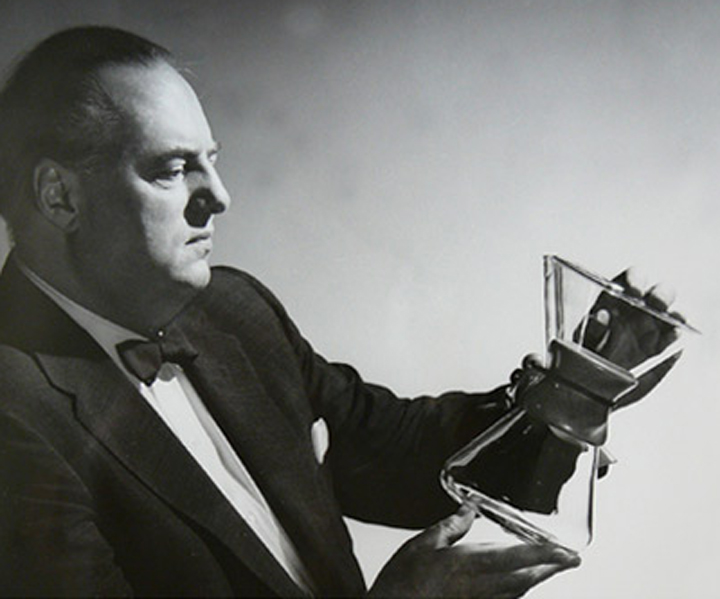
Dr. Peter Schlumbohm, Inventor of the Chemex
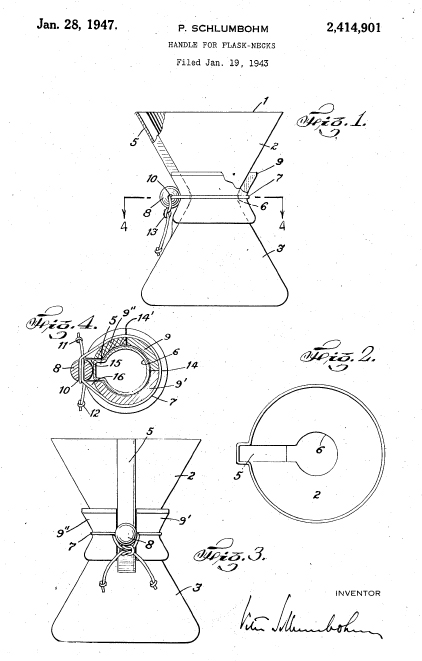

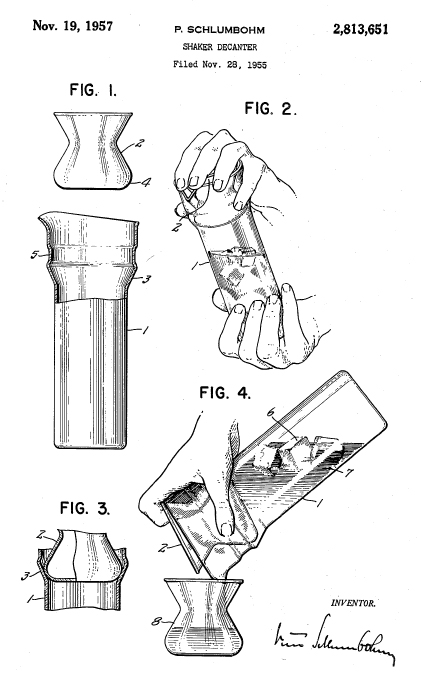
The Chemex Patent and Some of Dr. Schlumbohm's Other Inventions
Chemex Coffeee Brewer Patent No. 2,414,901 -- DRIP METHOD
Champagne Cooler Patent No. 2,163,568
Cocktail Shaker Patent No. 2,813,651
Click to Enlarge
The Chemex Coffeee Maker was invented by Dr. Peter Schlumbohm who was a real chemist who has an interesting life story, as told in Gourmet Magazine. We have reproduced (above) the patent diagrams from some of Dr. Schlumbom's other inventions as discussed in the Gourmet Magazine story.
Click here to look at another type of collectible, or keep on scrolling for more Coffee devices.
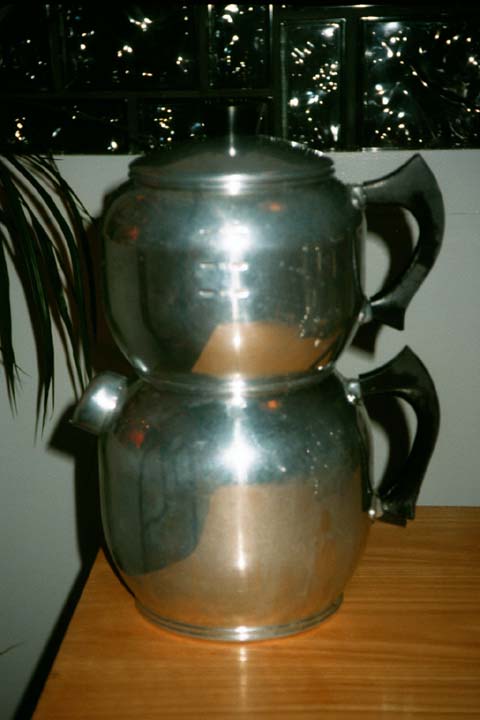
West Bend "Kwik-Drip" Coffee Maker
15 Cup Model
DRIP METHOD NOT Automatic
Click to Enlarge
This is one of the more popular collectible coffee brewers. The thing works very well, especially if you have to brew a large amount (like 15 cups...) in a short time. The distinctive curved handles and gently bulging shape are very attractive. The device uses an internal metal filter that is very well-designed. I have seen these at $100 and over.
I date this from before WWII. The manufacturer's information states:
West Bend Aluminum Company
West Bend, Wisconsin
Click here to look at another type of collectible, or keep on scrolling for more Coffee devices.
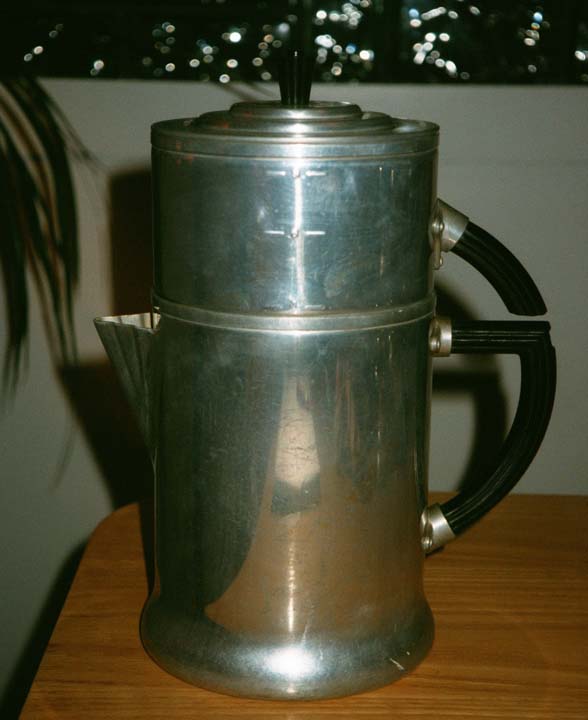
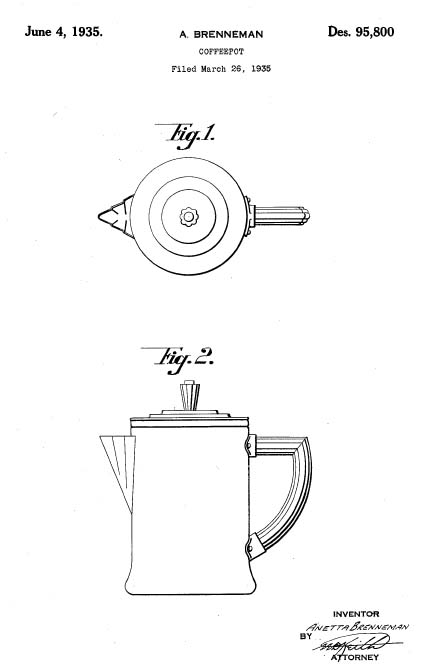
Wearever Coffee Maker
Anetta Brenneman Design Patent D-95,800
DRIP METHOD NOT Automatic
Click to Enlarge
This coffee maker is eminently collectible for the cylindrical shape and the "Dee" shaped handle. This utensil employs a paper filter in conjunction with the metal filter. I was very fortunate to find this as new old stock --- I have the original cardboard sleeve with the initial price ($0.75) written in black crayon. The piece dates from June of 1935 when the original design patent was issued.
The manufacturer's information states:
Wear-Ever Made in USA
PAT D-95799, PAT D-95800
This particular coffee maker was designed by Anetta Brenneman of TACU; a reproduction of her design patent drawing is shown above
Wear-Ever got started near Pittsburgh, Pa.
Aluminum, a new material, began to be seriously used as cookware as early as the 1890s when it was cast and stamped. Among the first manufacturers were the Pittsburgh Reduction Company which became U.S. Aluminum Company (USAC), and then the Aluminum Company of America (ALCOA). (Wagnerware and Illinois Pure Aluminum Co. were also manufacturers of aluminum cooking products at this time.)
In 1901, USAC formed "The Aluminum Cooking Utensil Company" (TACU), as its marketing subsidiary. In 1904 TACU adopted "Wear-Ever" as its trade name. These products won a prize at the St. Louis World's Fair, and in 1912, Wear-Ever aluminum utensils became standard issue for the U.S. Marine Corps. By 1925, USAC had become ALCOA and Wear-Ever became the name for TACU.
If the mark says "USAC", the piece is from before 1901; if it says "TACU" it's between 1901 and 1925; if it just says "Wear-Ever" it's after 1925.
We note that Anetta Brenneman identified herself as an employee of TACU.

Wearever Coffee Pots
"The Coffee Pot that Went to College"
DRIP METHOD NOT Automatic
Click to Enlarge
Above is a 1940s ad for Wearever products, including our little drip coffee maker. The motto is "The Coffee Pot that Went to College".
Click here to look at another type of collectible, or keep on scrolling for more Coffee devices.
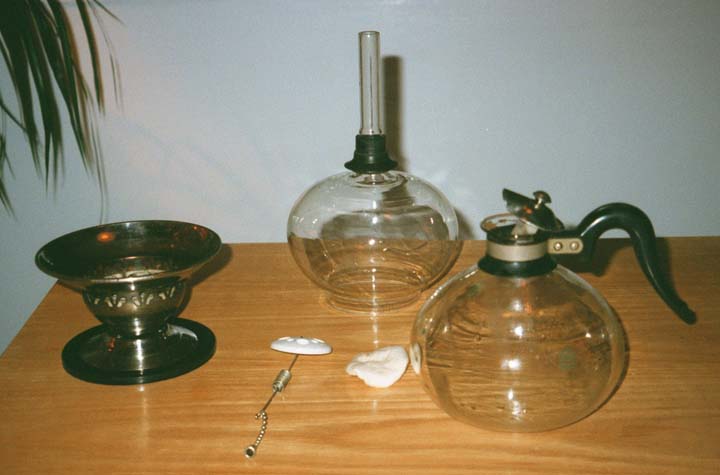
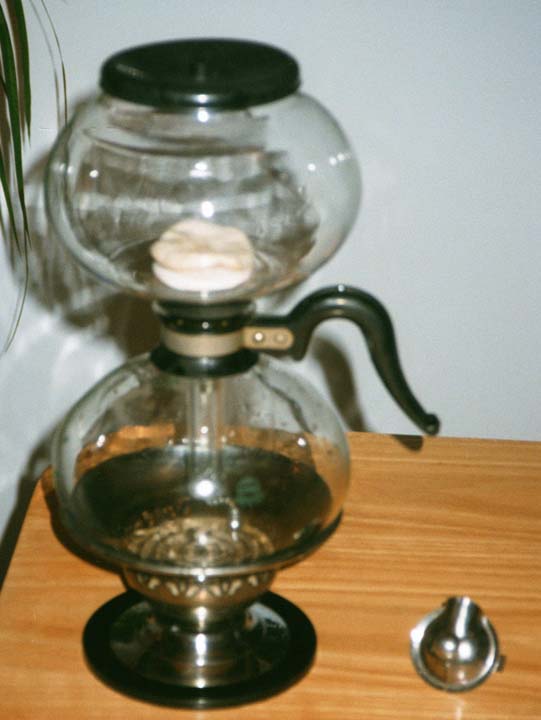
The Silex 10 Cup Coffee Maker
(left) Parts (right) Ready to Brew
VACUUM METHOD NOT Automatic
Click to Enlarge
This is an absolutely beautiful hand-blown vacuum coffee maker from the 1920s that was made by the Silex company which specialized in making heat-resistant glass vessels for industry. In the 1930s, the company merged and became Proctor-Silex, then Hamilton-Beach-Proctor-Silex, then Scovill Industries, etc, etc,etc. This is catalogue model EC-10, and made TEN cups.
The upper (disassembled) view shows the various components: At the far left is the heater "stove" which is simply a resistance coil mounted on an attractive metal stand. In the center is the Upper portion (resting upside down). The vacuum lock and a cheesecloth filter are in the foreground and the server is shown at far right. The fully assembled brewer is shown in the bottom photo. The small metal object on the right is the cap for the server when it is used at the table. This is NOT automatic --- you have to keep an eye on it to judge when all the water has passed into the upper chamber.
The Silex was immortalized by Norman Rockwell in his October 30, 1948 cover for The Saturday Evening Post, as shown below
The October 30, 1948 cover of The Saturday Evening Post
Click Here to read about the Douglas "Kitchen-Master" Chairs
Click Here to read about the Sunbeam T-9 Toaster
This is the eight cup version of the Silex Vacuum coffee maker (Catalogue EC-8).
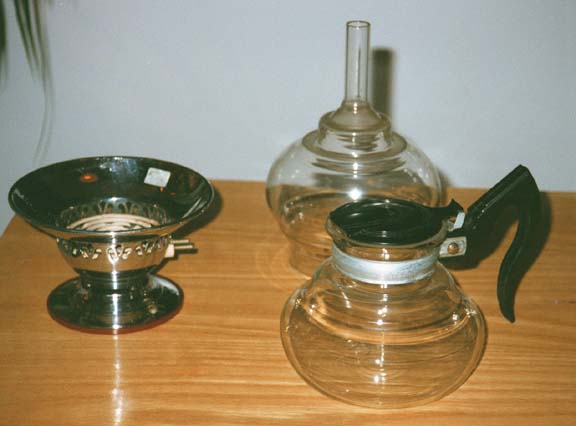
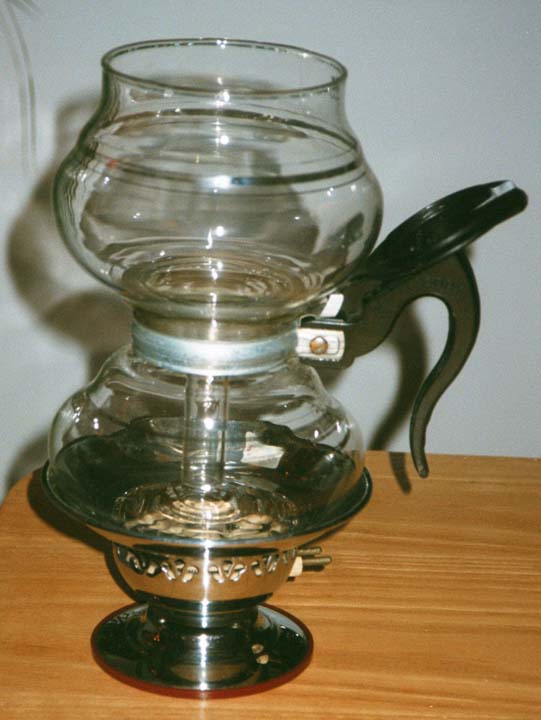
The Silex 8 Cup Coffee Maker
(left) Parts (right) Ready to Brew
VACUUM METHOD NOT Automatic
Click to Enlarge
Here is a FOUR cup model
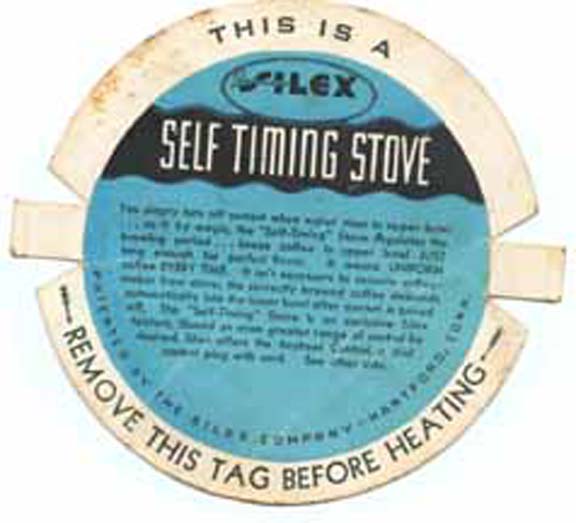
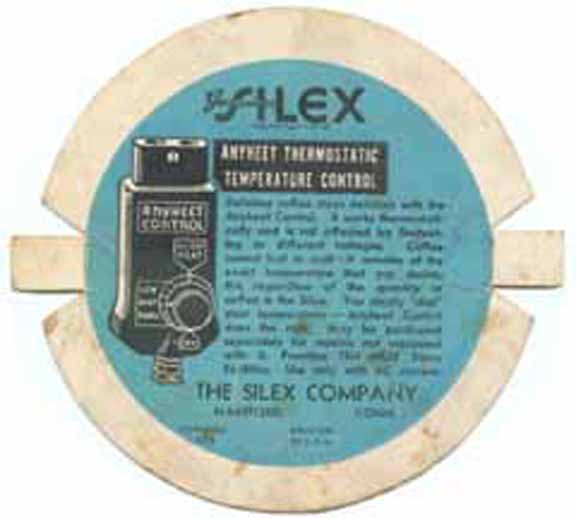
The Silex 4 Cup Coffee Maker
Label for the Stove
VACUUM METHOD NOT Automatic
Click to Enlarge
I am extremely fortunate to have all three of these beautiful objects! Here are representative directions for using the Silex coffee makers
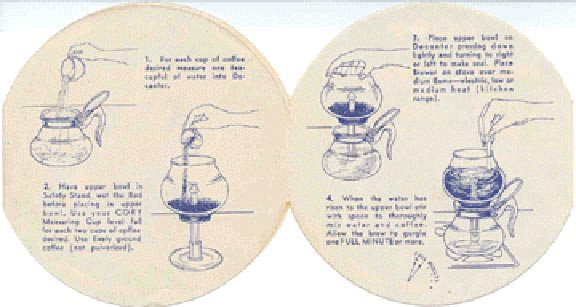
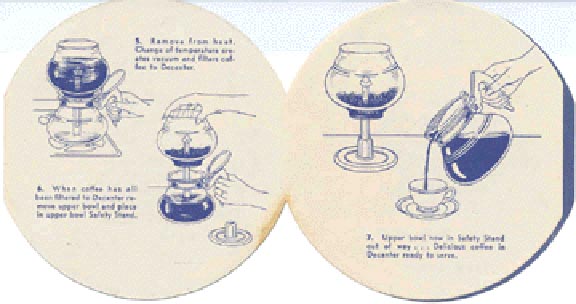
Directions for using a Silex Vacuum Coffee Maker
Click here to look at another type of collectible, or keep on scrolling for more Coffee devices.
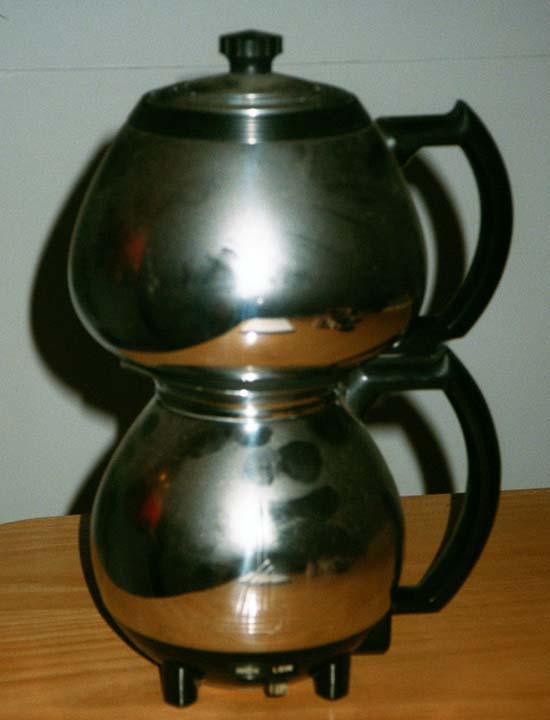
Sunbeam C30-A Coffee Maker
VACUUM METHOD -- Automatic
Click to Enlarge
This is a classic Sunbeam vacuum coffee maker, made famous in advertisements in Life magazine during the late 1940s. This is an automatic coffee maker --- you load it up and it takes care of brewing the coffee. A light comes on when you are ready to serve. This is a significant step in the evolution of coffee makers, so we have devoted considerable attention to it -- including lots of patent diagrams in our special page on Coffee Technology
Here are the directions for using the Sunbeam C30 Coffee Maker
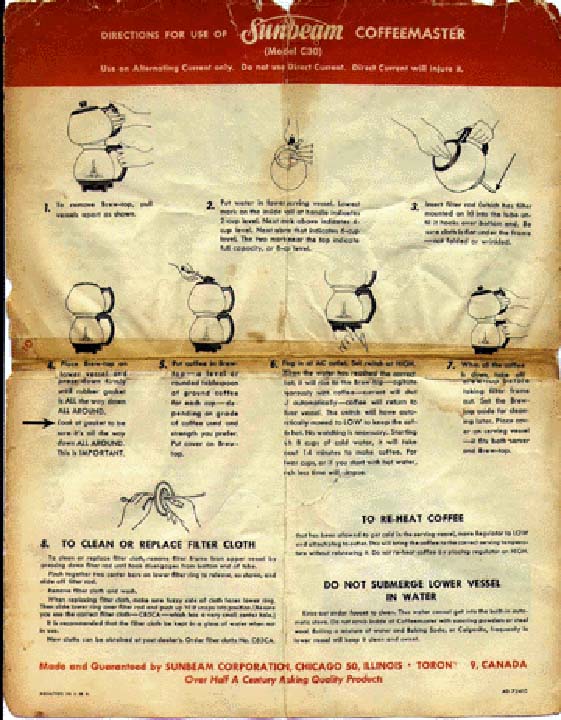
Directions for Using the Sunbeam C30-A Coffee Maker
Click to Enlarge
The Sunbeam came with an attractive tray set. While returning from the Reading Air Show, we stopped at a roaside flea market, and what should appear (for a quarter) but the tray!!
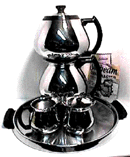
Here is the Manuufacturer's information:
US PAT 1994323,2345262,2345264,2345265
Canada Pat 1939-42-44
Model C30A
CSA Approval No 8402
110-120 V 100W
Here is a nice grouping of ads for the C30 and related products from Sunbeam
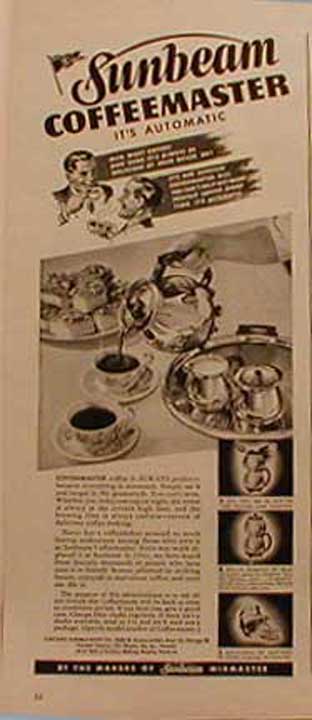
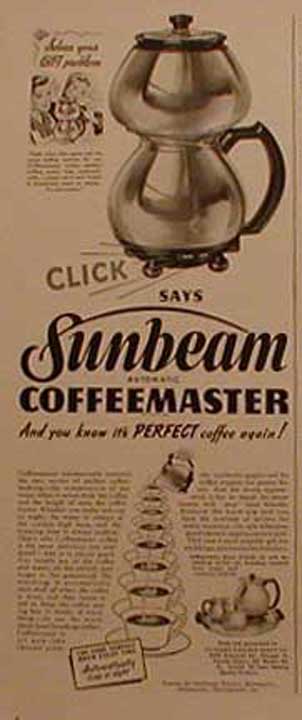
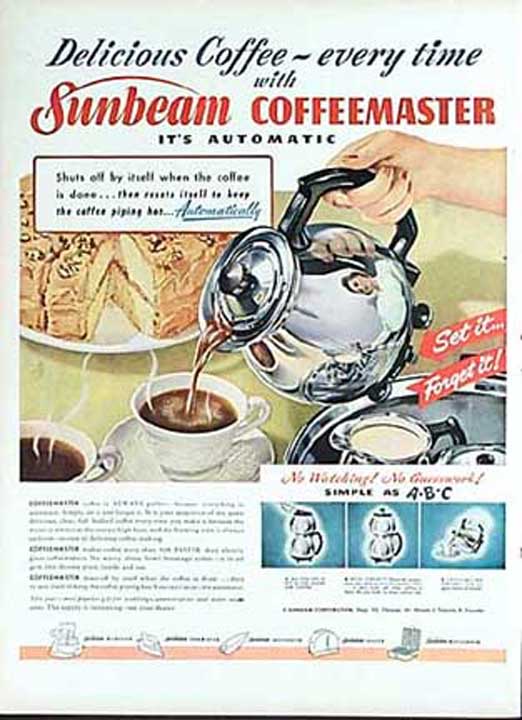
Ads for the Sunbeam C30 Coffeemaster
(left) LIFE Nov 3, 1941
(middle) LIFE Oct 6, 1941
(right) LIFE Nov 12, 1947
Click to Enlarge
Check out our Toaster Page for a discussion of the Sunbeam T-9 Toaster in the Ad
Problems with the C30A Seal
This is a high quality, well-made product. The principal design flaw resulted because Sunbeam did not expect that the product would have such a long life. The seal between the server (bottom part) and the reaction chamber (top part) is made of rubber. Over time, this changes composition and hardens. If the reaction chamber is in the Server, then you cannot get them apart. If the two parts are separated, the gasket will not compress and you cannot put them back together.
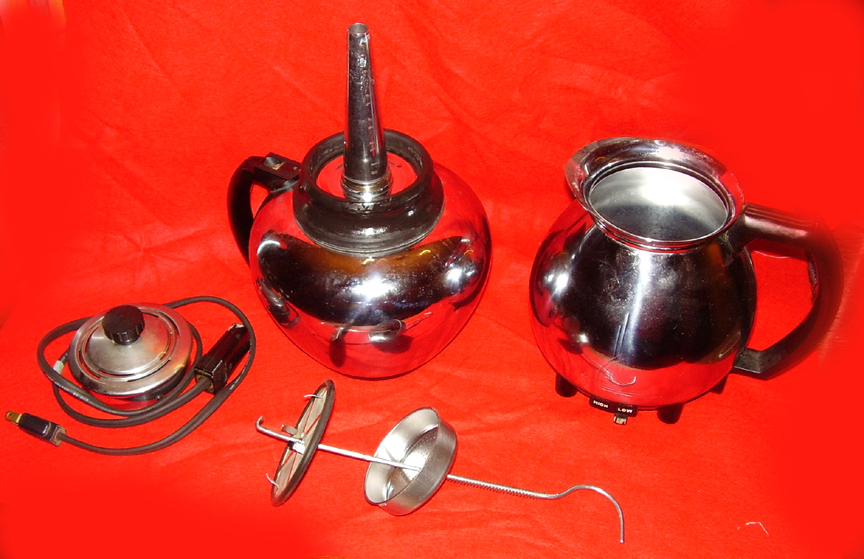
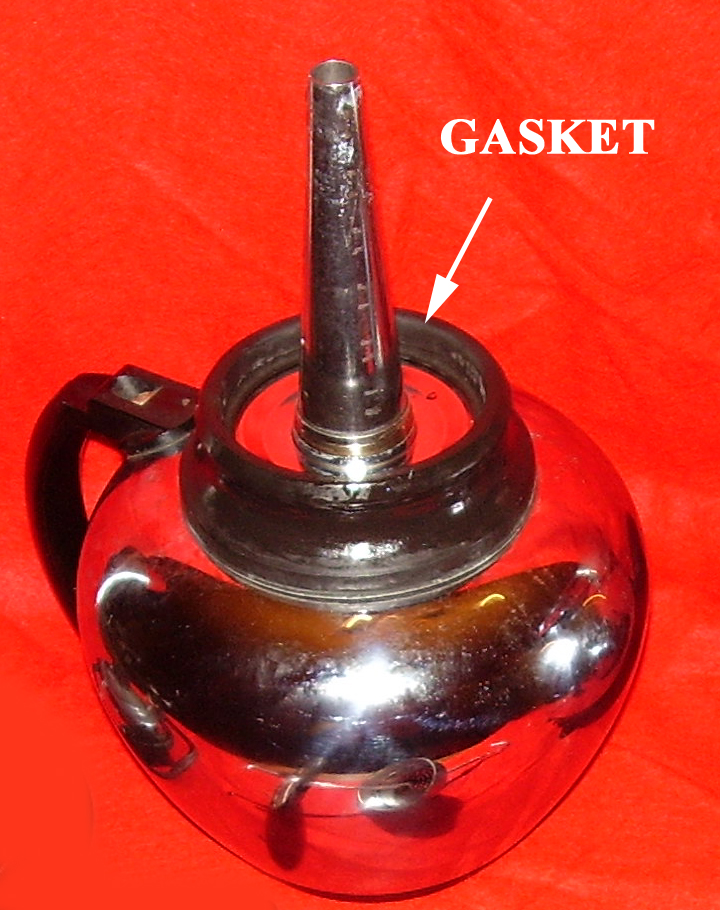
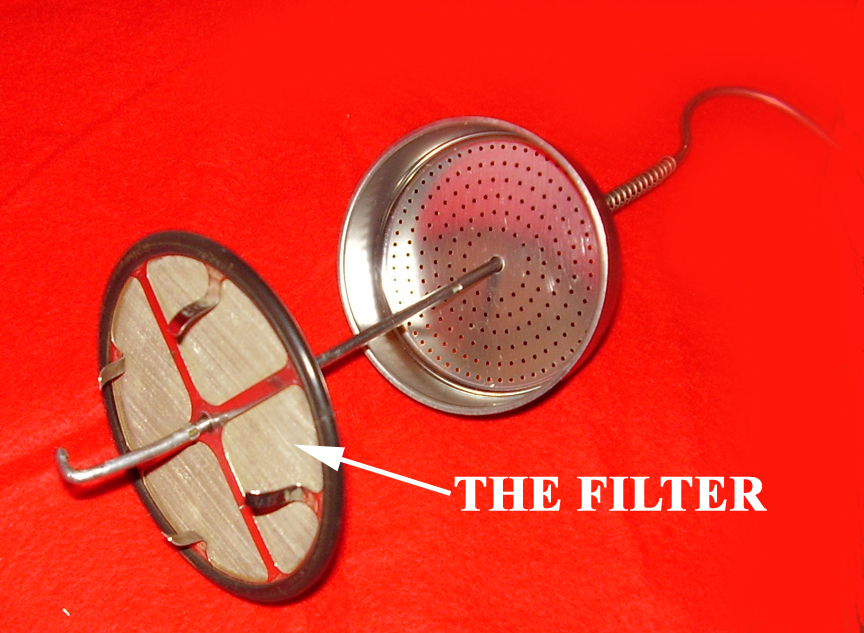
Components of the Sunbeam C30 Coffeemaster
(left) Display of Sunbeam Coffeemaster (C30A) Components
(middle) Reaction Chamber and Gasket
(right) Filter Assembly
Click to Enlarge
The photo on the right shows the C-30 filter assembly. My version has a brass filter screen. Earlier models have a cloth screen. At one time, Sunbeam sold replacement filter cloths, but these are now unavailable. You will have to get some unbleached muslin and sew your own.
The most frequent C-30 question that I get is: "How do I get the two pieces apart?"
My answer used to be "YOU CAN'T." Until 2010, the thing used to be shot, kaput, a total loss (other than parts). However, as of July 20, 2010 the miracle of entrepreneur capitalism has provided you with a great ray of hope.
All you have to do is go to the website of Dayseal.Com and order a new gasket. They cost about $30 plus shipping. The vendors will even help you get the old gasket off. This is a really great service, especially if you love the fantastic taste and automatic brewing associated with the C-30. We want to extend our very grateful appreciation to our reader Nancy who provided us with this information.
So, what did you learn:
- You MUST consider the condition of the gasket
- If you see one at a flea market, ask the SELLER to take the two halves apart. (Let him try...)
- If it is on an online auction do not bid unless the seller provides a photograph of the two halves apart and a closeup of the seal
- Examine the filter in the same way -- if a cloth filter is present, make a note that you'll be spending a lot of time sewing those replacements. It's better to only buy the version with the metal filter.
If you can't be certain that the gasket is functional, remember that you will have to spend about $30 for a new one -- deduct that from the price... This way, you can prevent yourself from either paying too much or winding up with a nice chrome sculpture that is useless as a coffee-maker
We have some FREE DOWNLOADS
You should know that the C-30 is discussed in more detail on our Coffee Technology page. Next, you can download the following items:
- C30 Operation Manual
- C30 Repair Manual
- Sunbeam Patent 1,994,323 (C30 Prototype - 1935)
- Sunbeam Design Patent D-113,512 (Alfonso Iannelli Exterior Design of the C30 -1939)
- Sunbeam Patent 2,223,450 (Original C30 - 1940)
- Sunbeam Patent 2,345,262 (Filter Assembly - 1944)
- Sunbeam Patent 2,345,264 (Bottom recess well - 1944)
- Sunbeam Patent 2,345,265 (Filter Assembly - 1944)
- Sunbeam Patent 2,687,469 Thermostat (1954)
- Sunbeam Patent 2,729,159 (C50 -- 1956)
Over the course of the years, the design of the C30A changed incrementally (in some, the filter screws on and off). I only have one manual for one particular variant. The basic principles of the C30 reamained constant through the years, so the manual can still be helpful.
Click here to look at another type of collectible, or keep on scrolling for more Coffee devices.
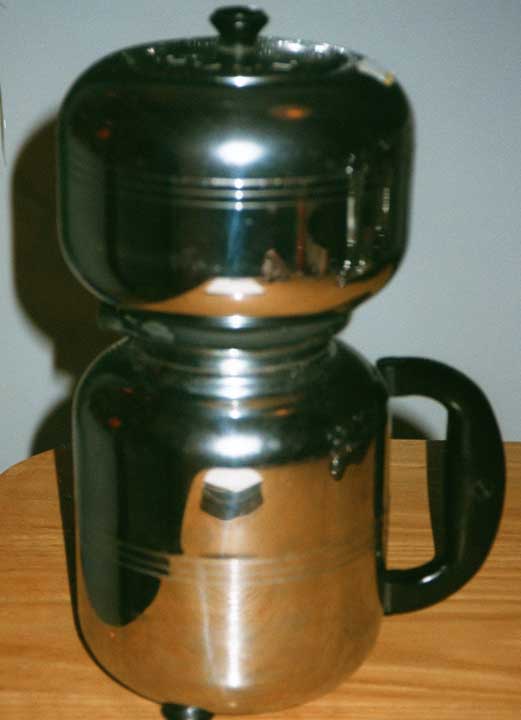
Westinghouse Coffee Maker
VACUUM METHOD -- Automatic
Click to Enlarge
This is a vacuum coffee maker from the 1950s. Surprisingly, not much has changed from the 1920s other than the complications necessary to make the thing fully automatic. Of the vacuum systems, the ones from the 1920s make the best coffee --- if you keep a close eye on it and have ground your coffee specifically for a vacuum maker. At 1000 Watts, this thing uses a whole lot of electricty --- no Conservation was envisioned by the Westinghouse corporation. Their appliances from the 1950s are NOTORIOUSLY inefficient.
Here is the Manufacturer's information:
Cat No CM-71, 1000W
115 V AC Only
Westinghouse
Mansfield, Ohio
Click here to look at another type of collectible, or keep on scrolling for more Coffee devices.
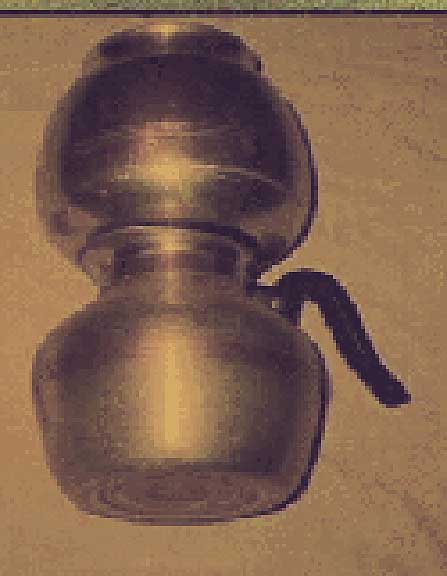
ABCO Metal Products
VACUUM METHOD -- Automatic
Click to Enlarge
I found this little vacuum rig in New Market -- it has no maker's information than ABCO Metal Products. It certainly has a nice style!
Click here to look at another type of collectible, or keep on scrolling for more Coffee devices.
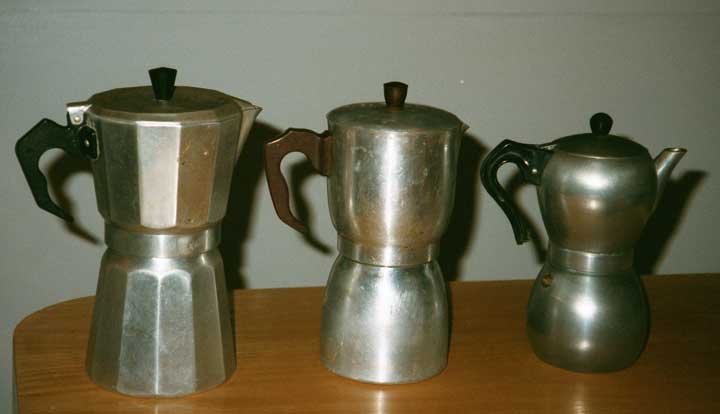
Vesuvio Style Espresso Makers
VESUVIO METHOD
Click to Enlarge
Here are three lovely Vesuvio style Espresso makers (6, 4, and 2 cup models). These things are widely available and can approximate a good cup of Espresso --- provided that you watch it very carefully, use distilled water and have very finely ground coffe. Tap water is death to these things because the minerals in it greally clog up the pressure valve. These things have to be kept scrupulously clean!
Click here to look at another type of collectible, or keep on scrolling for more Coffee devices.
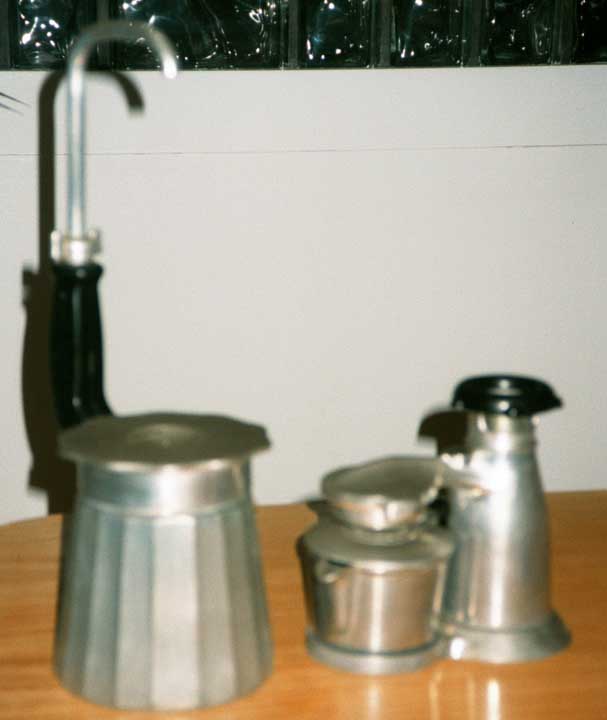
Vesuvio Style Capuccino Makers
VESUVIO METHOD
Click to Enlarge
These are the stovetop equivalent of the yuppie machines available at Williams-Sonoma. On the left is a milk-frother. It is simply a base unit from a Vesuvio-type machine with an attachment to allow steam to be directed into a container full of milk. The device on the Right contains a "charge" of coffee" It is placed directly on the burner and heated until; steam, rises in the cylinder. The black valve is turned to direct steam into the charge and the recovered liquid is held in a small server. BUT -- the steam pressure is not sufficient to extract all the oils that are essential to True Espresso.
You also have to be VERY observant and use the things just as the rush of steam is heard. There is not too much danger of them blowing up, but it is easy to get a blast of steam through the safety valve rather than through the milk or coffee... The yuppie machines just substitute resistance coils for the stove. No wonder you see a whole lot of the yuppie versions in thrift stores. They are often given as wedding gifts, but rarely used...
Click here to look at another type of collectible, or keep on scrolling for more Coffee devices.
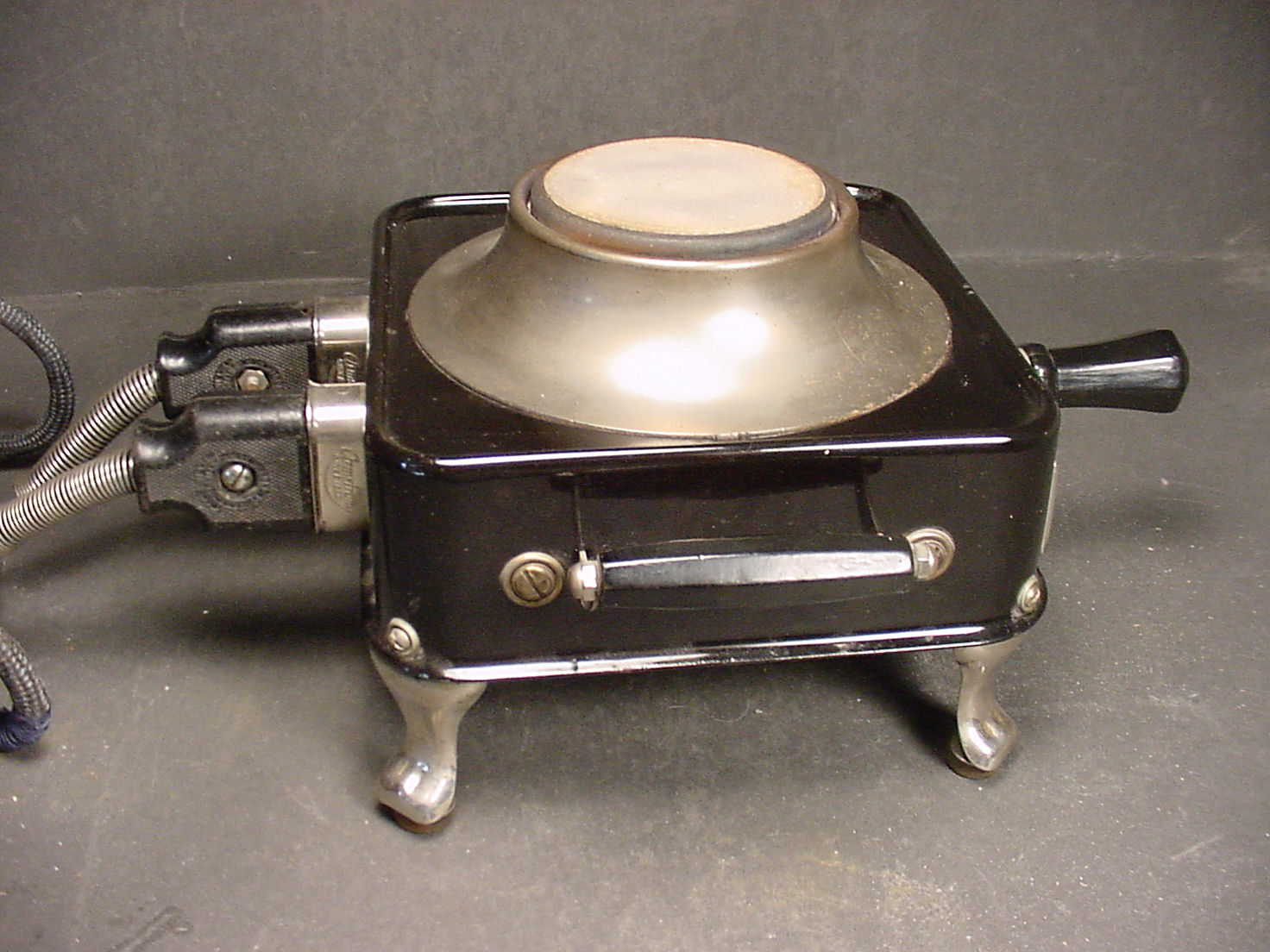
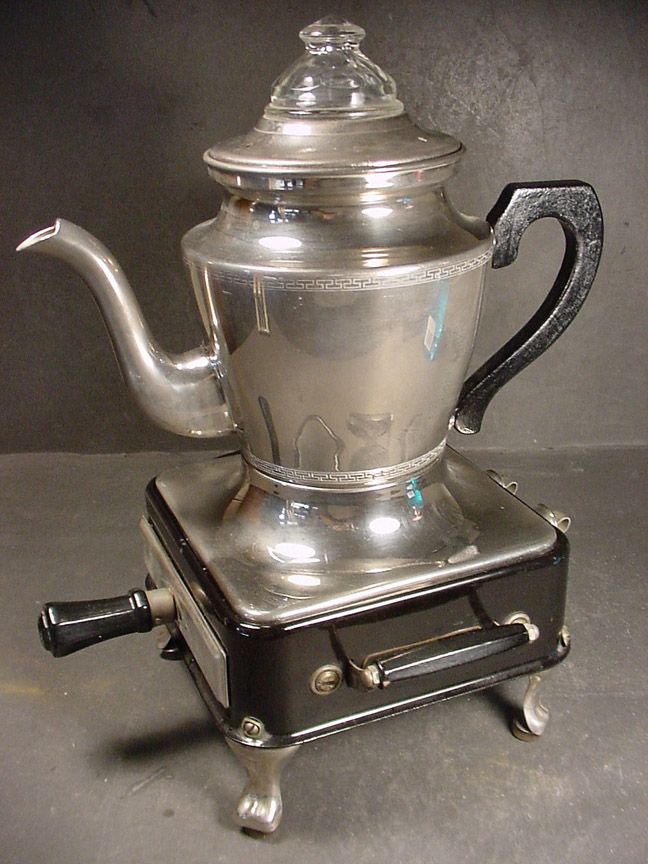
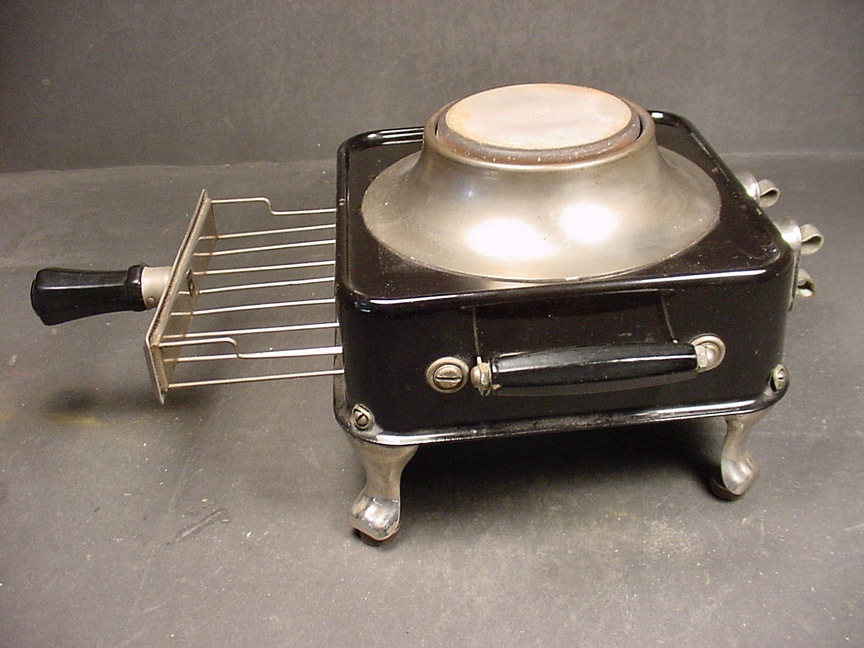
The Armstrong "Perc-O-Toaster"
This is a very interesting "hybrid" appliance that was manufactured during the 1920s by the Armstrong Electric Company of Huntignton, West Virginia. The unusual design has the toast elements in a drawer with heating elements on the top and bottom so that no "turning" is necessary. (It makes one slice at a time.) A separate mound-shaped compnent contains heating coils and fits within the bottom of the percolator. These items are quite rare. They were very well made but were rendered obsolete by newer, cheaper multi-slice toasters. Also, the percolator process does not make the best coffee.
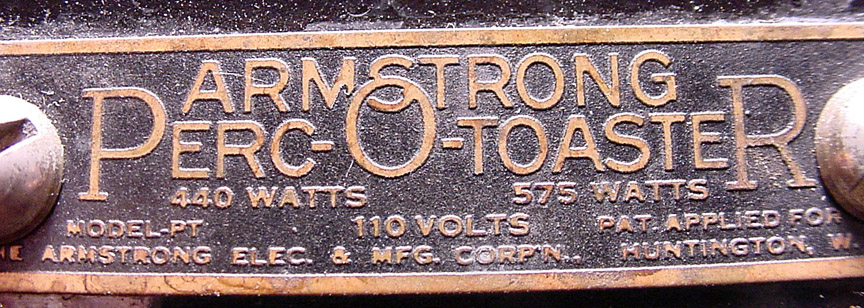
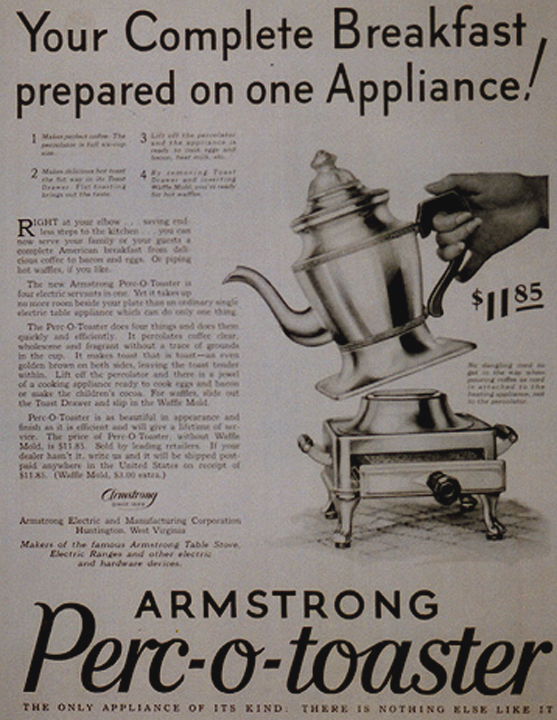
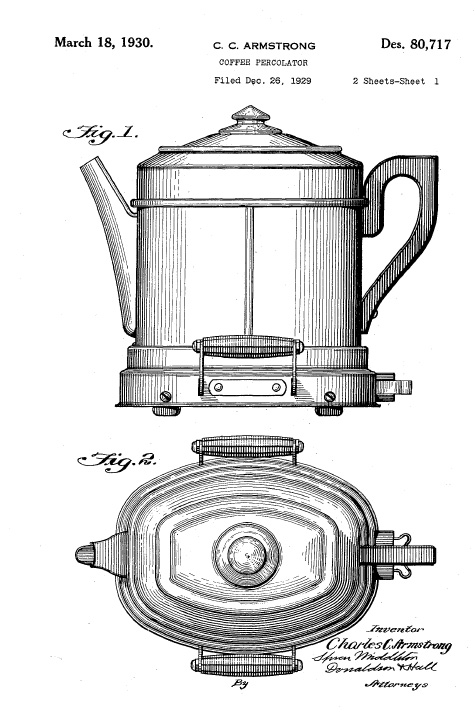
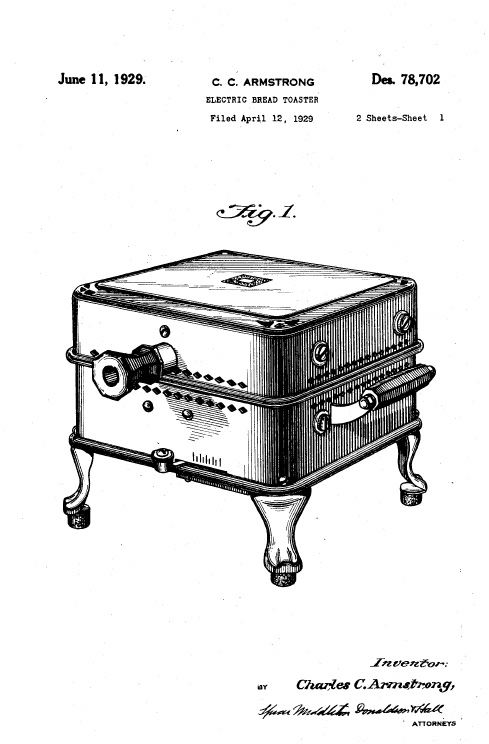
The Armstrong Perc-O-Toaster
Ad in the May 1931 Saturday Evening Post
Percolator Component Design Patent D-80,717
Toaster Component Design Patent D-78702
Click to Enlarge
Click Here to download a complete copy of the Percolator Patent
Click Here to download a complete copy of the Toaster Patent
If you are contemplating buying one of these, you should be very careful to insist on seeing the original cord and plug -- this uses a noonstandard plug arrangement that cannot be duplicated with new or period cords.
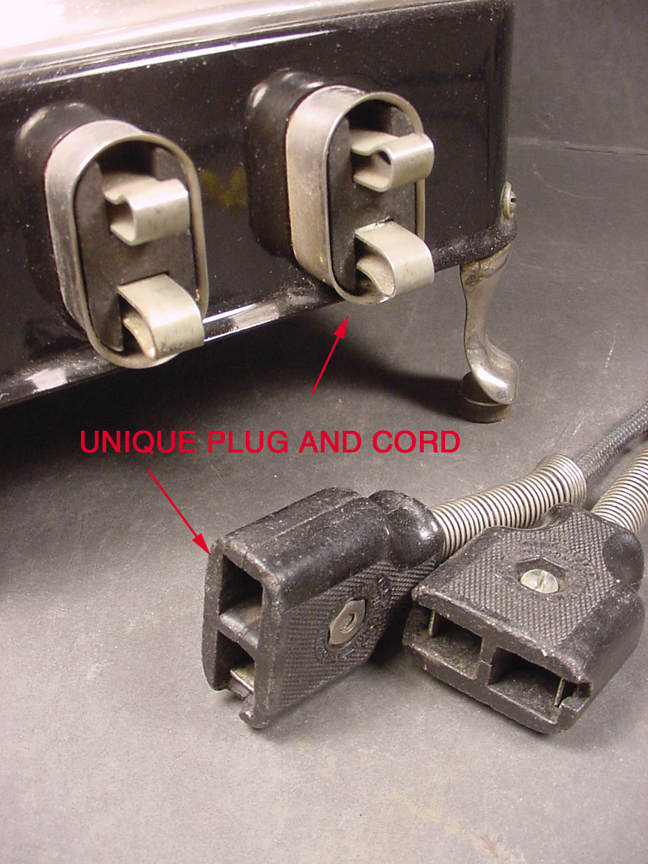
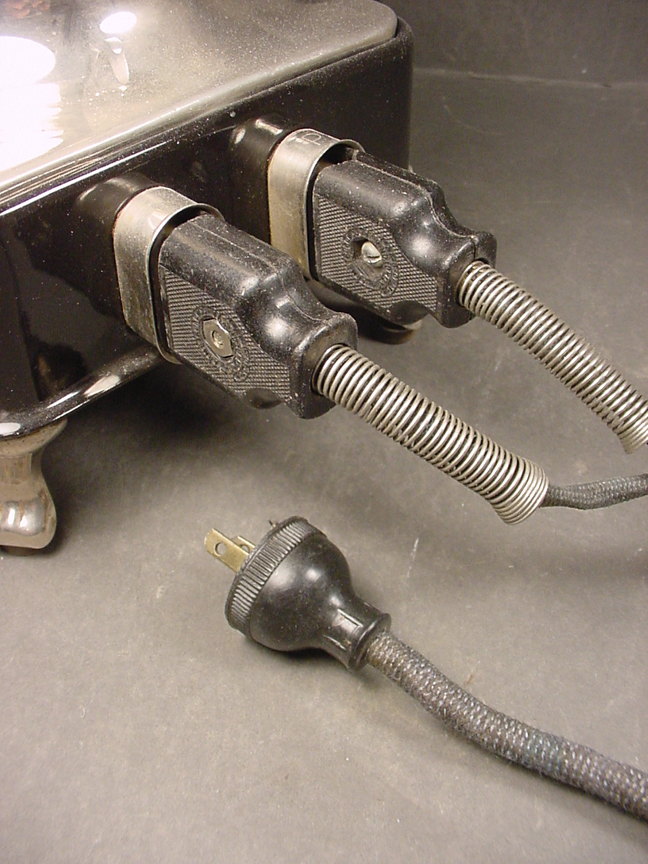
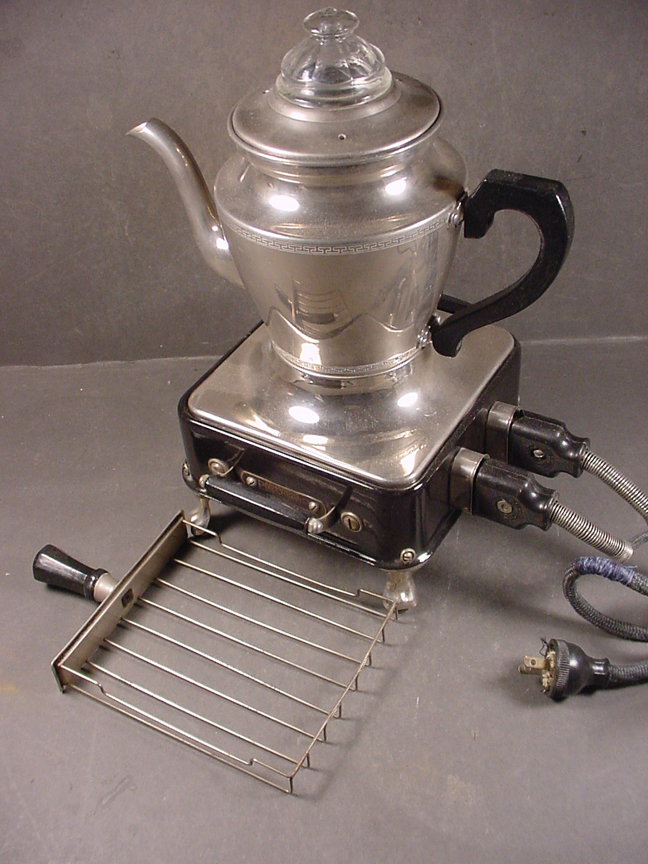
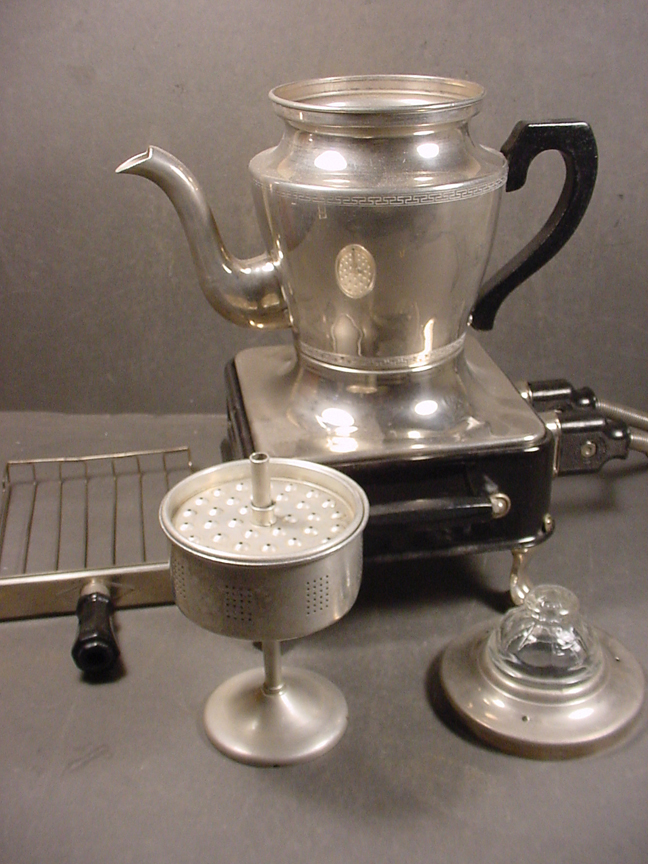
The Unusual Plug Arrangement
If you buy one, make sure that you get this!
Click to Enlarge
Click here to look at another type of collectible, or keep on scrolling for more Coffee devices.
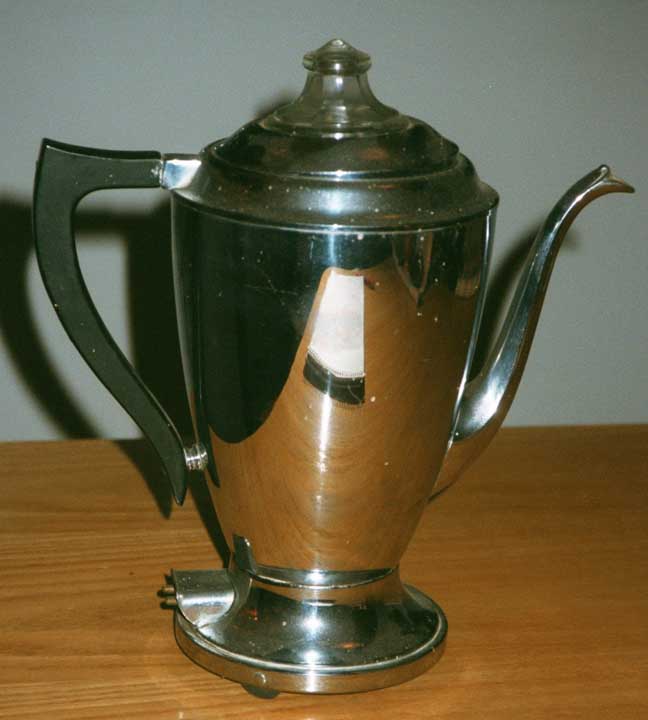
Royal Rochester Percolator
PERCOLATOR Method -- Automatic
Click to Enlarge
As percolators go, this is more-or-less the classic. It is designed to look like a seventeenth century Georgian silver coffee server. It is made of stainless steel. One of the commercial advantages of the percolator system is that they could be camouflaged to look like elegant silver pieces. The brewer is also the server. All of the other systems impose very specific design requirements and are somewhat inconvenient in that they have to be dis-assembled prior to serving. The percolator is "all in one piece" and enjoyed considerable popularity due to this simplicity.
Here is the Manufacturer's information:
Royal Rochester
110-120V 410 W
Robeson Rochester Corporation
Rochester, New York

The Pyrex Flameware Glass Percolator
PERCOLATOR Method -- Manual
Click to Enlarge
We'd like to thank our reader Candy Eve from Newbury Park, CA for compiling these directions on how to use the PYREX FLAMEWARE COFFEE PERCOLATOR
INSTRUCTIONS FOR BREWING AND CLEANING
These are written for the 9 Cup Model 7759 model; (They would be the same for the 6 or 4 cup models, just use less water and less coffee!)
The key, is be patient, be gentle and try to use this pot at least twice!!! There is a learning curve!
Our thanks to Candy -- here is an ad for the Pyrex Percolator that shows some of the various sizes available. You can still buy these percolators.
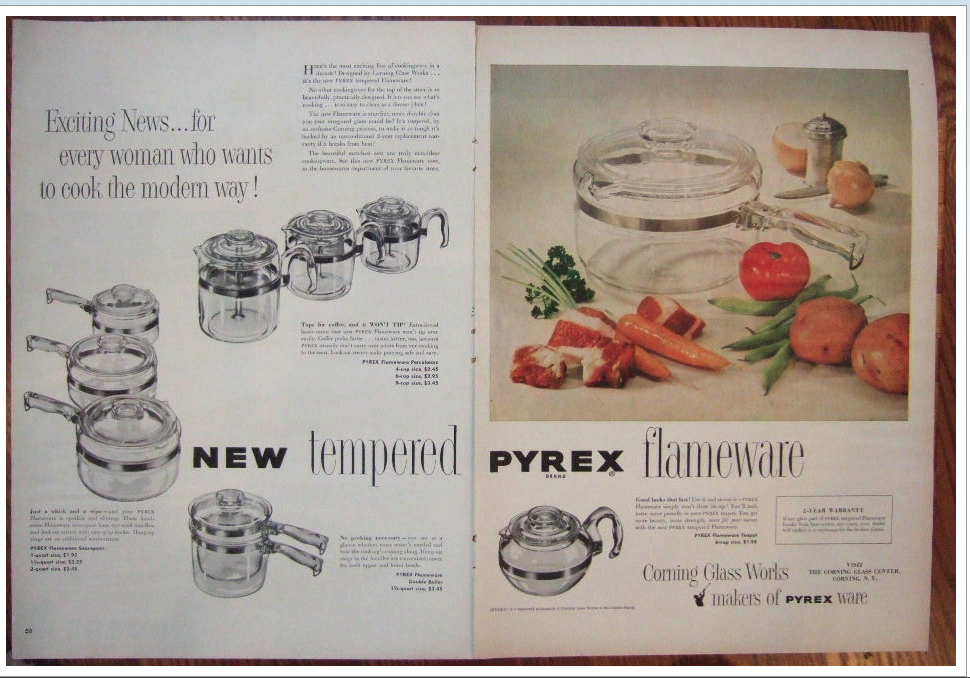
The Pyrex Flameware Glass Percolator
PERCOLATOR Method -- Manual
Click to Enlarge
Click here to look at another type of collectible, or keep on scrolling for more Coffee devices.
Farberware Coffee Robot
VACUUM Method
Automatic
Here is the bottom half of a Farberware Vacuum Coffee Robot, this time disguised as Dutch colonial silverware. I do not own the top half. When I got this, someone had stuck a percolator basket in it. They were probably fed up withthe difficulty of using the vacuum system and tried to do something else with it.
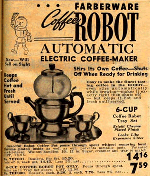
Original Ad for the Complete Robot
I only have the bottom...sigh..
Here is the Manufacturer's information:
S. W. Farber Company
Brooklyn, New York
Model 610
Here is a very lovely Farber Coffee Robot Model 511 with an accompanying Tray, Sugar and Creamer. The exterior was designed by Simon Farber of Brooklyn, New York. However, he relied heavily on both Ms. Pierce and John E. Smith (of Belleville, Illinois) for the "automatic" shut-off feature.
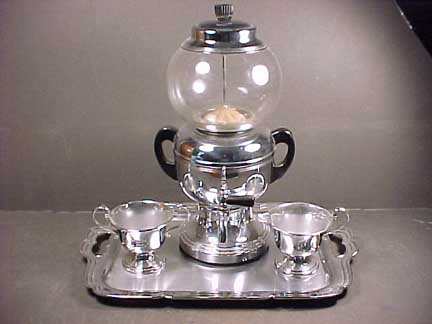
"Acme Ron" Owns this Mint Farber Model 511 Tray set
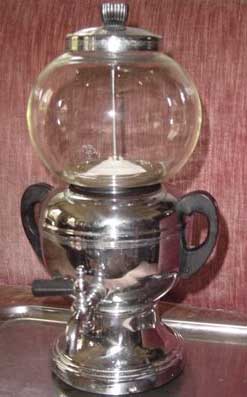
Our reader "Prudence" sent a photo of her Model 511
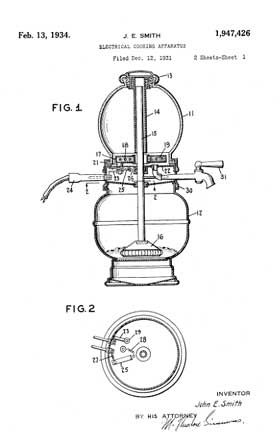
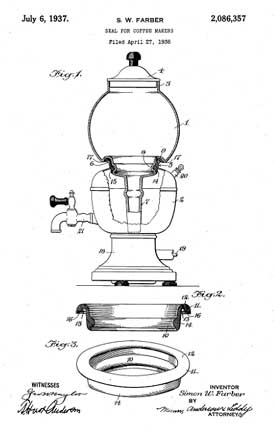
Smith and Farber's Mechanical Designs for the Coffee Robot
Click here if you want to learn how to get free Patent Drawings
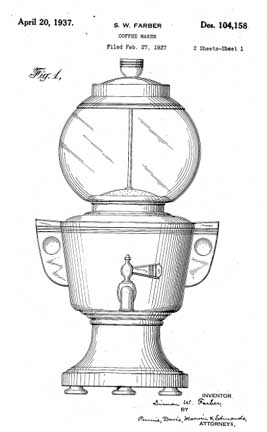
Simon Farber's Artistic design for the Coffee Robot
Click here if you want to learn how to get free Patent Drawings
We are indebted to "Acme Ron" for sending us this wonderful photo of a brand new "never-been-used" Farber Coffee Robot. Here is the original shipping tag!
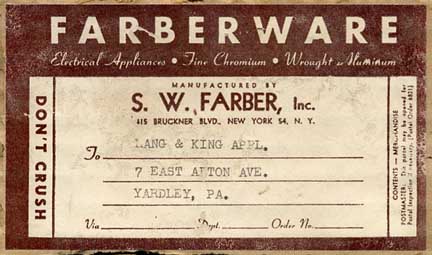
Original Shipping Label for the Coffee Robot
Click here to look at another type of collectible, or keep on scrolling for more Coffee devices.
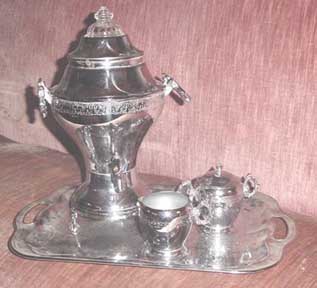
LaBelle Coffee Set
PERCOLATOR Method
Automatic
This is a very lovely "LaBelle" coffee service. The photos were sent by our reader "Pru." This would have been a wedding or anniversary present. Unfortunately, it is a percolator and it does not make very good coffee.
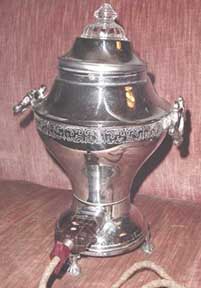
Electrical connections for the Percolator
I don't know anything about this mark other than the fact that it was made in Brooklyn.
Click here to look at another type of collectible, or keep on scrolling for more Coffee devices.

The Konditori Valand
in Stockholm
Click to Enlarge
This may be one of the very best and most authentic post-modern interiors in the world. Welcome to the the Konditori Valand (Translated somewhat loosely as the "Valand Pastry and Coffee Shop"). Our acquaintance with this wonderful place began with an e-mail from Niklas in Stockholm:
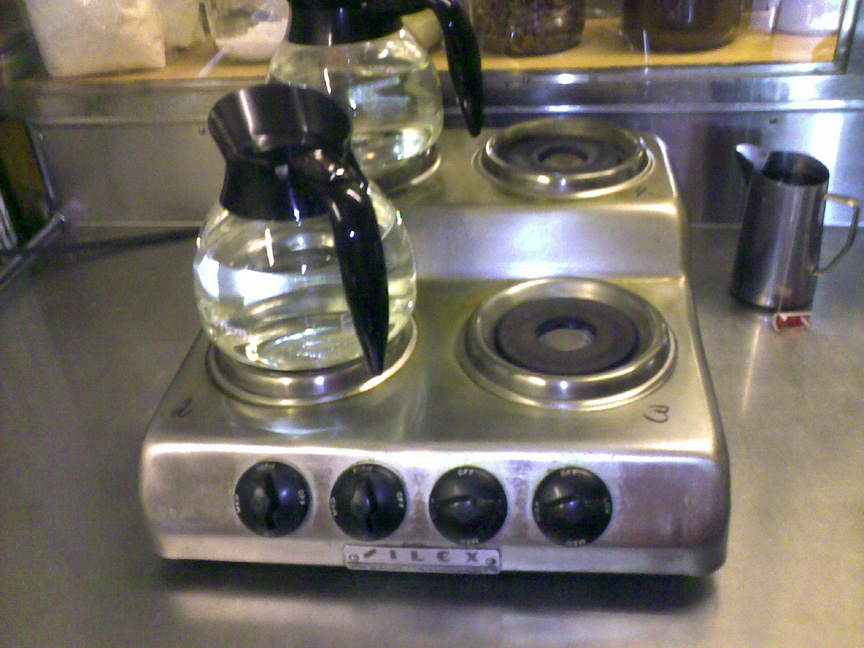
The Silex Heater
Can You Help?
Click to Enlarge
"... I am looking for spare parts for the cooker [warmer] of a Silex vacuum coffee maker. I have attached a picture of the stove part my the Silex Vacuum cooker. What I am looking for is spare parts to the cooker. Apparently there are parts that break in the cooker [warmer] itself, making the individual cooking [heating] sections to not work partially/completely. Do you have any idea where I can look for spares? ... As some history why I need this is that my parents, 79 and 88 years old own this coffee shop in Stockholm that my father designed in 1954. The place is totally unchanged since then, including the coffee maker machine - making the best coffee you can imagine. My parents have bought all spares they can know about in Stockholm/Sweden and feel forced to get a modern machine. I personally think that this would be a really bad idea..... "
Alas, we just do domestic appliances -- if you collect or deal in commercial coffee makers, please Contact Me and I will forward the information to Niklas, because it is VERY important to preserve the integrity of this marvelous place:

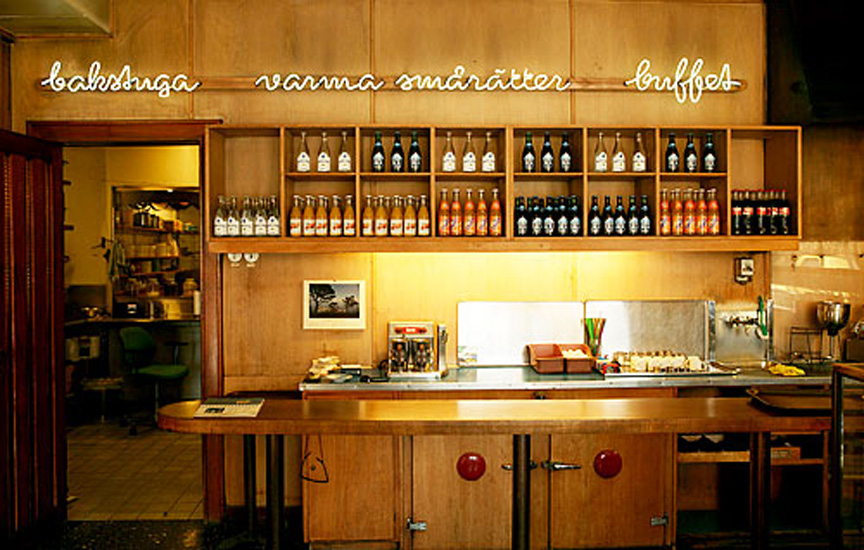
More views of the Konditori Valand in Stockholm
Looks just fantastic!
Click to Enlarge
Here are other websites that have articles about the Konditori Valand:
- Classic Cafes (UK Based Website)
- Individual's Post on Flickr
- The Mid-Century Modernist
Click here to look at another type of collectible, or keep on scrolling for more Coffee stuff.
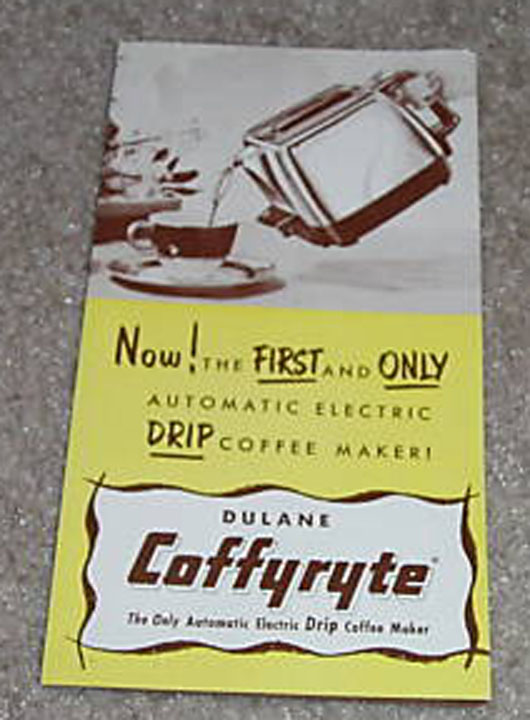
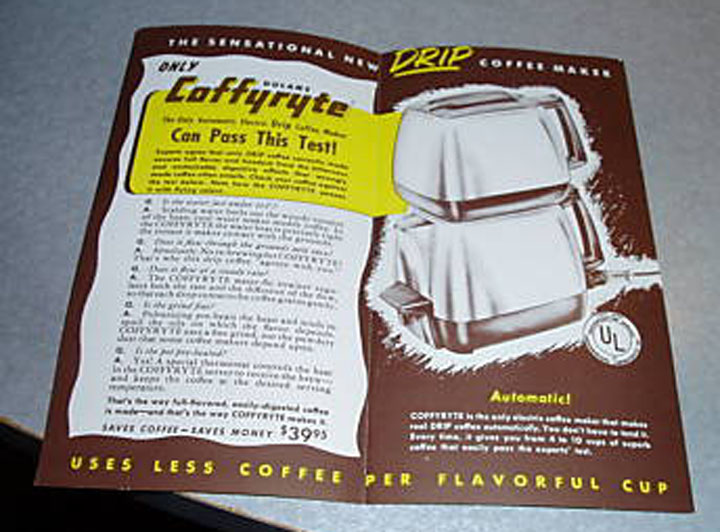
Coffyryte Advertising Flier
Drip Method
Automatic Click to Enlarge
The folks who invented the Fryryte deep fat fryer also invented a marvelous automatic drip coffeemaker -- probably the precursor to the "Mr. Coffee" machines. They called their creation the "Coffyryte" -- it was absolutely gorgeous but it didn't sell, possibly because of its square shape. I have been looking for one for years, but they never seem to come to market. Above are some photos of an advertising flyer for the Coffyryte:
Click here to look at another type of collectible, or keep on scrolling for more Coffee devices.

United Co. Percolator Set
PERCOLATOR Method -- Not Automatic
Click to Enlarge
This is a WONDERFUL Art Deco shape -- the beehive urn with Catalin Bakelite handles, plus the lovely cream and sugar set. This was the quintessential middle class wedding present of the 30s and 40s, so there are a whole lot of them around. This is not automatic --- you have to watch the color of the coffee in the little glass dome to decide when it is done. It makes LOUSY coffee.
Here are some photos of another United Coffee Set, this time with plexiglass handles. These were sent in by "Pru", one of our readers.
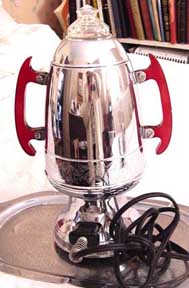
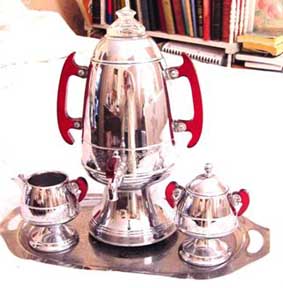
United Co. Percolator Set - Translucent Handles
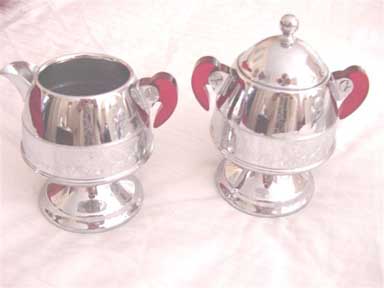
United Co. Percolator Set - Detail of Cream and Sugar
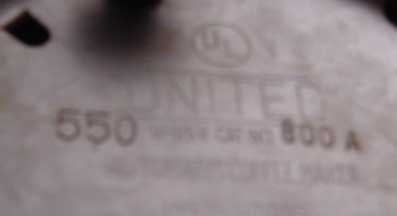
United Co. Percolator Set - Maker's Mark
Click here to look at another type of collectible.
Counter for the Entire Site (not just this page..)
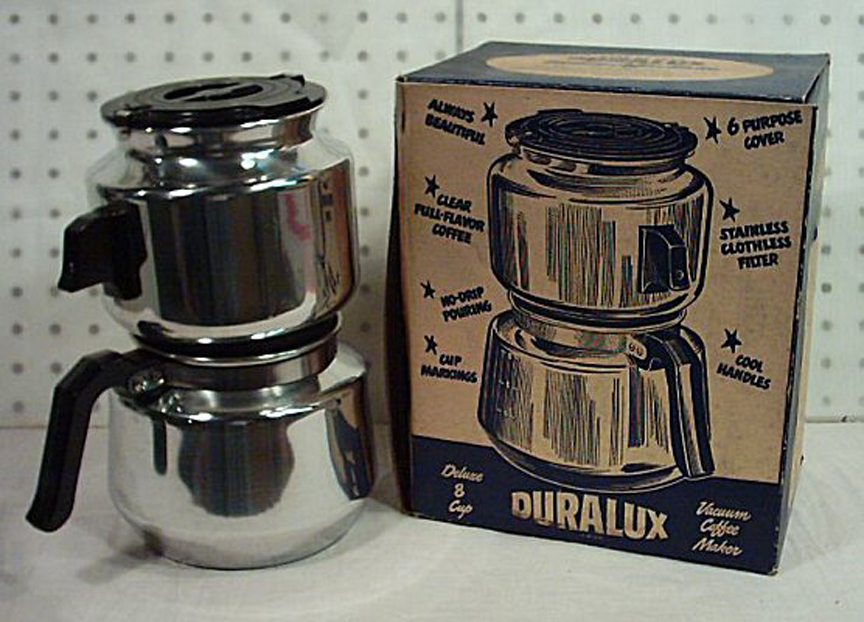
Duralux Coffee maker
Vacuum Method -- Not Automatic
Click to Enlarge
We are indebted to our reader David from the History department at Wooster College for theis analysis of the Duralux Coffee Maker.
"... here is a coffeemaker from the early 1950s called Duralux, made in Wooster, Ohio by the Buckeye Aluminum Company. It incorporated a unique filter), and it was patented by a local inventor and businessman who worked for the company, Mr. Joseph E. Fishelson, who later was president of Akron Brass and Red Head Brass. Attached is the patent and a photo of the coffeemaker. It had a nice design and was basically a stove-top model, though it could be matched with a hot plate/burner (like a Cory or a Silex burner), since it was aluminum. ..."

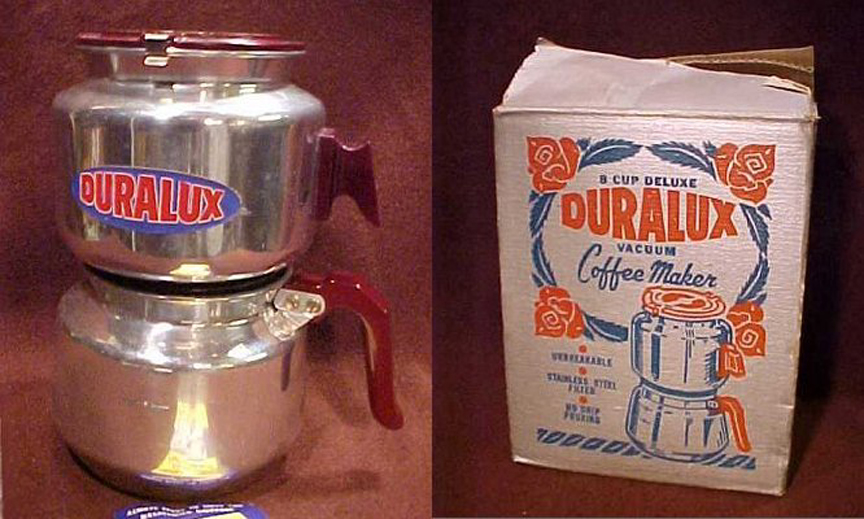
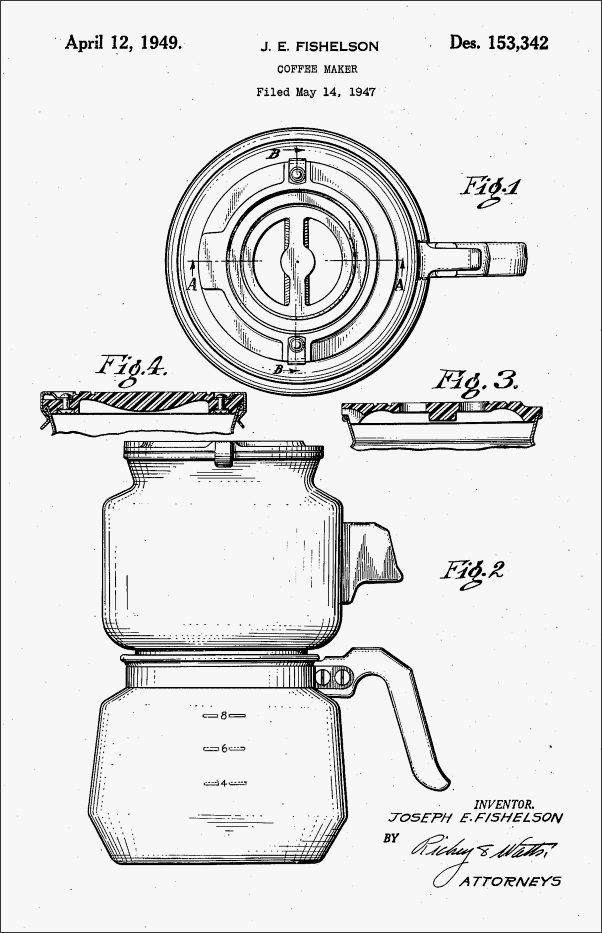
Duralux Coffee maker
Patent Number D-153,342
The DuraLux Coffee Maker appeared in this advertisement for Raleigh Cigarettes. In the 1940s, tobacco companies provided coupons with each pack ( and bonus coupons for cartons). In turn, these coupons could be redeemed for valuable merchandise. In this ad, the DuraLux could be had for smoking 425 packages (approximately 8,500 cigarettes). A one-pack a day habit could get you this beautiful coffemaker in about 14 months... if you didn't die of cancer first...
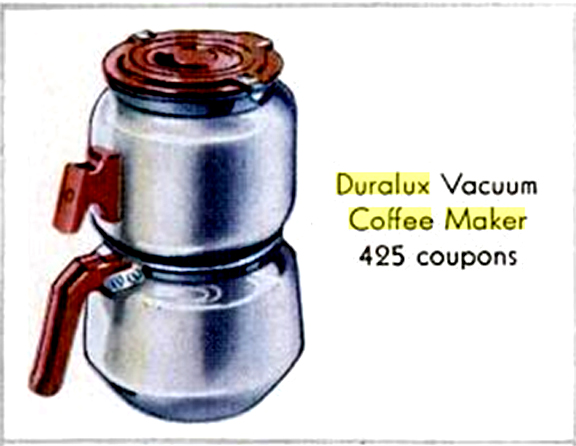
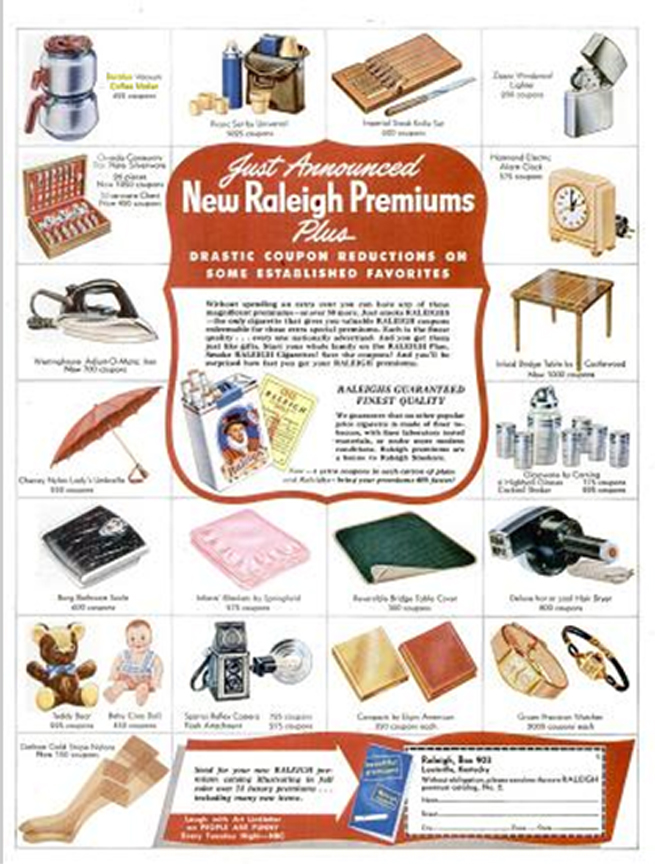
Duralux Coffee maker
From LIFE Magazine, October 31, 1949
Click here to look at another type of collectible.
Counter for the Entire Site (not just this page..)
Join Us on Facebook

Home | About Lindy | Last Week's Reviews | Upcoming Events | 1940s Collectibles
The Guide - Establishments - Travel - Accessories
Music | Links | Photo Gallery | Extras | Contact