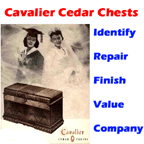
Cavalier Chest Label from the 1940s
Cavalier -- the Cadillac of Cedar Chests
Hi Lindy Hoppers!!!
A great place to store your Fondest Hopes

CAVALIER!!

Our discussion of Cavalier Cedar Chests began in our Furniture Section; however, a very large volume of mail has dictated that we put our coverage of cedar chests onto a separate page.

Frequently Asked Questions

Click here to see some photos that our readers have sent in

Here is what the fuss is all about:

Cavalier Cedar Chest After
Cedar Chest Restored to Service
Cavalier Cedar Chest Before
Cedar Chest in "Found" condition
Cavalier chest veneer repair
The Veneer Repair

Once again, Bulk Trash day proved to be a Bonanza. I was walking through my neighborhood on the way to the market and I spotted this beauty tilted vertically against a garbage can. It was Monday and the city sanitation trucks were due any minute. I immediately RAN home, got my moving dolly and ran back. The truck was one block away. This thing is HEAVY, but I managed to get it on the dolly. With appropriate sweat and frequent rests, I was able to get the thing home, into the workshop and up on sawhorses.

Why all the fuss? Simple --- this is a Cavalier cedar chest, sort of the Cadillac, Ferrarri, Lexus or what have you of this type of item. Plus, this has --- by far -- the very best styling of any waterfall chest that I have ever seen. As you can see from the top photo, the core of the chest is SOLID laminated cedar about two inches thick. This is actually a chest made from cedar, covered with veneer. It is NOT a chest made of plywood with a cedar veneer.

I believe that it had been thrown out because the veneer was completely missing from one end. There were also a number of scratches, but the piece was essentially complete. My guess is that the chest had been moved to a basement and humidity caused the glue to deteriorate and the veneer came loose. This is very common in all types of veneer furniture, especially the 1940s "Waterfall" genre of which I am so fond. This is surprisingly easy to fix!

It also helps that the chest had a shellac finish. In case you don't know, shellac is a product that is derived from the exoskeletons of a kind of beetle native to Southeast Asia. The substance dissolves in alcohol and can be applied like paint. When the alcohol evaporates, all that is left is a clear flexible film. The major problem with shellac is that it turns milky white with excessive humidity --- like when you put a cold drink glass on a table. (these "rings" are actually in the finish..., not a stain) A secondary problem is that shellac scratches VERY easily --- so easily that old 78 rpm records are made out of shellac!

The upside of shellac is that the finish can be "reamalgamated" --- that is, if you wipe the finish with alcohol, the surface will dissolve and fill in scratches. The finish of the cedar chest required a whole lot of "reamalgamation" --- approximately one gallon of denatured alcohol and several rolls of paper towels.

The veneer repair was straightforward. I spent a nice morning at Smoot Lumber in Alexandria (6295 Edsall Road, 703-823-2100) sorting through veneer samples until I found a piece of straight grain mahogny that fit in with the rest of the piece. Veneer is VERY THIN wood, like the thickness of a shirt cardboard. It can be easily worked with a sharp knife. Veneer is attached to the furniture "carcass" with Contact Cement. This type of glue is painted onto both surfaces and allowed to dry; when dry, it will not stick to anything except dry contact cement. When you bring the two surfaces together, it bonds immediately and permanently. Thus, you have to be VERY careful in aligning the two pices before you allow them to touch. The middle photo shows the new veneer in place. A sheet of veneer about two feet on each side costs about $20. If you collect Waterfall furniture, you will always have need for veneer. The edges were roughly trimmed with a sharp knife and then sandpaper was used to get a nice smooth edge.

The raw veneer received a coat of full strength shellac and then several coats of mahogany stain to match the rest of the piece. Lots of buffing and rubbing produced the final result shown in the third photo. I took the combination lock to a Wheaton Safe and Lock and they were able to deduce the combination and clean the lock. The inside cedar surfaces were lightly rubbed with synthetic steel wool to remove oxidation and liberate a wonderful cedar aroma. It is a wonderful addition! Be observant on Bulk Trash day!

We get a lot of mail about Cavalier Cedar Chests! here are the answers to some frequently asked questions:

1. How do I take care of the finish?

You need to make sure that the finish is clean and then apply a high quality funiture oil to feed the veneer. The chest is well made and should last forever, provided that the humidity doesn't get too high. Under moisture conditions, the glue will deteriorate and the veneer will loosen. Formbys makes a good line of cleaning and feeding products. Some of the pictures below show a chest from the 1930s that has, unfortunately, been given a silly taupe-grey fake "antique" finish. Until I questioned the owners and looked at the label, I thought it was from the 1950s when this type of finish was in vogue.

2. How do I restore the "cedar smell"?

Periodically, you should empty the chest and gently rub the cedar lining with sythetic steel wool. This will remove oxidation and allow the fresh cedar oils to come to the surface.

Cavalier Chest Interior
Interior of a 1930s Chest

3. What's the most important thing in using the chest?

Don't slam the lid.

4. What characteristics are unique to Cavalier Chests?

First of all, there is the Cavlier "Brand" -- this usally takes the form of a brass figure of a Cavalier in the court of Charles IX --- although later versions had the mark woodburned into the cedar.

Chest open

The Cavlier "Brand" - Metal 20s, 30s, 40s

Chest open

The Cavlier "Brand" Woodburned - 50s

In mint condition, there is a paper label inside the lid; the central design has an oval inset with a man dressed as a Cavalier. The label lists sveral reasons why you get the best when you buy the Cavalier Cedar Chest. Here is one of various labels from the 1930s, so identified by the typography as well as the hair and dress styles of the lady that is pictured.

Very Early Cavalier Chest Label
1920s Label

1930s Cavalier Chest  Label
1930s Label

1940s Cavalier Chest  Label
1940s Label

There was also a "Presentation Plaque" available. It slid into a little holder in the chest. It usually memorialized the gift of the Hope Chest to a daughter from Loving Parents. Add 10% to the value if you have the label and a suitably sentimental plaque.

Cavalier Chest Presentation Plaque Holder
Presentation Plaque Holder

Cavalier Chest Presentation Plaque Application
Application Form for the Presentation Plaque

5. What was it used for?

Basically, the chest provides a place to store fabric articles so that moths won't get at them. However, the marriage-related themes on the paper labels indicate that most of these were used as a "Hope Chest." Typically, this would be a gift from parents to a young lady on or about her 14th birthday (or so). The young lady then began a quaint ritual of assembling items for her dream home and storing them in this chest. This would include works of knitting, embroidery and/or crochet, to be augmented by occasional silver place settings given on birthdays and holidays. When young ladies of the period gathered, items from the hope chest would be retrieved one-by-one and set the stage for grave and serious discussion of the idyllic home life to come. These dreams were embodied in the following advertisement placed in LIFE Magazine.

Cavalier Ad
Ad For Cavalier Hope Chests
LIFE Magazine, November 24, 1947 p. 87

Cavalier Ads are Very Rare -- the Chests Sold by Word of Mouth

I do not believe that young ladies do much of this any more. This practice created an unusual situation for historians and other people who must reconstruct every day life in the past -- most "typical" homes contained objects that reflected an eclectic taste over the 4-10 year period that young women may have been assembling their "Hope Chest." There were lots of other people manufacturing "Hope Chests" -- here are some of their ads. Note that they, too rely on Graduation and Weddings as a theme.

West Branch Hope Chest Ad - 1941  West Branch Hope Chest Ad - 1941  Caswell-Runyan Hope Chest Ad - 1941
Ad For Cavalier's Competitors from June, 1941
Wedding and Graduation are the Themes

This was serious business in the 1930s through the 1950s. Women only got to choose a few things in those days. Even though the choices might be towels, doilies and silver patterns, they were made with great care and with significant investment of emotional energy.

Cavalier Ad-1943
Ad For Cavalier Hope Chests from November of 1943
Cavalier Ad-1944
Ad For Cavalier Hope Chests from November of 1944
Cavalier Always Used Sentiment and Memories in its Advertising

6. What is it worth?

Our lawyer reminds us that the monetary value of any object can only be determined in a fair auction with willing and knowledgeable buyers. We neither buy nor sell Cavalier chests and the information on this page is our best opinion given the facts. It is impossible to give a specific appraisal of any object without actually touching it. We do not give appraisals and do not represent ourselves as being qualified to do so.

I have seen Waterfall Cavalier chests from the 1930s in good to excellent condition go for $500. Chests from the 1950s are worth a bit less. Here is an unusual 1930s chest with some minor damage in a not-so-attractive and definitely not authentic grey tone stain that was popular as "driftwood" in the 1950s. I questioned the owner and found out the original finish is very dark indicating that it may be a VERY Early Cavalier. (Be warned, however, that Cavalier offered a "Limed Oak" finish which has a grey appearance (like Driftwood) -- so don't rush to refinish your grey Cavalier chests.) If this was truly NOT the original "limed oak" , a nice refinish and repair job wpould greatly enhance the value of this particular chest. I wish that something was left of the records of the Cavalier Co. so that I could accurately assign a date to this piece and to help you separate refinished pieces from actual Limed Oak piceces.

1930s Cavalier Chest
Possible 1930s Chest

In the early 1930s, furniture makers were very reluctant to move into the new Style Moderne or "Waterfall" genre, which was associated with cities, immigrants, and avant garde thinking. Much of the "Colonial" furniture in vogue at the time was Jacobean in origin; this style is more traditional, deriving from early New England pieces. No doubt that some of the Pilgrims packed their belongings in Jacobean chests that may have been cheap in Plymouth, being about 50 years old in 1620. In Colonial restorations like Sturbridge Village, they will note that the original chests didn't have legs and that when colonists prospered they added the legs so that you could dust under them. Sometimes, you can see applied decorations on the side that cover the holes where rope handles were attached to heft the things into the ships.

Many individuals who craved social mobility (and, possibly to hide an immigrant heritage) sought to furnish their homes in things that looked like they may have come over on the Mayflower... Of all things, here is a maple Cavalier chest that actually has a carving of The Mayflower on it! This is the very "un-subtle" approach to creating an "heritage"...

Mayflower Chest - full
Mayflower Chest - inset
The "Mayflower" Chest

Here is a fairly early Cavalier Chest in the Jacobean style that is in marvelous condition. Carol, a reader from Virginia writes:


" ...My 92 year old mother-in-law married in 1933 and this was her hope chest. I don't know what year she received it. She lived in NJ at the time.. I personally thought it was too ornate for my tastes, but I love that it has been with her most of her life and hope to keep it in our home as it is a sturdy piece ..."

Jacobean Chest - full   Jacobean Chest - front
Jacobean Chest - medallion   Jacobean Chest - leg
Carol's Jacobean Chest

In the 1920s, the social elite was proud of their colonial ancestors and antique furniture. All of this association with Colonial America was very reassuring to people in the prosperous times of the 1920s because it signalled that they were advancing in the social hierarchy. The elite collected Old Masters. If you couldn't get into the elite due to race, religion or ethnicity, history had no use. Those folks had to depend on the Future and hence, Modern Art, Modern Furniture, etc. Mies Van der Rohe who was associated with the Communist-inspired Bauhaus in Germany, said "Less is More." Gertrude Stein and Solomon Guggenheim collected the works of the Cubists while Hollywood embraced radical architects like Richard Neutra, all of whom were embracing "simplicity".

Of course, it turned out that "modern" furniture could be made "cheaper" and was "less expensive to maintain" so corporate America also developed an interest in modernism. By the 1960s, the only people who could afford Mies' "Barcelona Chair" were corporate titans like IBM (the original having been designed as an example of the Workers' Paradise in 1923!).

The trend in value (as opposed to history) is definitely for the Waterfall chests. Personally, I think that Jacobean is clumsy, but then I do a website devoted to style moderne furniture. However, historically speaking, this is a significant piece and is probably of much better quality than its waterfall cousins. If you have such an item, fix it up, keep it and wait for trends to change. It is a marvelous cedar chest of quality that you really can't buy today. Maybe this would bring $50-$75 in this condition.

Our reader Arthur sent us this picture of his Aunt Evey's Hope Chest which she got for her 16th birthday; it is also in the Jacobean style.

Cavalier Chest Presentation Plaque Application
Aunt Evey's Cavalier Chest

Our reader Frank sent us this picture of a VERY well-preserved Cavalier Chest in the Queen Anne style. The characteristic "Cabriolet Legs" (they look like they have knees..) and the Shell motif in the center are the hallmarks of this style.

Queen Anne Cavalier Chest
Queen Anne Style Cavalier Chest

You can buy a Cavalier chest in excellent condition for somewhere in the neighborhood of $500 (depending on style). Vastly inferior new cedar chests cost even more. If you choose to have your chest restored by a professional, any expenditure over $500 is most likely based on sentiment, not investment value.

7. How can I fix minor scratches in the finish?

Get an old wool sock. Cut off the toe about halfway. Then cut the rest into little strips; get a piece of clean muslin and wrap the strips very tightly in it, until you have a thing about the size of a golf ball. Soak this in alcohol and then add just a bit of shellac. Put the "ball" inside the "toe" of the sock and whack it on a board until the "toe" part is wet. Rub this in a figure-8 motion --- very quickly --- across the surface. The alcohol will dissolve the shellac and the slightly abraisive wool will "reamalgamate" the finish. This is called "French Polishing" --- although classic use of the term involves a whole lot more steps.

Stain to be fixed by amalgamation
A Good Candidate for Amalgamation

8. What kind of veneer damage can be repaired?

Fear not -- the Cavalier Chest is so well built that almost anything can be fixed. In many cases, we can give you some helpful advice, but you'll have to send us a description of what's wrong with the veneer. Some pictures would be VERY helpful!

Here are some common problems with veneer:

  • Bubbles: there is what appears to be a "lump" in the veneer. This is caused by a localized loosening of the glue which allows moisture from humidity to swell the veneer. This is fixed by making a "slit", injecting glue with a hypodermic-like tool and clamping
  • Deep scratches: often, deep scratches can be completely removed by the "amalgamating" technique described above
  • Fringe: if the chest has been stored in a humid basement, the veneer may start to deteriorate on the lower edges --- the veneer comes to resemble "fringe" A small patch can be grafted on
  • Holes, dents, cigarette burns: it is also possible to patch small defects. Professionals use a punch of irregular shape (it looks like an amoeba); the patch is placed on the defect, aligned to match the grain, and then both are hit with the punch, simultaneously cutting the existing veneer and the patch. The patch is glued into its matching hole
  • Large areas: existing veneer is stripped off, the substrate is sanded smooth and new veneer is applied with contact cement. This is illustrated above AND in our step-by step restoration of the RadioBar
  • Substrate problems: the substrate is the layer below the veneer. This type of repair can be a LOT more complicated than veneer because you are dealing with the actual load-bearing structure of the piece. We faced some problems of this sort in restoring the RadioBar.

Here are some examples to the kind of defects that can be repaired by the average homeowner:

Cavalier Chest Presentation Plaque Holder
Fringing

Cavalier Chest Presentation Plaque Application
Patching

After your veneer has been patched, you have to match the original color and finish. These techniques are illustrated in the RadioBar article.

Here is an ad from 1949 -- it appeared in the Saturday Evening Post, November 12, 1949. From what I can see, the Cavalier Corporation advertised once a year generally at the beginning of the Christmas shopping season. All the ads I have are from early November.

1949 Cavalier Chest Ad
Focus on Eventual Marriage
An Unusual Veneer Treatment on the Chest


9. My chest is painted -- did Cavalier make painted cedar chests?

As far as I know, Cavalier chests were by definition veneered. That is, the attraction is the solid Tennessee red cedar core. The thin veneer layer was intended to fit the piece into various furniture decorating styles. I know of NO Cavalier pieces that were sold with a painted finish.

In order to get the paint off, avoid strippers at all cost. Let's look at the layers:

  1. Red Cedar Core
  2. Glue
  3. Veneer
  4. Shellac (2-3 coats)
  5. Paint

The paint is sticking to the shellac, not the veneer. So, the idea is to dislodge the shellac from the veneer, taking the top layer of paint along with it. Shellac dissolves in alcohol but alcohol won't dissolve the glue that holds the veneer. So, to get the paint, target the shellac.

If you are VERY patient, buy two gallons of denatured alcohol and a LOT of paper towels. Find a place on the paint that isn't very visible -- say, at the bottom -- and VERY carefully scrape away the paint with a razor blade, (like "shaving" it..) until you get a patch about 1/2 inch square. Then apply denatured alcohol as applied to a "pad" made of folded paper towel. This will dissolve the shellac in the immediate area of the little patch. You can use a plastic scraper to push back the paint that will crinkle up. Repeat lots of times and you'll have a clean piece (THIS IS A LOT OF WORK AND TAKES A LOT OF TIME). You will have to apply a tone stain to correct the veneer color, but the method will reveal any veneer effects, like bookmatching and contrasting colors. You may also find that you have some veneer repairs to do.

With patience, you will have a very nice Cavalier chest.

10. What can you tell us about the company that made Cavalier Chests?

Chattanooga

The company was founded in 1865 in Chattanooga, Tennessee and was ideally located due to the proximity of high quality hardwoods, skilled labor and rail connections and the very special Tennessee Red Cedar. The original name was The Tennessee Furniture Company, but the trademark Cavalier was first used in 1923; the trade mark application was made in 1924.

Cavalier Trade Mark
Trademark Registration for the name "Cavalier"
No Cavalier Chests before 1923
From the US Patent and Trademark Website


The Company also made refrigerators (actually wooden iceboxes) and coolers. The name Cavalier seems to have been restricted to Cedar Chests and Iceboxes. Here is an example of one of their famous personal beverage coolers. The outside was made of metal, there was a wood frame and the inside was lined with galvanized metal.

Cavalier Coke Cooler
General Appearance of a Cavalier Beverage Cooler

Cavalier Coke Cooler, Manufacturer's mark
Manufacturer's Mark on the Cavalier Beverage Cooler

This Cooler is probably from the 1940s

11. Did this company make Coke machines?

During the Depression (1935), the company started a second line of business making soft drink vending machines. Not only did they make wonderful cedar chests, they also made all the classic Coca Cola vending machines that are so eminently collectible today.

Here is an example of one of their famous Coca Cola Machines.

Cavalier Coke Machine--front
Cavalier Coke Machine -- front view

Cavalier Coke Machine--end
Cavalier Coke Machine -- end view

Cavalier Coke Machine, Manufacturer's mark
Manufacturer's Mark on the Cavalier Coke Machine

This Cooler is probably from the late 1940s

1948 Cavalier Chest Ad
Hopes and Dreams were the Cornerstone of the Cavalier Company
This one is a masterpiece of veneer!
Ad from LIFE Magazine, November 10, 1948


Cavalier promotional Plate
Graduation Time was a Good Occasion to Give Cavalier
This plate was given away by a dealer
The back says "Congratulations! from your Cavalier Cedar Chest and Bedroom Furniture Dealer"
The Plate is Manufactured by Homer Laughlin


In the 1960s, they were taken over by the Seeburg Corporation, a manufacturer of jukeboxes. Seeburg, in turn was the subject of a number of takeovers, court actions, lootings, and bankruptcies. In the 1990s, Cavalier was spun off as an independent employee-owned company. They went completely out of business in 2001.

Cavalier Ad
Ad For Cavalier Hope Chests from November of 1951
Note that there is a marked decline in the quality of this adverisement when it is compared to the others, above.

There is some sociological meaning in all of this: The Cavalier Cedar Chest is a mirror of American business history. We used to manufacture wonderful things that lasted forever. Now all we produce are lawsuits and corrupt corporate officials; the manufacturing is left to far-away dictatorships.

Here are some photos of the labels from a very early Cavalier Chest

Cavalier Chest


Cavalier Chest


Cavalier Chest


12. What does the "serial number" mean?

Nobody knows for sure what the cryptic numbers on the bottom of the chest actually mean. The factory closed nearly 50 years ago and there were a lot of corporate takeovers that resulted in mass destruction of records. From my correspondence and about 8 years of collecting pictures from my readers, this is my "guess":

Serial numbers were generally of this general form:

ddd - aaayyxx
  • "ddd" refers to a "style"
  • aaa (3 letters) refers to the finish
  • yy is year
  • xx nobody knows -- could be day of the year (Jan 1 = 1, Dec 31 = 365), but it could be "week"
There just isn't enough data to completely decode these things. BUT, if we had a serial number that looked like:

Chest open

125 - WAL3235

That said, the particular chest is most lokely "Style 125", Walnut finish, made in 1932, either March 5 or (more likely)sometime in early October April (35th week)

THERE ARE APPARENTLY EXCEPTIONS!

Here are photos of two more Cavalier Chests, sent in by our friend, JoAnn. She writes:

"... These two Cavalier Chests were given to me back in the early 50's. One of the chests still has the key and it works. Underneath the chest it says: 48 WAL TENN. I assume the 48 means 1948. The other one has written on it: Chest pattern no. 711, and Serial no. 3994. ..."

Cavalier Chest
Traditional Style

Cavalier Chest
Deco Style

Here is another form of Serial number, this time for a mahogany ("MAH") chest:

Chest open

The Model and finish code are stenciled on the bottom

Here is another Cavalier Chest -- this one with serial number "2747384", sent to us by reader John, who professses to be a "New Age Redneck."

Chest open

Chest open

And, here is yet another type of serial number, this one sent in by Chris. His chest had an electric clock built into the lid, so maybe "Type 6" refers to the presence of the clock:

Chris' serial number

Another Variant of the Serial NUmber

With all those corporate reorganizations, it is very likely that the company might have switched its method for assigning serial numbers --- several times.

Here are photos of a 1940s chest sent to us by our friend Katie in Kokomo (seriously...)

Indiana Large letter postcard

She writes:

"I was just given this beautiful Cavalier Cedar Chest. All I know is that it was given to a lady when she was little. I have no idea if it was passed on to her from someone, or any idea of how old it is. It has all the original paper on the inside and the shelf as you can see in the picture. "

Cavalier Hope Chest
1940s Hope Chest, Closed

Cavalier Hope Chest
1940s Hope Chest, Open

Here are photos of a 1940s chest sent to us by our friend Deb, in Illinois

Illinois Large letter postcard

She writes:

"My Aunt passed away on Feb. 1st at 84 years of age. While cleaning out her house, I found this chest. It was complete with all of her gathered utensils, tablecloths, towels, sheets, bowls, cups, etc. Under all of these treasures, hidden in a brown paper bag, were love letters written to and from a man that once had propsed to her."

Deb's Cavalier Hope Chest
1940s Hope Chest, Closed

Deb's Cavalier Hope Chest
1940s Hope Chest, Open

Deb's Cavalier Hope Chest
1940s Chest Interior
There is no presentation plaque...but the order form is still inserted in the label.


Deb's Cavalier Hope Chest
1940s Label
The Presentation Plaque Booklet is that dark red area to the left of the happy couple!


The Presentation Plaque
Deb's Cavalier Hope Chest
Closeup of The Presentation Plaque Booklet

Deb's Cavalier Hope Chest

Deb's Cavalier Hope Chest

Deb's Cavalier Hope Chest

Deb's Cavalier Hope Chest

Deb's Cavalier Hope Chest

Deb's Cavalier Hope Chest

Deb's Cavalier Hope Chest

here is a photo of a great Cavalier Cedar Chest sent to us by our friend LeAnn. She writes:

This chest was bought at an auction for $125.00 had it in my antique shop for 10 months before we discovered it had hide away spots.(thank goodness it didn't sell it's now my daughters hope chest) It's in super condition. Reads: Cavalier Cedar Chest with keepsafe dial. Pat. 326 Serial 5-1639

Leann's Cavalier Cedar Chest

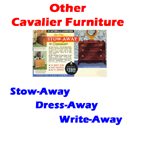
Cavalier Stowaway Chest

Here is something called a "Stowaway Chest" that was sent in by our friend Elaine

She writes:

The first picture is the front of the chest, the second pic is a combination pic; one of both sides (showing the detailed corners of the chest) and the bottom of the chest, and the third picture is of the interior of one of the drawers showing the Cavalier name, emblem, stowaway name, and a portion of the 6 circulation slits which is on each of the 3 drawers. The slits are 5-1/2" long and 1/4" wide. The overall size of the chest is 36" wide, 19-1/2" deep, and 30" tall. As mentioned in my first email, the chest has been painted. There is a number on the back of the chest which is difficult to make out. It could be either a 3 or four digit number.

As to the history of how I got this chest -- my son works for the town of Middleton and a truck from an elderly home brought the chest to the dump. He noticed the condition of the chest and the cedar interior and immediately called me to see if I wanted it. Needless to say my answer was "yes" and upon getting the chest in my home, researching the internet for info on the chest, it brought me to your web site.

Chest Front
Stowaway Chest, Front

Interior
Stowaway Chest, markings on shelf

side and base
Stowaway Chest,Side detail

side and base
Stowaway Chest,Side detail

side and base
Stowaway Chest,Base detail

Here is an ad for the Stowaway Chest -- it was on a postcard. The front and back of the card are shown:

Stowaway Chest Postcard ad Front
Stowaway Chest Postcard Ad, Front

Stowaway Chest Postcard ad back
Stowaway Chest Postcard Ad, back

There was also a Cavalier "Write-Away" chest that doubled as a desk. From the photos, it appears that this is a "stow-Away" chest with a top that slides out to become a desk; this would have been very useful in a small apartment or a dorm room. This was sent in by our reader Melanie. She'd like to know more about it. If there are any of you out there who have special knowledge about the "Write-Away", please send it on in!

Cavalier Write-Away Chest
Write-Away Chest, Front

Cavalier Write-Away Chest
Write-Away Chest, desk

Cavalier Write-Away Chest
Write-Away Chest, drawer

Cavalier Write-Away Chest
Write-Away Chest, trademark

Here is another Write-Away chest that is owned by our reader John who lives in Cahttanooga -- he says "... The lady that gave this desk to me has lived here all her life and probably bought it back in the the 40s or 50s. ...". We note that this one looks a lot like the Stow-Away with the addition of the writing desk. John thinks that the chest may have been painted and then stripped.

Cavalier Write-Away Chest
John's Write-Away Chest, Front

Cavalier Write-Away Chest
John's Write-Away Chest, Side

Cavalier Write-Away Chest
John's Write-Away Chest, drawer

Cavalier Write-Away Chest
John's Write-Away Chest, Trademark

Cavalier Write-Away Chest
John's Write-Away Chest, Serial Number

And, of all things, there was also a "Dress-Away" chest that had a fold-out mirror! [I hope they did not make Bathroom furniture...] We'd like to thank Bill and Laura for sending these photos in.

Cavalier Dress-Away Chest  Cavalier Dress-Away Chest

Cavalier Dress-Away Chest  Cavalier Dress-Away Chest

The Cavalier "Dress-Away Chest"

Photos From Our Readers

Here are some photos of a more traditional Chest -- there is no veneer over the Cedar.

Chest open
"Raw" Chest, Open

Interior
"Raw" Chest, Closed

Here are some photos sent in by Jerry from Berkeley California. He writes: "I recently aquired this cedar chest from a relative and I am wondering if you can help date it for me?.....It seems to be solid cedar with a dark walnut stain on the outside. It has a small metal tag on the inside of the top that says 'Cavalier' and has an image of a cavalier on it. I am sending 5 photos that will show you what it looks like. It is not in the waterfall style. To me it looks older. One of the photos is of the bottom showing a number and 'WAL' which I assume indicates the walnut stain.."

Chest open

Chest open

Chest open

Jerry's Cavalier Chest

Here are sme photos sent in by Bob. He writes: "My friend bought at a garage sale this Cavalier Cedar Chest for 10 dollars! I'm doing her the favor of trying to restore the finish. It is model# 860 and serial #9674" He's going to have a real nice cedar chest when he gets finished!

Chest open

Chest open

Bob's Cavalier Chest

Our friend Joanna sent in these pictures of a traditional chest from the 1930s. She writes: " I recently bought this cedar chest from an antiques dealer in Towson, Maryland. I noticed the Cavalier metal stamp on the inside of the lid and also the chest came with a cardboard tag naming the maker. The dealer I purchased the chest had restored it beautifully! He also mentioned that he thought the chest was from the 1920s or 1930s."

Chest open

Chest open

Chest open

Chest open

Chest open

Chest open

Joanna's Cavalier Chest

Here are some photos of a chest that is in need of some tender loving care (see above for refinishing techniques.) The owner wrote "This chest belonged to my mother-in-law. We are not certain of its age. It was presented to her as a gift before she was married which was in 1941 or 1942. We do not know is it was new then or not. You will see in the pictures that the top has water damage. The end pieces of the lid are warped and the legs appear to be rotting or coming apart in places. There is a brass strip about 1/2 inch wide around the top inside edge. The tray or drawer that should have been inside is missing. The markings on the underside of the chest are Serial #1492 254-X. The little brass plate of the man is still intact on the lid. "

Chest open

Chest open

Chest open

1950s Cavalier Chest

Here are some photos of a Cavalier Chest from the 1950s.

Chest open

Chest open

Chest open

Chest open

Jennifer's Cavalier Chest

Here are some photos of a very old chest that I believe to be from the period 1924-1928. Our friend Jenifer from Massachusetts wrote: "The bottom has a stenciled mark 42-WAL. I have the chest hidden, since my 2 yr. old's eyes just LIT up when he saw it - he was quickly banished from the area!) "

Chest open

Chest open

Chest open

The Appliques are Quite Unusual

Oldest Label

This is the oldest label that I have seen

Here are some more photos that were sent to me recently.

Chest open

Chest open

Chest open

Chest open

Chest open

Chest open

Here are some photos from a family who found a Model 123 in very poor condition and then gave it a loving restoration. Thanks, guys!

Chest Before

Chest after

Serial Number

Before, After and Manufacturer's ID

Here are some photos of a 1932 Cavalier Chest in the Jacobean mode, sent in by our reader leanne, who writes:

"... I bought this chest from a barn sale for $30 in Lynnfield, Mass. The back legs need to be repaired but I fell in love with it anyway. The one with my son is when he was 2 and 1/2 yrs taken on 7/18/06 just so you can tell the size of it. ..."

32 Cavalier Chest   32 Cavalier Chest

32 Cavalier Chest   32 Cavalier Chest

Leanne's 1932 Cavalier Chest

Cavalier Bedroom Suite

For a while, the Cavalier Company made a whole line of bedroom furniture.

Here is an early set with a four-poster bed! Thanks to our reader Pam, we have the following nice photos:

Four Poster Cavalier Bedset

Four Poster Cavalier Bedset

Four Poster Cavalier Bedset

The Early Cavalier Bed Set

This is a very nice set from the mid 1950s showing the influence of Scandinavian design

Chest open

Chest open

Chest open

Chest open

Chest open

Very nice cedar-lined drawers

Chest open

I really like the little "tuffet" seat for the vanity bench

Chest open

Chest open

The little Cavalier Medalion is inside the drawer

Chest open

This is a detail from the mirror support

Here is a very unusual and highly detailed table made by the Tennessee Furniture Company. It was sent by our reader Kim (from Ohio) who writes,"...I've attached a photo of one of two end stands I recently inherited. The metal Cavalier tag is located in the drawer (pattern no. 5809). What's unique is that the end stands can be used from the front or back - the drawers pull out either way, and there's knobs on both the front and back. I've stripped the paint off of one and plan on stripping the other (when I get the gumption). I love the acorn finials too...".

Cavalier End Table No. 5809

Cavalier End Table #5809

Recently, we heard from Coleen:

...Hello,
I came across your site while surfing the net. I acquired a Cavalier chest that was my grandmothers after she passed away a couple of years ago. I was wondering if you could advise me how to date the chest or what to look for to do that. I am attaching a picture I took of it. I believe it to be in the 1950's sometime, but not sure. It is different than most I have seen on your site, since it has a more pointed, squared lid and body. Any information or other sites you could direct me to for help would be greatly appreciated.
Thank you much, Colleen
...

Coleen's Cedar Chesr

My guess is that this chest dates from the mid to late 1950s

Jim sent us some very nice photos of a 1940s chest that had belonged to his grandmother. The exterior of the chest could use a little "amalgamating" (see above), but it is in fine shape for a 55-60 year old. It is remarkable that the interior label has been preserved intact. Note that the figures from a wedding cake have been preserved in the chest. This is a very nice piece.

Jim's Cavalier Chest, front

Jim's Cavalier Chest, top

Jim's Cavalier Chest, open

Jim's Cavalier Chest, label

Chris from Indiana sent us these photos of a very unusual chest that he found in Delaware. It has an electric clock built into the lid! This chest is in very good shape and has all the labels. This was a nice find. By the way, it looks like the cord needs to be replaced on that clock!

Chris' Cavalier Chest with a clock, front

Chris' Cavalier Chest with a clock, front

The Chest With a Clock, Possibly for Short-term Hopes...

Chris' Cavalier Chest with a clock, front

Chris' Cavalier Chest with a clock, front

The labels are Complete, Dating this Piece from the 1930s

Miss Rusty writes to show us some photos of a chest made from Tennessee Red Cedar that was constructed in Rockford, Illinois (just West of Chicago) by the Continental Desk Company. They seem to have emulated the products of the Cavalier Corporation. The owner says that she has had it for quite some time and that it was "old" before she got it. This chest looks like it might be from the 1930s.

Continental cedar Chest Chest, front

Continental cedar Chest Chest, open

Continental cedar Chest Chest, label

Ms. Michelle, from Minnesota found another cedar chest made by the Continental Desk Company. This one includes the application for the Moth Insurance Policy.

Continental cedar Chest Chest, front

Continental cedar Chest Chest, front

Continental cedar Chest Chest, front

Continental cedar Chest Chest, front

One of our readers sent these photos to us. After some consideration, we decided that this was not a Cavalier chest, although the veneer is quite nice. First, the interior drawers used woods that were not Tennessee cedar and the chest does not have a combination lock. Cavalier chests of this period with Art Deco motifs always had a combination lock.

Non-cavalier Chest

Non-Cavalier Chest

Our reader Kathi from Kansas sent us some pictures of a chest with a Cavlier tag that has us stumped -- the chest has been restored, but evidently looked like this originally. Kathi writes: "... This Cedar chest belonged to my grandparents who were married in 1916 in St. Louis, MO. It has the metal Cavalier Furniture Tag, but it seems different from any of the others in your web site as it is painted on cedar. When we got it, the finish was a very dark black and crackled, but as we removed the old varnish, we found the black painted design which wasn’t visible before. Do you have any idea what style this is? Each of the black areas is outlined by a thin carved line. In one of the corners on the top, the carver goofed and re-did the carving, and you can still see the original carved line, so I am sure it was all hand carved and painted. Thanks for putting this on the website, maybe someone will recognize it. I really don’t know if someone did the detailing work of incising the wood and painting it after it was bought, but the way it fits with the detailing, raised wood areas, etc. makes me think it came that way from the factory. ...

Kathi's Painted Cavalier Chest

The Cavalier Tag

Kathi's Painted Cavalier Chest

Detail from Kathi's Cavalier Chest

Similar detail Cavalier Chest

Simiar incised detail on an unpainted Cavalier chest

Kathi's Painted Cavalier Chest

Kathi's Painted Cavalier Chest

Kathi's Painted Cavalier Chest

More views of the cedar chest

Analysis: We here at Jitterbuzz are puzzled. Our guess would be that someone "customized" this chest, possibly in the 1940s or 1950s. I don't think that the Tennessee Furniture Company would have sold a chest with some sort of mistake -- they were perfectionists! On the other hand, I really LIKE the treatment shown here. This is a great way to bring the Jacobean style into harmony with Style Moderne. However, wedon't want you to do anything irrepairable to your Cavalier Chest, either.

If you send me a picture of your chest, I will be glad to put it on the website.

We got this from Sean, a reader from Ohio:

Cedar Chest Sells for $23,000


Columbus, Ohio -After an intense bidding war, a 1930s cedar chest, which normally sells for approximately $300, brought the astounding winning bid of $23,000 during an estate auction in June.

The estate belonged to Tillie E. Coleman, a local aficionado of antiques and collectibles who had attended auctions during much of her adult life. The auction, conducted by Mike Brandly, CAI of Columbus, drew over 400 bidders from four states.

Cavalier Chest ad from 1938
1938 Magazine Ad for Cavalier

The bidding war began when two 1930s cedar chest produced by Cavalier reached the auction block. After receiving an opening bid of $75, two bidders, both friends of Coleman, began competing for one of the chests, eventually driving the price to $23,000.

Neither chest was "terribly uncommon," Brandly said. "They sell normally anywhere from $150 to $300."


You are visitor to jitterbuzz.com since April 1, 1997.
You are visitor
hit counter
To this page, this Week


Home | About Lindy | 1940s Collectibles | Upcoming Events | Vintage Clothing
The Guide - Establishments - Travel - Accessories
Music | Links | Photo Gallery | Extras | Contact