 Boogie Woogie and the Turpentine Camps
These Infamous Institutions Existed into the Mid 1960s
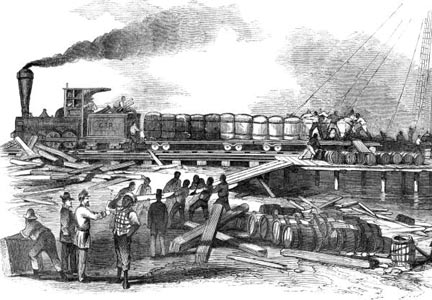
Shipping Turpentine by Rail
In 1939, African American historian E. Simms Campbell wrote, “Boogie Woogie piano playing originated in the lumber and turpentine camps of Texas and in the sporting houses of that state.” Campbell called Boogie Woogie power piano playing “a fast, rolling bass, giving the piece an undercurrent of tremendous power."
Before and after 1900, East Texas was blanketed by vast virgin stands of longleaf pines dotted with camps of men who spent most of their "working" hours harvesting resin for the distillation of turpentine. That is, if you could call it "work" -- a better word would be "peonage" or "Debt Slavery." In 1926, the Georgia Baptist Convention warned that "There are more white people involved in this diabolical practice than there were slaveholders. There are more Negroes held by these debt-slavers than were actually owned as slaves before the war between the states. The method is the only thing that has changed."
The "modern" method consisted on the one hand of the company owned comissary-a common feature of the turpentine and lumber camps of the South and the cotton plantations of the South and Southwest. In these establishments, commonly referred to as "robbersaries" , the "employees" were obliged to obtain their food and other basic necessities of life at exorbitant prices which keep them perpetually in debt and preclude their receiving cash wages for their work. At the same time, this private enterprise system had the support of law enforcement agencies, who bring to bear the vagrancy and so-called fraud laws, so that the only escape for the debt slave is into a prison camp or convict work gang.
At night and on weekends, the camps were infamous for drunken brawls, card cheating, and murderous knife fights, much of it encouraged by the owners to rake in a bit more cash on booze. Slowly, the owners began importing musicians to provide entertainment. Being parsimonious, they settled on piano players who could provide both rhythm and melody (i.e. only one musician was needed) In the camps, there were always barrelhouses, where barrels were made and filled with resin. On Saturday nights, planks of lumber were placed across the barrels and became makeshift bars. Consequently, before Boogie Woogie began to make its way into music history, the style of piano was also known as barrelhouse piano.
Dr. John Tennison of San Antonio, founder of the Boogie Woogie Foundation, believes brothers Hersal and George W. Thomas were responsible for bringing the Boogie Woogie style from such barrelhouses in East Texas to Houston, and then to New Orleans and Chicago. In Texas, the term Booger Rooger, was used by blues guitarist Blind Lemon Jefferson as early as 1917-18. However, the earliest evidence of Boogie Woogie as a descriptor of piano music was in the 1923 reprinting of George Thomas’ New Orleans Hop Scop Blues.
Early Boogie Woogie musicians were also inspired by the sounds of steam locomotives rolling through the turpentine and lumber camps of East Texas. In a 1988 British television broadcast about Boogie Woogie, music historian Paul Oliver said: “...the conductors were used to the logging camp pianists clamoring aboard, telling them a few stories, jumping off the train, getting into another logging camp, and playing again for eight hours. In this way, the music got around, all through Texas, and eventually...out of Texas.” Music historian Alan Lomax also wrote in 1993: “Anonymous black musicians, longing to grab a train and ride away from their troubles, incorporated the rhythms of the steam locomotive and the moan of their whistles into the new dance music they were playing in jukes and dance halls. Boogie Woogie forever changed piano players, as piano players transformed the instrument into a polyrhythmic railroad train.”

Zora Neale Hurston
Drawing by Swing Dancer Marcia Klioze
Going up some roads and down some others to see what Negroes do for a living. Going down one road I smelt hot rosin and looked and saw a “gum patch.” That’s a turpentine still to the outsider, but gum patch to those who work them. It was not long before I was up in the foreman’s face talking and asking to be talked-to. He was a sort of pencil-shaped brown-stained man in his forties and his name was John McFarlin. He got to telling and I got to listening until the first thing I knew I was spending the night at his house so I could “Ride the Wood” with him next morning and see for myself instead of asking him so many questions. So that left me free to ask how songs go in the turpentine woods.
He said “No, Ma’am. they don’t make up many songs. The boys used to be pretty good about making up songs but they don’t do that now.”
I said, “If you don’t make up songs while you are working, don’t you all make some up round the jook? [juke box]”
He said “No mam like I told you. Taint like saw-mills and such like that. Turpentine woods is kind of lonesome.”
Foreman McFarlin had me up before five o’ clock next morning. He had to wake up his camp and he always started out about 5:30 so that he had every man on the job by 6. Every man took his tools, went to his task-whatever he was doing when he knocked off at 5:30 the afternoon before, he got right on it in the morning. The foreman had 18 men under him and he saw everyone in his place. He had 5 chippers, 7 pullers and 5 dippers and a wood-chopper. All the men off to work, John McFarlin straddled his horse, got one for me and we began riding the wood. Talking about knowing his business! The foreman can ride a “drift” and with a glance tell if every “face” on every tree has been chipped.
Chipping Turpentine
First he rode a drift of virgin boxes. That is when a tree is first worked, it is a virgin box for three years. That is the finest rosin. The five men were chipping away. The chipper is the man who makes those little slanting cuts on pine trees so that the gum exudes, and drains down into the box. He has a very sharp cutting tool that heavily weighted in the handle and cunningly balanced so that he chips at a stroke. The company pays a cent a tree. We stopped and watched Lester Keller chip because he is hard to beat anywhere in the world. He often chips 700 or more trees a week.
A puller is a specialized chipper. He chips the trees when they have been worked too high for the chipper. He does this with a chipping axe with a long handle knows (sic) as a puller. The foreman explained that the tree are chipped three years and pulled three years then it is abandoned. Leroy Heath is the champ puller.
He inspected a drift that was being dipped. The men who dip take the cup off the tree, scrape out the gum with the dipping iron and put it back in place and pass on to the next face. The dippers are paid $.85 a barrel for gum and 10 barrels a week is good dipping. Dan Walker is the champ. He can dip two barrels a day.
The wood-chopper cuts wood for the still. Wood is used to fire the furnace instead of coal because the company owns millions of cords of wood for burning in trees that have been worked out.
McFarlin explained that thee(sic) is no chipping and dipping from November to March. In November they stop working the trees, scrape the faces, mow and rake around the trees as a caution against fire. The foreman gets $12.50 a week, the foreman’s house, all the firewood he wants and all the gardening space he wants. He said shyly that he would raise(sic) in wages, but feels that he will not get it. He wants to know if the Government is sending people around to make folk pay better wages. He hopes so.
Click here for another memory of the camps [from the white perspective...]. Here is a story about Dixie County, Florida home of a notorious Turpentine Camp.
Finally, if you think that all of this stuff is in the far-distant path, you should read Stetson Kennedy's picture of the US in 1960. Here's a little segment from "A Guide to Jim Crow" As you read this remember that 1960 was the time of space exploration, John Kennedy's election and coast-to-coast television.
Counter for the Entire Site (not just this page..)

Home | About Lindy | 1940s Collectibles | Upcoming Events |
The Guide - Establishments - Travel - Accessories
Music | Links | Photo Gallery | Extras | Contact Us