 Hit Parade, 1935-1959
Don't look for jive tunes in the Top Ten




Join Us on Facebook
First of all, we'd like to welcome our search engine folks. If you'd like to avoid the sociological discussion that follows, you may:
- Go directly to the Hit Parade Listings for 1935-1959
- Look at covers from Hit Parader Magazine, 1943-1959
- Examine the Davy Crockett Phenomenon
If you came into this page from a search engine, you should know that this is primarily a website for people who dance. I, and most of my readers, specialize in a particular dance form called Lindy Hop that is performed to uptempo 8-count swing or rock music. (e.g. One O'Clock Jump or Johnny B. Goode). As dancers, we face a lot of the same problems today that killed partner dancing in the 1960s -- a lack of music that fits our needs. Popular taste does not now favor Lindy-danceable songs. Our research, discussed below, seems to indicate that it never really did.
We have been looking into the "Hit Parade" for the Swing and Rock'n'Roll Era (i.e. 1935-1959). Guess what: You would be TOTALLY WRONG if you believed that:
- In 1935, Duke Ellington was selling a lot of copies A-Train or
- In 1937, Cab Calloway was playing to SRO crowds at the Cotton Club. He MUST have had a blockbuster hit with Minnie the Moocher
- In 1938, Benny Goodman played the legendary Carnegie Hall Concert. He DEFINITELY was on the charts big time with Sing, Sing, Sing
- Louis Jordan must have had a whole long string of mega hits with Choo Choo Ch'Boogie,Saturday Night Fish Fry,or Caldonia
- Louis Prima and Keely Smith must have been regularly in the top ten, especially with Jump, Jive, and Wail
- Chuck Berry must have had at least one big hit (maybe Johnny B. Goode?)
All of those statements are TOTALLY FALSE! Virtually NONE of the songs that we love to dance to ever got anywhere near the top of the Pop Charts!!! In fact, from 1950 through 1959, only 8 Lindy-danceable songs made the Overall Top Ten for these years (that's 8 out of 100!). For a week or two, some of the songs that we love may have come close to the top, but when sales are considered for the whole year, generally uptempo killer-dillers lose out.
In Case you are interested, they are:
- Mona Lisa, Nat King Cole, 1950, #5
- How High the Moon,Les Paul, 1951, #2
- Sh-Boom,Crew Cuts, 1954, #5
- Rock Around the Clock,Bill Haley, 1955, #1
- Don't be Cruel,Elvis Presley, 1956, #1
- All Shook Up,Elvis Presley, 1959, #9
- At The Hop,Danny and the Juniors,1958, #10
- Mack the Knife,Bobby Darin, 1959, #1
- People had a taste for nostalgia (Yellow Rose of Texas), sentiment (Oh My Papa), movie themes (Tammy), and outright schlock (Witch Doctor).
- Hot numbers and "edge" didn't sell records. Elvis had only three Yearly Top Ten hits during 1955-1959. The Platters had four , and the Everley Brothers and Johnny Mathis had two, as did Latin star Perez Prado.
- There are actually four Big Band hits during 1955-1959 (Lisbon Antigua, Canadian Sunset, Moonglow/Picnic, and So Rare) I think that Jimmy Dorsey's So Rare which was #9 for 1957 was the last major hit for a Swing Era big band.
Small subcultures formed to enjoy uptempo music with a strong beat -- it was the zoot-suiters and jitterbugs of the 1940s and the High School Hoppers and Boppers of the 1950s that bought and shared swingable music. Most "fast dance" was prohibited at school events, so it had to be practiced in basements and "Rumpus Rooms" located sufficiently far from Dad so that he wouldn't say "Turn that noise off."
The fuel for these clandestine parties came from an unusual source. On Sunday night the white-bread local stations turned their power down because nobody was listening. At this magic moment several southern stations ( like KPFK in Helena, Arkansas) came alive and played the "Race Music" that was forbidden by the Minister, the Principal, and Dad. A teenager who was lucky enough to own a reel-to-reel tape deck could attain high status by bringing this ill-gotten treasure to basement dance parties. Once they knew the names of the songs and the artists, kids would travel from the segregated suburbs to the "Negro Neighborhoods" to buy records for themselves. None of that got on the "pop charts."
Haven't People Come to Love the old Uptempo Songs?
In brief, apparently not..
Several years ago, the now defunct Oldies 100 (WBIG-FM) produced a brochure that contained their "Big 500 Oldies of All Time" -- that would be from the time that they were released to about 1999. For what it's worth, very few Lindy-danceable songs made this list. Of 500 songs, I count only 15 that are even marginally danceable! Here they are:
- #2 American Pie, Don Mclean, 1972 (marginal)
- #9 Mack the Knife, Bobby Darin, 1959
- #26 Johnny B. Goode, Chuck Berry, 1958
- #34 Rock Around the Clock,Bill Haley, 1955
- #81 Don't Be Cruel, Elvis Presley, 1956
- #116 Peggy Sue, Buddy Holly, 1958
- #146 Maybelline, Chuck Berry, 1958
- #258 Rockin' Pneumonia, Johnny Rivers, 1973
- #327 Rave On, Buddy Holly, 1958
- #338 Jail House Rock, Elvis Presley, 1957
- #392 Yakety Yak, The Coasters, 1958
- #422 Green Onions, Booker T and the MGs,1962 (marginal)
- #427 Devil with a Blue Dress, Mitch Ryder, 1966
- #445 That'll be the Day, Buddy Holly, 1957
- #490 Your Mama Don't Dance, Loggins & Messina, 1973 (marginal)
So, What Is a "Hit Parade", anyway?
Your Hit Parade was a popular American radio and television program, sponsored by Lucky Strike cigarettes and broadcast from 1935 to 1955 on radio, and 1950 to 1959 on television.
Each Saturday evening, the program offered the most popular and best selling songs of the week. The earliest format involved a presentation of the top 15 songs. Later, a countdown with fanfares led to the top three finalists, with the number one song for the finale. Occasional performances of standards and other favorite songs from the past were known as "Lucky Strike Extras," the equivalent of "Oldies But Goodies."
Listeners were informed that:
The survey checks the best sellers on sheet music and phonograph records, the songs most heard on the air and most played on the automatic coin machines, an accurate, authentic tabulation of America's taste in popular music.
However, the exact methodology for this "authentic tabulation" was never revealed. We have a Special Jukebox Page that goes into some detail about that business. Until the 1950s, jukeboxes offered (at most) 24 selections while hundreds of songs were released each year. If you follow our discussion of jukebox mechanisms, you'll find that most machines did not keep totals of how many times each record had been played. Based on our look at organized crime and jukeboxes, we suspect that the selections that were made available reflected "payola" rather than popular taste.
As far as sheet music is concerned, Who would think of buying the sheet music for Sing,Sing, Sing? As far as airplay goes, most jive records were kept off the air -- black artists were discriminated against, Rock and Roll was the tool of the devil, etc. In other words, the "survey" had a lot of flaws.
Another factor was economics-- until the 1950s, teenagers didn't have a lot of purchasing power. (In the Depression, nobody had a lot of purchasing power...) This meant that buying a record was more like an investment than an impulse. Mom and Dad exerted a levelizing influence on record purchases and phonograph time, so sales tend to reflect sentimental ballads that weren't likely to stir up any adolescent hormones. With the prosperity of the 1950s, teenagers got their own radios, phonographs and televisions. After that, things began to change.
Your Hit Parade eventually folded because the cast, made up of big band singers, could not render songs like Hound Dog or Blue Suede Shoes in a fashion that was convincing to teenagers.
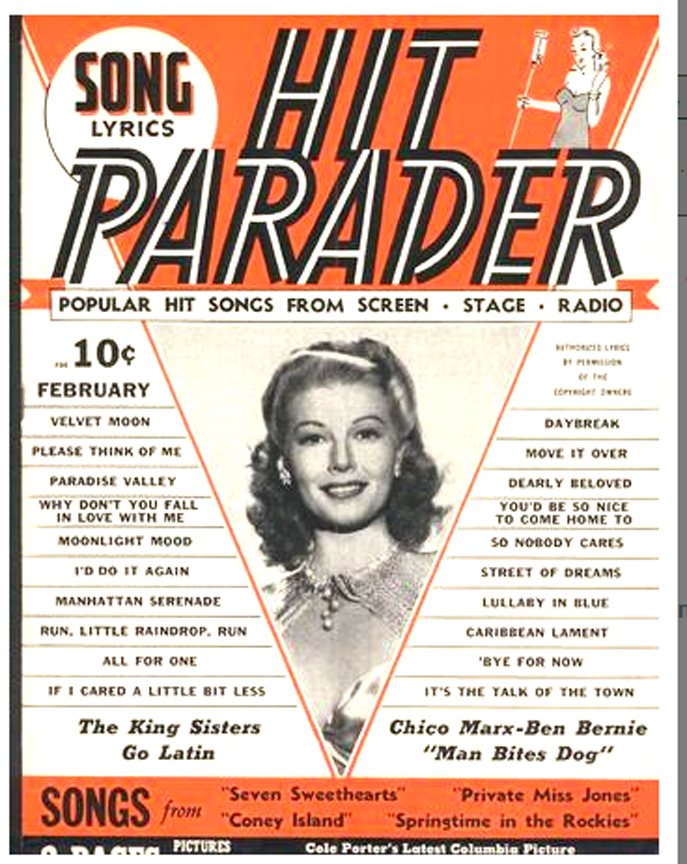
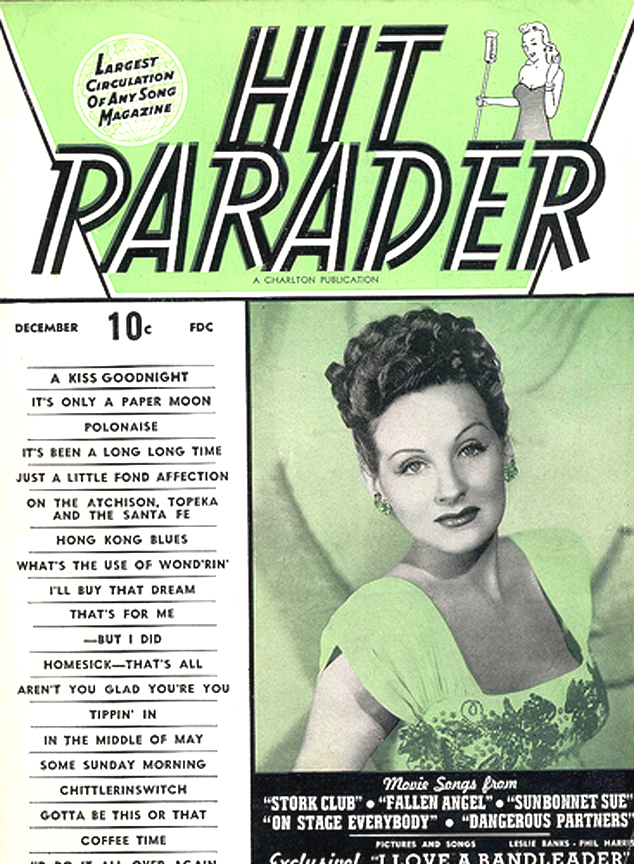
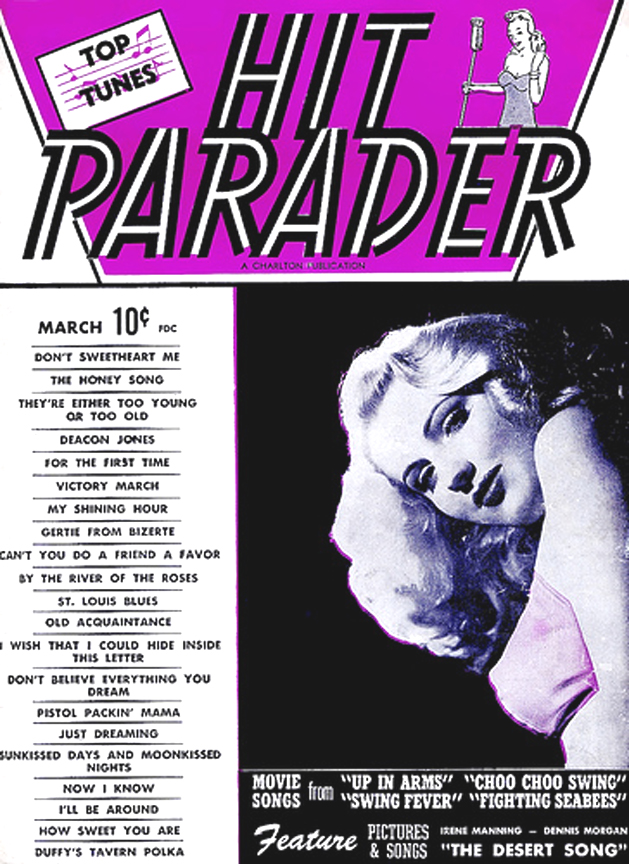
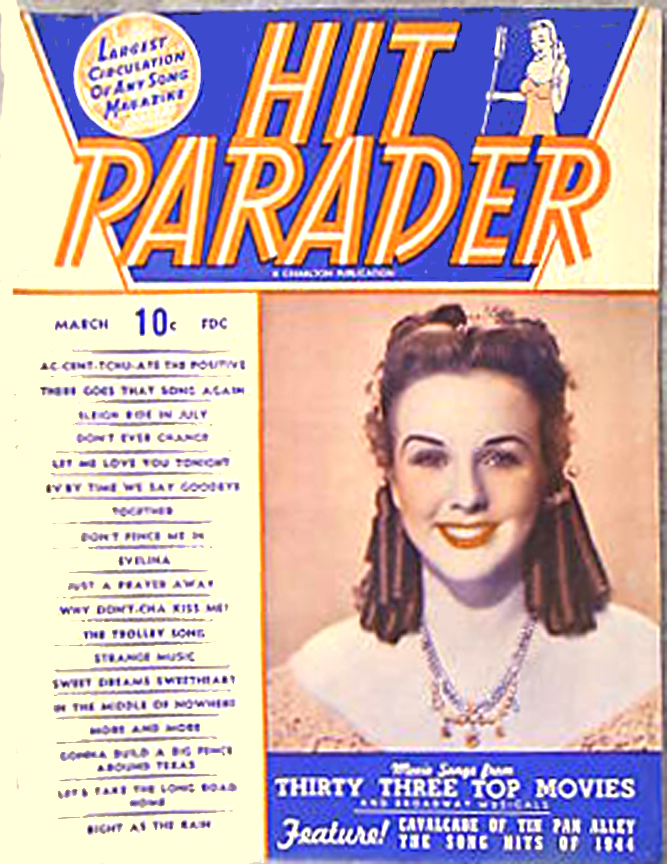
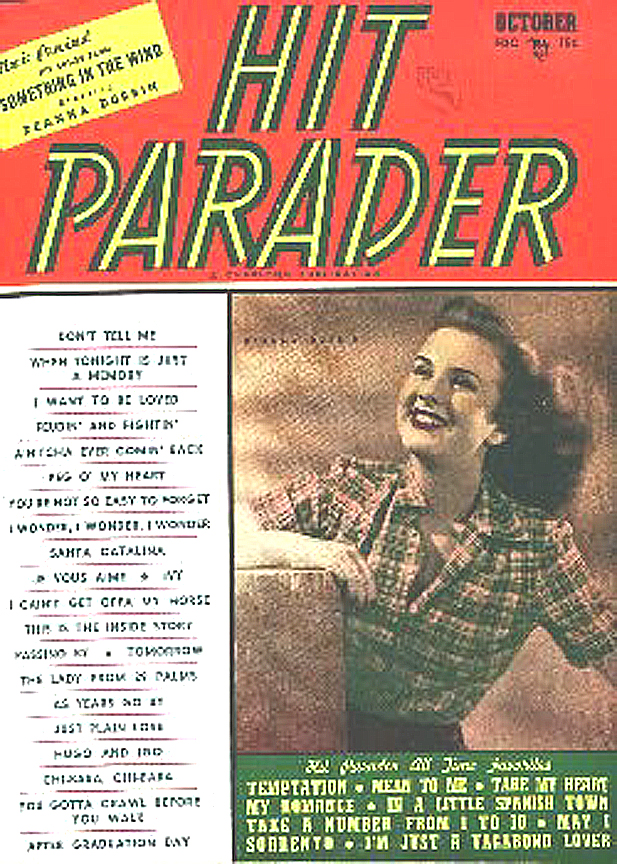
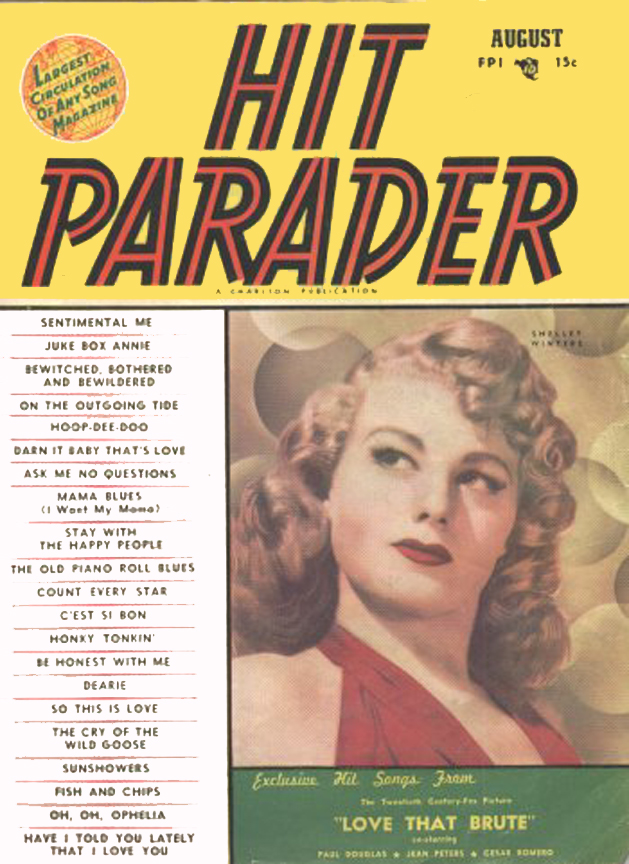
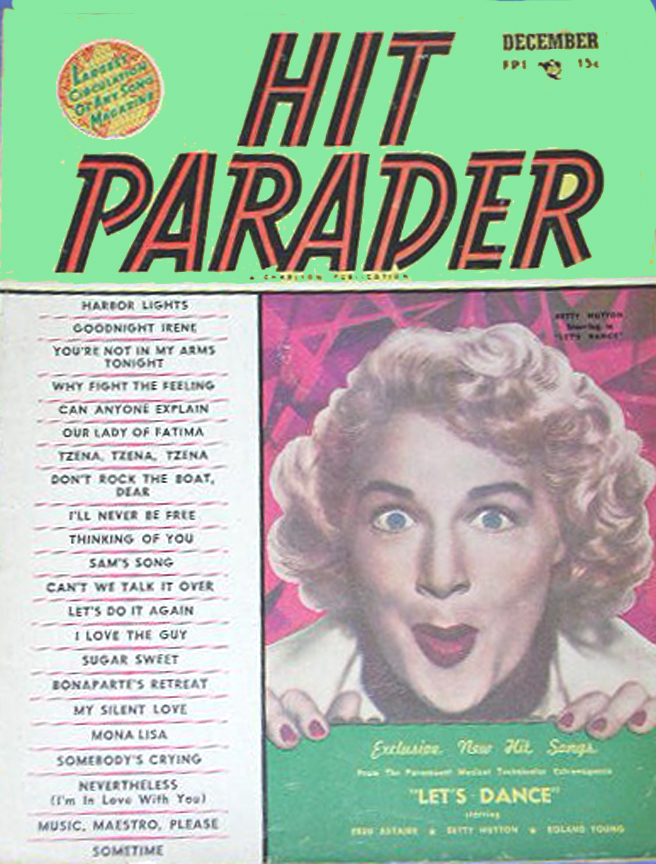
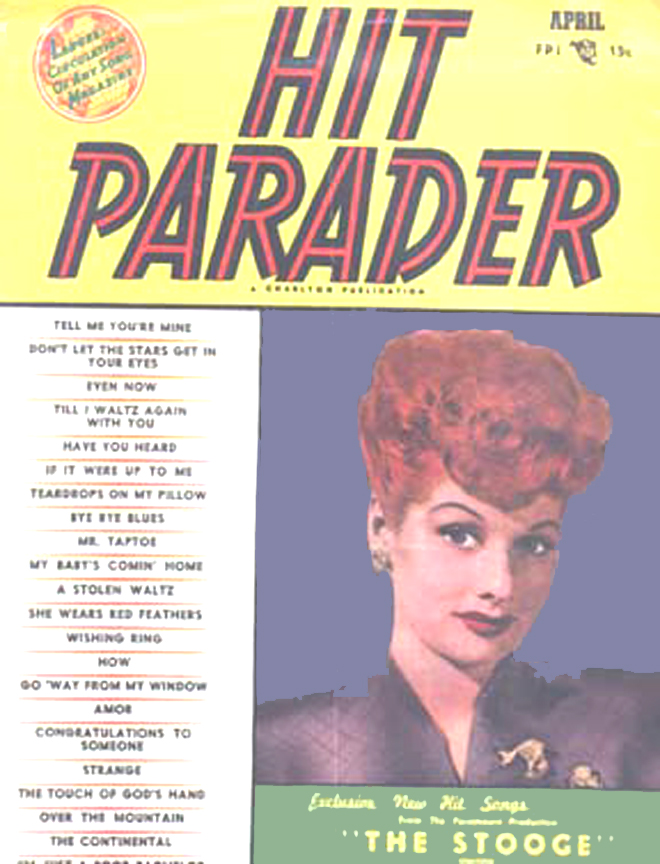
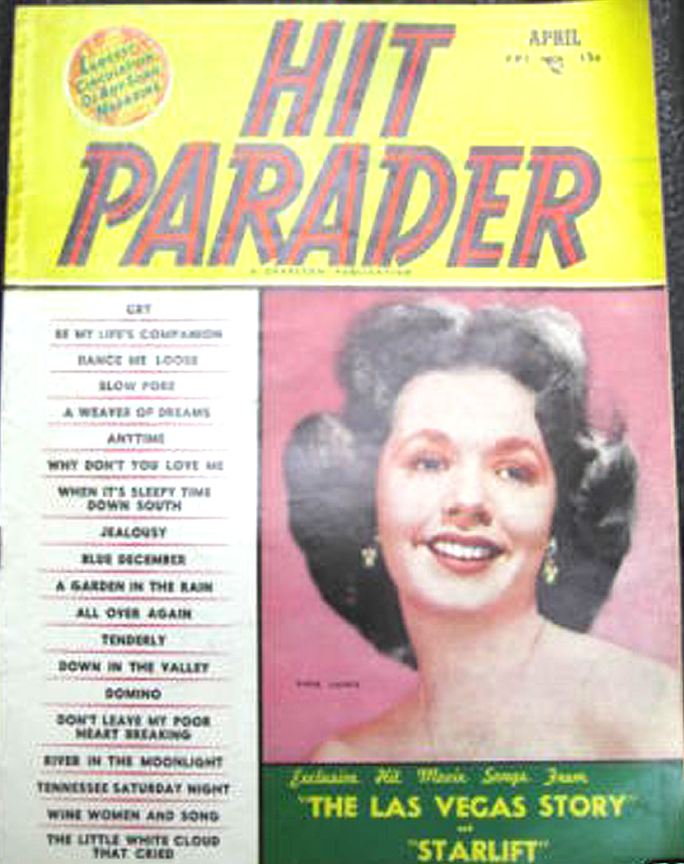
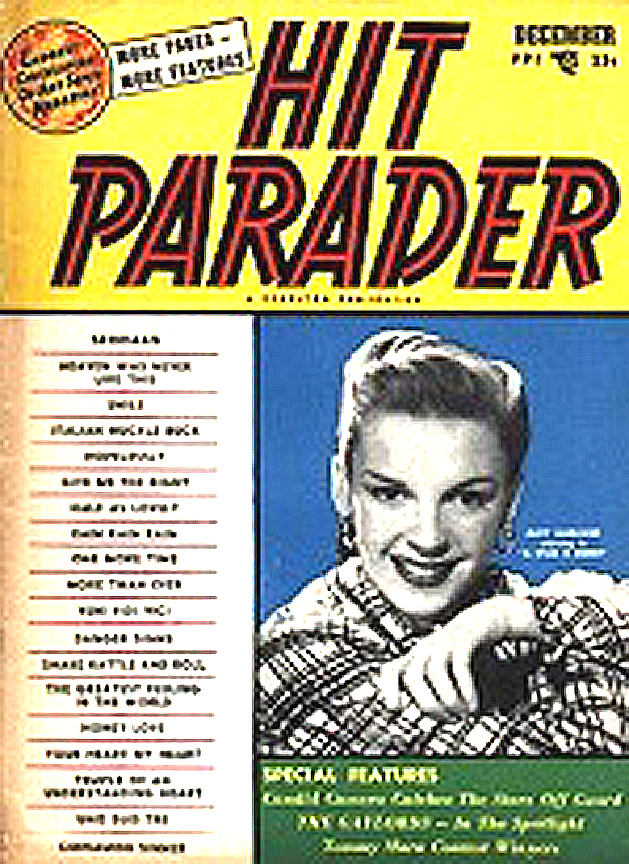
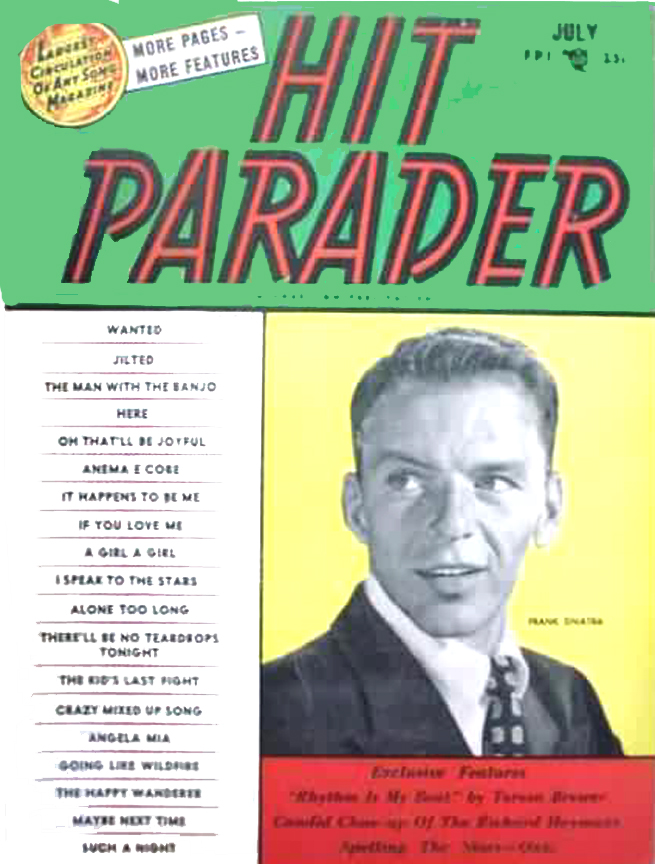
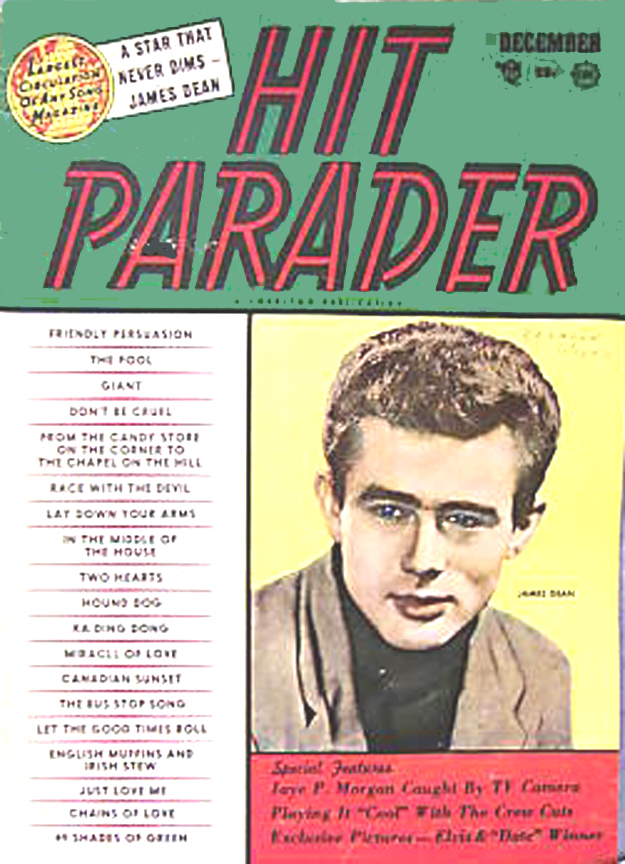
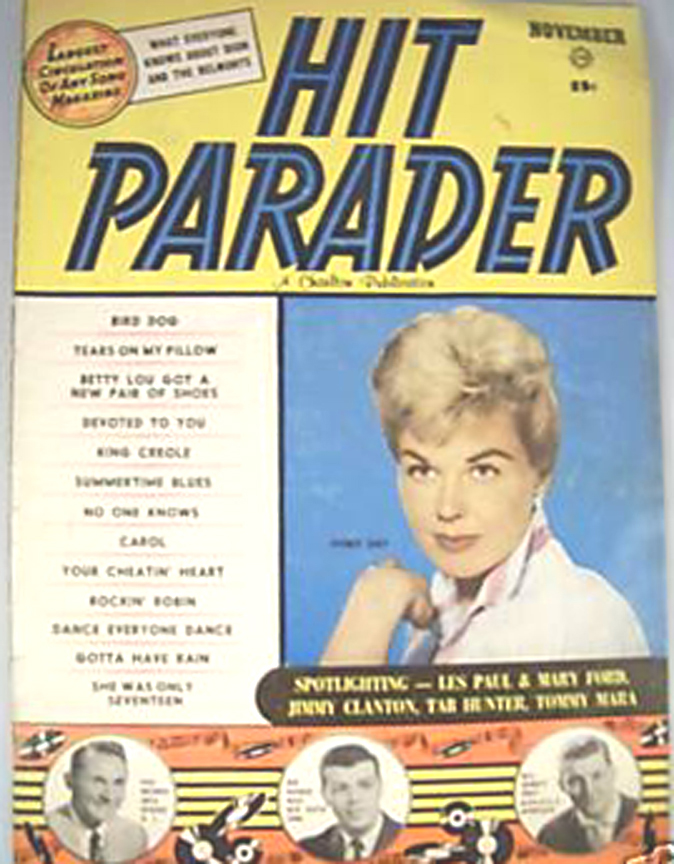
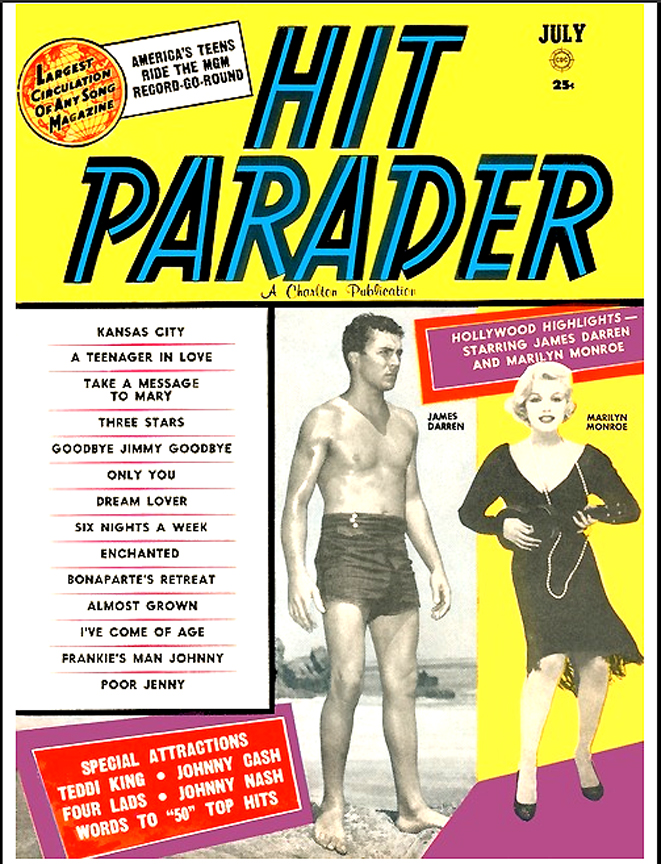
Another source of information about popular musical tastes was a magazine called Hit Parader that was issued on a monthly basis. The magazine contained the lyrics to popular songs and various articles about personalities in the music industry. Copies of Hit Parader are somewhat collectible, especially if the star featured on the cover has a cult following. The magazine was first published in 1942 and survives to this day, but is largely unrecognizable from its former incarntation, now embellished with the sort of Doom and Gloom graphics favored by teenage boys who eat too many cheez curls.
Here are some representative magazines that I have collected. You can click to enlarge each cover to have a look at the songs that were popular that month:

The Early 1940s
Feb, 1943, Dec 1943,March 1944, Sept. 1944
The Late 1940s
March 1945, October 1947, August 1948, December 1949

The Early 1950s
April 1951, April 1952,December 1952, October 1953
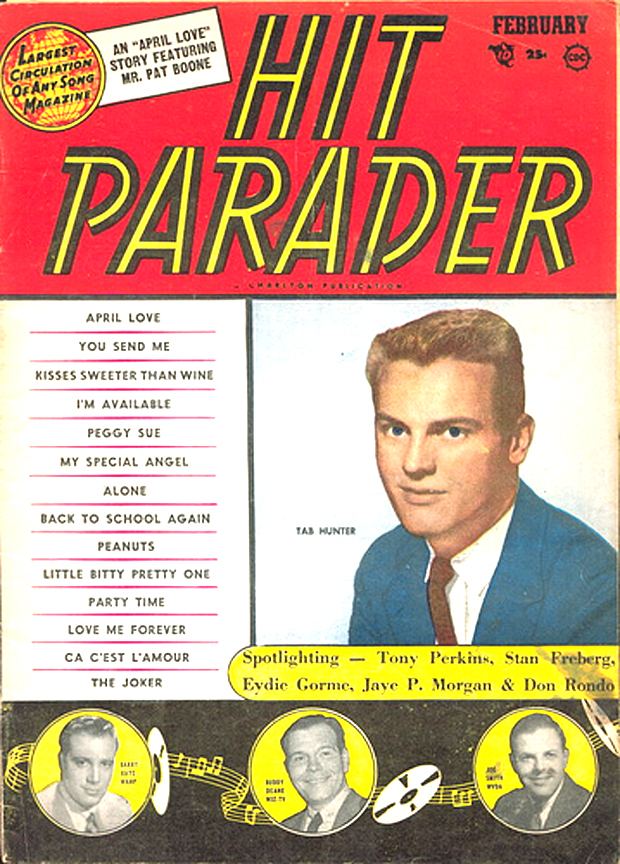
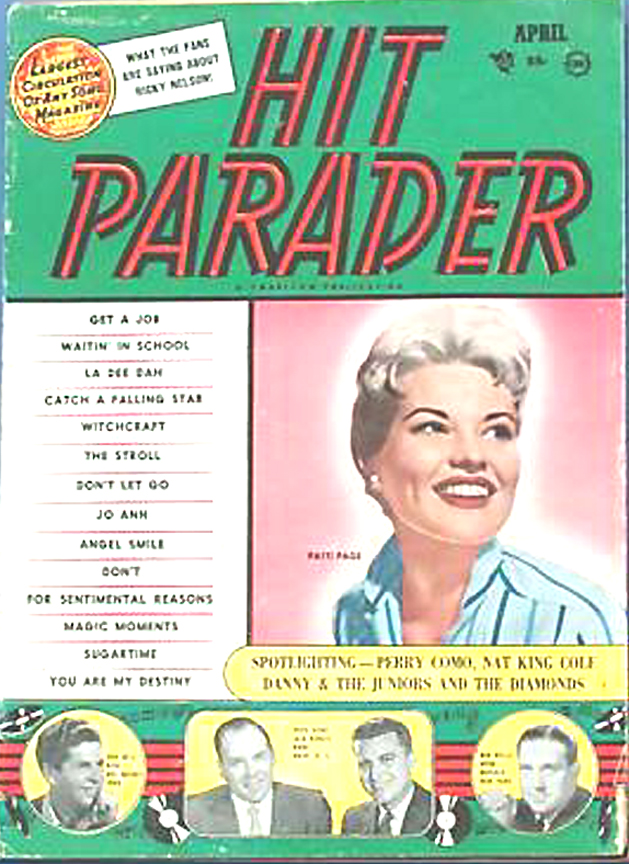
The Mid 1950s
July, 1954, December 1956,February, 1958 April, 1958
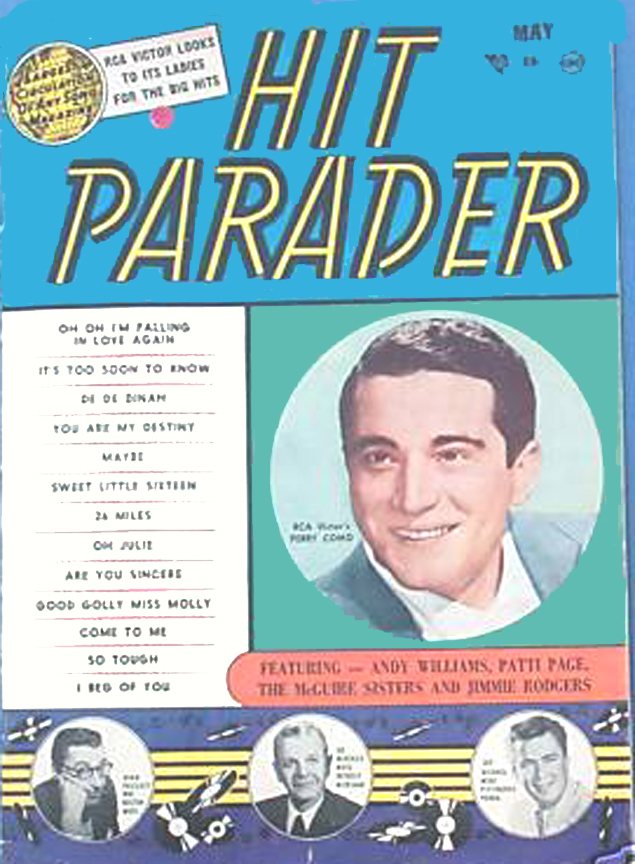
The Late 1950s
May 1958, November 1958, July 1959
Click to Enlarge
Here are sources for Hit Parade information from the past.
- For the yearly best from the Your Hit Parade Radio and TV Show, 1935-1955 click here. This site also has a stunning amount of information about Big Bands.
- The source for years 1956-1959 is: The Good Old Days, Time Life Books,1996, ISBN 0-7835-4845-1, especially p 186
- If you want to go beyond 1959, check out the yearly best from Billboard Magazine, 1962-1972, click here. This site actually lists the Top 100 AND has lyrics for all the songs. If a particular song was an "instrumental", the site has a downloadable MP3 soundbite)
Without further ado, here are the years, 1935 - 1959. Table entries are the overall best sellers for the calendar year as tabulated by Cash Box magazine
1935
- CHEEK TO CHEEK Fred Astaire
- ISLE OF CAPRI Ray Noble
- WHEN I GROW TOO OLD TO DREAM Glen Gray
- RED SAILS IN THE SUNSET Guy Lombardo
- LOVELY TO LOOK AT Eddy Duchin
- SHE'S A LATIN FROM MANHATTAN Victor Young
- I'M IN THE MOOD FOR LOVE Little Jack Little
- I WON'T DANCE Eddy Duchin
- TRUCKIN' Fats Waller
- IN A LITTLE GYPSY TEA ROOM Bob Crosby
1936
- PENNIES FROM HEAVEN Bing Crosby
- THE WAY YOU LOOK TO NIGHT Fred Astaire
- THE GLORY OF LOVE Benny Goodman
- ALONE Tommy Dorsey
- GOODY GOODY Benny Goodman
- A FINE ROMANCE Fred Astaire
- THE MUSIC GOES ROUND AND ROUND Tommy Dorsey
- DID I REMEMBER? Shep Fields
- IT's A SIN TO TELL A LIE Fats Waller
- IS IT TRUE WHAT THEY SAY ABOUT DIXIE? Jimmy Dorsey
1937
- SWEET LEILANI Bing Crosby
- ONCE IN A WHILE Tommy Dorsey
- THE DIPSY DOODLE Tommy Dorsey
- IT LOOKS LIKE RAIN IN CHERRY BLOSSOM LANE Guy Lombardo
- BOO HOO Guy Lombardo
- SEPTEMBER IN THE RAIN Guy Lombardo
- THAT OLD FEELING Shep Fields
- WHISPERS IN THE DARK Bob Crosby
- GOODNIGHT,MY LOVE Benny Goodman
- THE MOON GETS IN YOUR EYES Bing Crosby
1938
- Begin the Beguine Artie Shaw
- Love Walked In Kenny Baker
- A-Tisket-A-Tasket Ella Fitzgerald
- Heart and Soul Larry Clinton
- Bei Mir Bist du Schoen The Andrews Sisters
- Change Partners Fred Astaire
- You Must Have Been a Beautiful Baby Bing Crosby
- Cathedral in the Pines Shep Fields
- Ti-Pi-Pin Horace Heidt
- Umbrella Man Kay Kyser
- Wabash Cannonball Roy Acuff
- So Help Me Mildred Bailey
- Boogie Woogie Tommy Dorsey
- I'm Gonna Lock My Heart Billie Holiday
- Jumpin' at the Woodside Count Basie
- I've Got a Pocketful of Dreams Russ Morgan
- They Say Artie Shaw
- One O' Clock Jump Harry James
- Alexander's Ragtime Band Bing Crosby,
- I Let a Song Go Out of My Heart Duke Ellington
- Don't Be That Way Benny Goodman
- Big Noise from Winnetka Bob Crosby & His Orchestra
- Deep Purple Jimmy Dorsey
- Music, Maestro, Please Tommy Dorsey
- Flat Foot Floogee The Mills Brothers
1939
- Moonlight Serenade Glenn Miller
- Two Sleepy People Bob Hope
- God Bless America Kate Smith
- Three Little Fishies Kay Kyser
- All The Things Your Are Tommy Dorsey
- Darn That Dream Benny Goodman
- My Heart Belongs To Daddy Mary Martin
- Beer Barrel Polka Will Glahe
- If I didn't care The Ink Spots
- Hold Tight, Hold TIght Andrew Sisters
- An Apple For The Teacher Bing Crosby
- Woodchoppers Ball Woddy Herman
- Cherokee Charlie Barnett
- In The Mood Glenn Miller
- Penny Serenade Sammy Kaye with Jimmy Brown
- South Of The Border Shep Fields with Hal Derwin
- Our Love Tommy Dorsey
- Deep Purple Larry Clinton
- Over The Rainbow Judy Garland
- And The Angels Sing Benny Goodman
- Day In, Day Out Bing Crosby with Helen Ward
- Bubbles in The Wine Lawrence Welk
- Address Unknown Ink Spots
- Sunrise Serenade Glen Gray with Frankie Carle
- Blues In The Night Jimmie Lunceford
1940
- When You Wish upon a Star Cliff "Ukelele Ike" Edwards
- I'll Never Smile Again Tommy Dorsey & His Orchestra
- Frenesi Artie Shaw & His Orchestra
- All the Things You Are Tommy Dorsey & His Orchestra
- We Three (My Echo, My Shadow and Me) The Ink Spots
- Down Argentine Way Bob Crosby & His Orchestra
- In the Mood Glenn Miller & His Orchestra
- Darn That Dream Benny Goodman & His Orchestra
- Pennsylvania 6-5000 Glenn Miller & His Orchestra
- Sierra Sue Bing Crosby
- On the Isle of May Connee Boswell
- The Breeze and I Jimmy Dorsey & His Orchestra
- Blueberry Hill Glenn Miller & His Orchestra
- Maybe The Ink Spots
- Only Forever Bing Crosby
- Beat Me Daddy, Eight to the Bar Will Bradley & His Orchestra
- Ferryboat Serenade The Andrews Sisters
- Body and Soul Coleman Hawkins & His Orchestra
- Romance in the Dark Lillian "Lil" Green
- It's a Blue World Tony Martin
- Trade Winds Bing Crosby
- Make Believe Island Mitchell Ayres & His Fashions in Music
- I'm Nobody's Baby Judy Garland
1941
- Stardust Artie Shaw & His Orchestra
- Green Eyes Tommy Dorsey & His Orchestra
- Amapola Jimmy Dorsey & His Orchestra
- Perfidia Xavier Cugat & His Orchestra
- Elmer's Tune Glenn Miller
- I'll Be with You in Apple Blossom Time The Andrews Sisters
- Racing with the Moon Vaughn Monroe & His Orchestra
- You Made Me Love You Harry James & His Orchestra
- Daddy Sammy Kaye & His Orchestra
- I Don't Want to Set the World on Fire The Ink Spots
- Chattanooga Choo Choo Glenn Miller & His Orchestra
- Boogie Woogie Bugle Boy The Andrews Sisters
- Let Me Off Uptown Gene Krupa & His Orchestra
- Oh! Look at Me Now Tommy Dorsey & His Orchestra
- I Hear a Rhapsody Charlie Barnet & His Orchestra
- Take the 'A' Train Duke Ellington & His Orchestra
- God Bless the Child Billie Holiday
- Yes, Indeed! Tommy Dorsey & His Orchestra
- Maria Elena Tommy Dorsey & His Orchestra
- There'll Be Some Changes Made Benny Goodman & His Orchestra
- I Got It Bad (And That Ain't Good) Duke Ellington & His Orchestra
- New San Antonio Rose Bob Wills and His Texas Playboys
- Dolores Bing Crosby
- 'Til Reveille Kay Kyser
1942
- Don't Sit Under the Apple Tree (With Anyone Else But Me) Glenn Miller & His Orchestra
- (There'll Be Bluebirds Over) The White Cliffs of Dover - Kate Smith
- Tangerine Jimmy Dorsey & His Orchestra
- Strip Polka Johnny Mercer
- (I Got Spurs That) Jingle, Jangle, Jingle Kay Kyser
- Deep in the Heart of Texas Alvino Rey & His Orchestra
- Somebody Else Is Taking My Place Benny Goodman & His Orchestra
- Who Wouldn't Love You? Kay Kyser
- I Left My Heart at the Stage Door Canteen Sammy Kaye
- One Dozen Roses Harry James & His Orchestra
- For Me and My Gal Judy Garland
- My Devotion Vaughn Monroe & His Orchestra
- Sleepy Lagoon Harry James & His Orchestra
- Blues in the Night Dinah Shore
- Jersey Bounce Benny Goodman & His Orchestra
- Trav'lin' Light Paul Whiteman Orchestra
- (I've Got a Gal In) Kalamazoo Glenn Miller & His Orchestra
- I Don't Want to Walk Without You Harry James & His Orchestra
- Cow Cow Boogie Freddie Slack & His Orchestra
- A String of Pearls Glenn Miller & His Orchestra
- Flying Home Benny Goodman
- Be Careful, It's My Heart Bing Crosby
- Moonlight Cocktail Glenn Miller & His Orchestra
- There Are Such Things Tommy Dorsey & His Orchestra
1943
- Zing! Went the Strings of My Heart Judy Garland
- When the Lights Go on Again (All over the World) Vaughn Monroe & His Orchestra
- As Time Goes By Dooley Wilson
- You'll Never Know Dick Haymes & the Song Spinners
- Moonlight Becomes You Bing Crosby
- Don't Get Around Much Anymore The Ink Spots
- Comin' in on a Wing and a Prayer Song Spinners
- I've Heard That Song Before Harry James & His Orchestra
- Sunday, Monday or Always Bing Crosby
- You'd Be So Nice to Come Home To Dinah Shore
- People Will Say We're in Love Bing Crosby
- Paper Doll The Mills Brothers
- Stormy Weather Lena Horne
- That Old Black Magic Glenn Miller & His Orchestra
- Brazil Xavier Cugat & His Orchestra
- Pistol Packin' Mama Al Dexter and His Troopers
- Let's Get Lost Vaughn Monroe & His Orchestra
- Juke Box Saturday Night Glenn Miller & His Orchestra
- Boogie Woogie Tommy Dorsey & His Orchestra
- I'm Old Fashioned Fred Astaire
- Why Don't You Do Right? Benny Goodman & His Orchestra
- I Had the Craziest Dream Harry James & His Orchestra
- In the Blue of Evening Tommy Dorsey & His Orchestra
- Taking a Chance on Love Benny Goodman & His Orchestra
1944
- The Trolley Song Judy Garland
- I'll Get By (As Long as I Have You) Harry James & His Orchestra
- Mairzy Doats Merry Macs
- Besame Mucho (Kiss Me Much) Jimmy Dorsey & His Orchestra
- Swinging on a Star Bing Crosby
- You Always Hurt the One You Love Mills Brothers
- I'll Be Seeing You Bing Crosby
- Speak Low (When You Speak, Love) Guy Lombardo & His Royal Canadians
- It's Love, Love, Love Guy Lombardo & His Royal Canadians
- Straighten up and Fly Right Nat King Cole
- San Fernando Valley Bing Crosby
- Shoo Shoo Baby Andrews Sisters
- G.I. Jive Louis Jordan
- Artistry in Rhythm Stan Kenton & His Orchestra
- Don't Sweetheart Me Lawrence Welk & His Orchestra
- Time Waits for No One Helen Forrest
- It Could Happen to You Jo Stafford
- And Her Tears Flowed Like Wine Stan Kenton & His Orchestra
- Is You Is or Is You Ain't My Baby? Louis Jordan
- Cherry Harry James & His Orchestra
- My Heart Tells Me Casa Loma Orchestra
- Do Nothin' Till You Hear from Me Duke Ellington & His Orchestra
1945
- On the Atchison, Topeka and Santa Fe Johnny Mercer
- You Belong to My Heart Bing Crosby
- Rum and Coca-Cola The Andrews Sisters
- It Might As Well Be Spring Dick Haymes
- My Dreams are Getting Better All the Time Les Brown
- There! I Said It Again Vaughn Monroe
- Tampico Stan Kenton
- There Goes That Song Again Russ Morgan
- Its Been a Long, Long Time Harry James
- If I Loved You Perry Como
- Candy Jo Stafford
- A Little on the Lonely Side Frankie Carle
- Gotta Be This or That Benny Goodman
- I'll Buy That Dream Helen Forrest
- I Can't Begin to Tell You Bing Crosby
- Till The End Of Time Perry Como
- I'm Beginning To See The Light Harry James
- Ac-cent-tchu-ate the Positive Johnny Mercer
- Caldonia Louis Jordan
- Laura Woody Herman
- Dream The Pied Pipers
- Don't Fence Me In Bing Crosby (feat. the Andrews Sisters)
- Sentimental Journey Les Brown
- Dig You Later Perry Como
1946
- Sioux City Sue Bing Crosby
- I Got the Sun in the MorningLes Brown & His Orchestra
- Rumours Are Flying Frankie Carle & His Orchestra
- Ole Buttermilk Sky Kay Kyser
- You Keep Coming Back Like a Song Dinah Shore
- Prisoner of Love Perry Como
- PersonalityJohnny Mercer
- I Don't Know Enough About You Peggy Lee
- Doin' What Comes Natur'lly Freddy Martin
- Oh! What It Seemed to BeFrankie Carle & His Orchestra
- To Each His Own The Ink Spots
- Shoo Fly Pie and Apple Pan Dowdy Stan Kenton & His Orchestra
- Surrender Perry Como
- South America, Take It Away!The Andrews Sisters, Bing Crosby
- Laughing on the Outside (Crying on the Inside)Dinah Shore
- I'm a Big Girl Now Sammy Kaye
- Symphony Freddy Martin
- Doctor, Lawyer, Indian ChiefBetty Hutton
- Stone Cold Dead in the MarketElla Fitzgerald, Louis Jordan
- The Gypsy The Ink Spots
- Come Rain or Come Shine Margaret Whiting
- They Say It's Wonderful Perry Como
- The Whole World Is Singing My Song Les Brown & His Orchestra
- The Old Lamplighter Sammy Kaye
1947
- Open the Door, Richard Count Basie Orchestra
- Linda Ray Noble & His Orchestra
- A Sunday Kind of Love Claude Thornhill & His Orchestra
- Anniversary Song Al Jolson
- Chi-Baba, Chi-Baba (My Bambino Go to Sleep) Perry Como
- Feudin' and Fightin' Dorothy Shay
- That's My Desire Frankie Laine
- I Wish I Didn't Love You So Vaughn Monroe & His Orchestra
- Mam'selle Art Lund
- Heartaches Ted Weems & His Orchestra
- Managua, Nicaragua Freddy Martin & His Orchestra
- I Never Knew Sam Donahue & His Orchestra
- Across the Alley from the Alamo Mills Brothers
- Peg O' My HeartBuddy Clark
- Guilty Margaret Whiting
- Near You Francis Craig & His Orchestra
- Ballerina Vaughn Monroe & His Orchestra
- When You Were Sweet Sixteen Perry Como
- You Do Dinah Shore
- I Wonder, I Wonder, I Wonder Eddy Howard, & His Orchestra
- Huggin' and Chalkin' Hoagy Carmichael
1948
- It’s Magic Doris Day
- Nature Boy Nat King Cole
- Little White Lies Dick Haymes
- Serenade Of The Bells Sammy Kaye w/Don Cornell
- Buttons And Bows Dinah Shore
- Love Somebody Doris Day & Buddy Clark
- Manana (Is Soon Enough For Me) Peggy Lee
- You Were Only Fooling Ink Spots
- Baby Face Art Mooney
- Hair Of Gold, Eyes Of Blue Gordon MacRae
- Until Tommy Dorsey w/Harry Prime
- Because Perry Como
- You Call Everybody Darlin’ Al Trace w/Bob Vincent
- On A Slow Boat To China Kay Kyser
- I’ll Dance At Your Wedding Ray Noble w/Buddy Clark
- How Soon Vaughn Monroe
- You Can’t Be True Dear Vera Lynn
- Twelfth Street Rag Pee Wee Hunt
- Golden Earrings Peggy Lee
- Maybe You’ll Be There Gordon Jenkins w/Charles LaVere
- A Tree In The Meadow Margaret Whiting
- I’m Looking Over A Four Leaf Clover Art Mooney
- Now Is The Hour (Maori Farewell Song) Bing Crosby
- My Happiness Pied Pipers
- Beg Your Pardon Francis Craig w/Francis Lamm
1949
- Mule Train Frankie Laine
- Careless Hands Mel Tormé
- Again Doris Day
- Room Full of Roses Sammy Kaye
- Baby, It's Cold Outside Margaret Whiting, Johnny Mercer
- Some Enchanted Evening Perry Como
- A Little Bird Told Me The Stardusters
- Forever and Ever Russ Morgan
- Galway Bay Bing Crosby
- My Darling, My Darling Jo Stafford, Gordon MacRae
- Don't Cry Joe (Let Her Go, Let Her Go, Let Her Go) Gordon Jenkins
- Riders in the Sky Vaughn Monroe
- I've Got My Love to Keep Me Warm Les Brown
- Slipping Around Margaret Whiting, Jimmy Wakely
- Bali Ha'i Perry Como
- That Lucky Old Sun (Just Rolls Around Heaven All Day) Frankie Laine
- Maybe It's Because Dick Haymes
- So Tired Russ Morgan
- Lavender Blue (Dilly Dilly) Sammy Kaye
- Powder Your Face With Sunshine (Smile! Smile! Smile!) The Stardusters
- Someday (You'll Want Me to Want You) Vaughn Monroe
- "A" You're Adorable (The Alphabet Song) Perry Como, The Fontane Sisters
- Cruising Down the River Blue Barron
- Far Away Places Margaret Whiting
1950
- Music! Music! Music! Teresa Brewer
- Enjoy Yourself (It's Later Than You Think) Guy Lombardo & His Royal Canadians
- I Wanna Be Loved The Andrews Sisters
- A Bushel and a Peck Betty Hutton
- My Foolish Heart Gordon Jenkins
- Play a Simple Melody Gary Crosby
- The Cry of the Wild Goose Frankie Laine
- All My Love Patti Page
- Sentimental Me The Ames Brothers
- There's No Tomorrow Tony Martin
- I'll Never Be Free Kay Starr
- Harbor Lights Sammy Kaye
- Hoop-Dee-Doo The Fontane Sisters
- I Can Dream, Can't I? The Andrews Sisters
- Mona Lisa Nat King Cole
- Nevertheless (I'm in Love with You) The Mills Brothers
- Goodnight Irene The Weavers
- Bewitched, Bothered and Bewildered Doris Day
- Rag Mop The Ames Brothers
- Bonaparte's Retreat Kay Starr
- La Vie en Rose Tony Martin
- The Tennessee Waltz Patti Page
- Dear Hearts and Gentle People Bing Crosby
- It Isn't Fair Sammy Kaye
1951
- How High the Moon Les Paul & Mary Ford
- My Truly, Truly Fair Guy Mitchell
- In the Cool, Cool, Cool of the Evening Bing Crosby, Jane Wyman
- Too Young Nat King Cole
- Detour Patti Page
- Be My Love Mario Lanza
- Come On-A My House Rosemary Clooney
- I Get Ideas Tony Martin
- Jezebel Frankie Laine
- Because of You Tony Bennett
- Down Yonder Del Wood
- Cry Johnnie Ray
- Undecided The Ames Brothers
- Mister and Mississippi Patti Page
- The Loveliest Night of the Year Mario Lanza
- My Heart Cries for You Guy Mitchell
- Mockin' Bird Hill Les Paul & Mary Ford
- (It's No) Sin Eddy Howard
- Shrimp Boats Jo Stafford
- If Perry Como
- On Top of Old Smokey The Weavers
- Cold, Cold Heart Hank Williams
- (Why Did I Tell You I Was Going To) Shanghai Doris Day
- Charmaine Mantovani
1952
- The Glow Worm Mills Brothers
- Wheel of Fortune Kay Starr Starr
- Maybe Half as Much Rosemary Clooney
- Slow Poke Pee Wee King & His Golden West Cowboys
- You Belong to Me Jo Stafford
- Lady of Spain Eddie Fisher
- Delicado Percy Faith & His Orchestra
- Kiss of Fire Georgia Gibbs
- I'm Yours Don Cornell
- The Little White Cloud That Cried Johnnie Ray
- Lover Peggy Lee
- Wish You Were Here Eddie Fisher
- Jambalaya (On the Bayou) Jo Stafford
- Blue Tango Leroy Anderson & His "Pops" Concert Orchestra
- I Went to Your Wedding Patti Page
- High Noon (Do Not Forsake Me) Tex Ritter
- Tiger Rag Les Paul & Mary Ford
- Tell Me Why The Four Aces
- A Guy Is a Guy Doris Day
- Here in My Heart Al Martino
- Anytime Eddie Fisher
1953
- Don't Let the Stars Get in Your Eyes Perry Como
- Side by Side Kay Starr
- You, You, You Ames Brothers
- April in Portugal Les Baxter & His Orchestra
- Vaya Con Dios (May God Be with You) Les Paul & Mary Ford
- I'm Walking Behind You Eddie Fisher
- Ricochet (Rick-O-Shay) Teresa Brewer
- No Other Love Perry Como
- Oh! Pee Wee Hunt & His Orchestra
- Rags to Riches Tony Bennett
- (How Much Is) That Doggie in the Window? Patti Page
- Dragnet Ray Anthony & His Orchestra
- Many Times Eddie Fisher
- Till I Waltz Again With You Teresa Brewer
- The Song from Moulin Rouge (Where Is Your Heart?) Percy Faith & His Orchestra
- Keep It a Secret Jo Stafford
- Ruby Richard Hayman & His Orchestra
- Eh, Cumpari Julius LaRosa,
- I Love Paris Les Baxter & His Chorus and Orchestra
- Changing Partners Patti Page
- Pretend Nat King Cole
- Baubles, Bangles and Beads Peggy Lee
- P.S. I Love You The Hilltoppers
1954
- This Ole House Rosemary Clooney
- I Need You Now Eddie Fisher
- Make Love to Me Jo Stafford
- Hold My Hand Don Cornell
- Stranger in Paradise Tony Bennett
- Mr. Sandman Chordettes
- Papa Loves Mambo Perry Como
- Hernando's Hideaway Archie Bleyer
- Little Things Mean a Lot Kitty Kallen
- Misty Erroll Garner Trio
- Three Coins in the Fountain Four Aces
- Secret Love Doris Day
- Cross over the Bridge Patti Page
- Hey There Rosemary Clooney
- If You Love Me (Really Love Me) Kay Starr
- The High and the Mighty Les Baxter
- I Get So Lonely (When I Dream About You) Four Knights
- If I Give My Heart to You Doris Day
- Oh! My Pa-Pa (O Mein Papa) Eddie Fisher
- Teach Me Tonight Jo Stafford
- The Happy Wanderer Frank Weir
- The Man That Got Away Judy Garland
1955
- Rock Around the Clock, Bill Haley
- Ballad of Davy Crockett, Bill Hayes (See below)
- Cherry Pink and Apple Blossom White, Perez Prado
- Melody of Love, Billy Vaughn
- Yellow Rose of Texas, Mitch Miller
- Aint That a Shame, Pat Boone
- Sincerely, The McGure Sisters
- Unchained Melody, Les Baxter
- Crazy Otto Rag, Crazy Otto
- Mister Sandman, The Chordettes
1956
- Don't be Cruel,Elvis Presley
- Great Pretender, The Platters
- My Prayer, The Platters
- Wayward Wind, Gogi Grant
- Whatever Will Be, Will Be, Doris Day
- Heartbreak Hotel, Elvis Presley
- Lisbon Antigua, Nelson Riddle
- Canadian Sunset, Hugo Winterhalter
- Moonglow/Theme from "Picnic", Morris Stoloff
- Honky Tonk, Bill Doggett (Benny Hill's theme song...)
1957
- Tammy, Debbie Reynolds
- Love Letters in the Sand, Pat Boone
- It's Not for Me to Say, Johnny Mathis
- Young Love,Tab Hunter
- Chances Are, Johnny Mathis
- Little Darlin, The Diamonds
- Bye Bye Love, Everly Brothers
- All Shook Up, Elvis Presley
- So Rare, Jimmy Dorsey
- Round and Round, Perry Como
1958
- Volare, Domenico Modugno
- It's All in the Game, Tommy Edwards
- Patricia, Perez Prado
- All I Have to Do is Dream, Everly Brothers
- Bird Dog, Everly Brothers
- Little Star, The Elegants
- Witch Doctor, David Seville ("Ting Tang Walla Walla Bing Bang")
- Twilight Time, The Platters
- Tequilla, The Champs
- At the Hop, Danny and the Juniors
1959
- Mack the Knife, Bobby Darin
- Battle of New Orleans, Johnny Horton
- Venus, Frankie Avalon
- Lonely Boy, Paul Anka
- There Goes My Baby, The Drifters
- Personality, Lloyd Price
- Three Bells, The Browns
- Put Your Head on My Shoulder, Paul Anka
- Sleep Walk, Santo and Johnny
- Come Softly to Me, The Fleetwoods
AND, just in case you were not around in 1955, here is the scoop on "Davy Crockett" --- I was 11 then and believe me, the following is DEFINITELY true:
- ABC-TV's first episode of Disney's Davy Crockett trilogy debuted on Dec. 15, 1954.
- By the time the second episode, Davy Crockett Goes to Congress, was broadcast on Jan. 26, 1955, the country was in a Crockett frenzy.
- The last episode, Davy Crockett at the Alamo, was shown a month later and kids nationwide were sleeping in Crockett pajamas and singing The Ballad of Davy Crockett on every playground, mourning the death of Davy at the hands of the evil General Santa Ana.
Crockett's trademark coonskin cap (which looked pretty much like a raccoon sleeping atop the wearer's head) became a fad among preadolescent fans and ironic teenagers alike. All told, more than $100 million worth of Davy Crockett material was sold within just a few months of the Disney show's premiere. Even the U.S. government caught Crockett fever: In the early 1960s, the army produced a lightweight cannon that fired small nuclear warheads, named the "Davy Crockett"
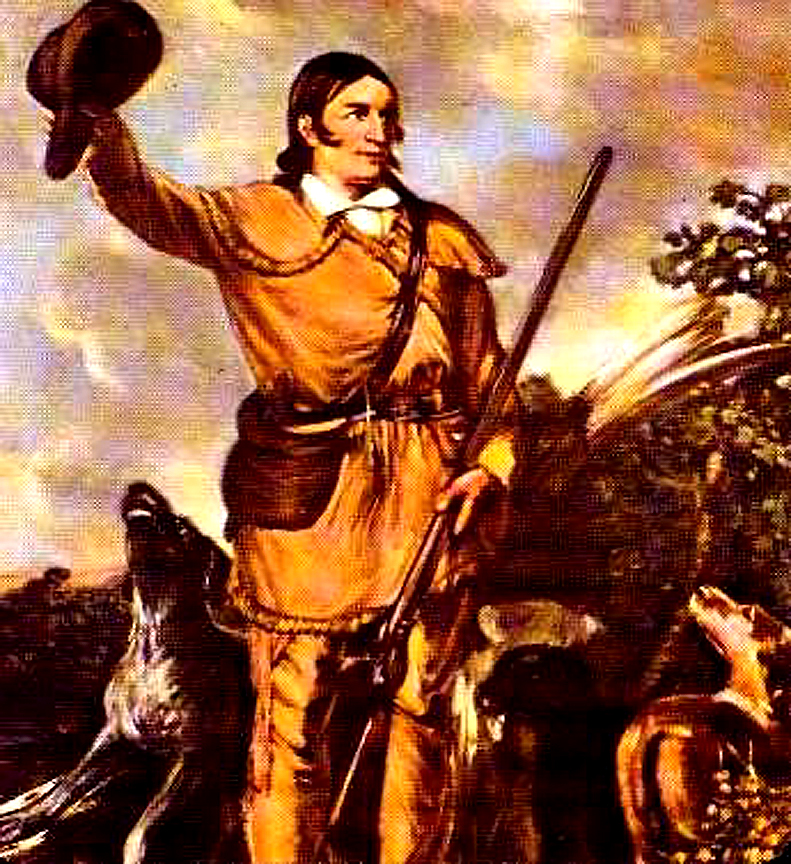
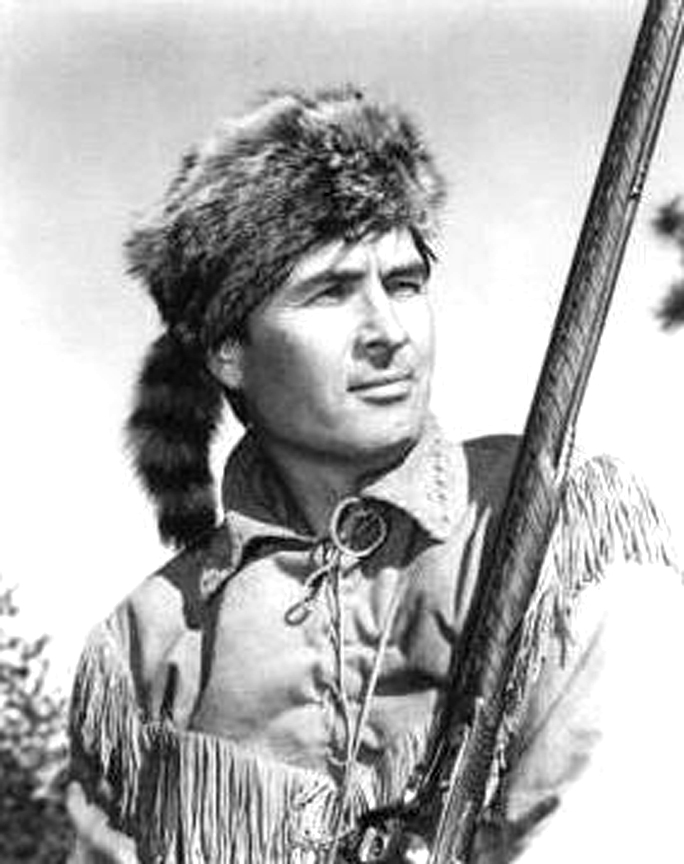

Davy Crockett and Legacy
Left: Heroic Portrait of Crockett
Middle: Fess Parker as Davy Crockett in the 1954-1955 Disney TV Show
Right: a Child of the 1950s suitably attired in Crockett regalia
If you are reading this in 2050, this dorky kid could have been your great-grandfather..
Click to Enlarge
Recordings of the show's theme song, The Ballad of Davy Crockett, sold seven million copies in the first six months of 1955. In case you're interested, the immortal words are:
Greenest state in the land of the free,
Raised in the woods so he knew every tree,
Kilt him a b'ar when he was only 3.
Davy, Davy Crockett, King of the Wild Frontier!
Through the magic of the internet, you can watch Fess Parker sing this memorable ode:
Throughout the decades of the 20th Century, Fess Parker, then John Wayne gave us a steady, unwavering Davy Crockett, champion of Freedom and Right. Attributed to Davy, Wayne's immortal words in the 1960 film The Alamo were the byword of a generation that had grown up to hate the Commie Menace:
"... Republic. I like that word. Means that people can live free, talk free, go or come, buy or sell, be drunk or sober, however they choose. Some words give you a feeling. Republic is one of those words that makes me tight in the throat ..."
In fact, once again through the magic of the internet, you can hear John Wayne actually speak those momentous words.
While John is talking however, you might want to mull this over: General Santa Ana was "visiting" because the American settlers in Texas brought their SLAVES with them. Slavery was illegal under the Mexican constitution. The principal issue between the "Texicans" and the "Mexicans" was slavery, plain and simple. Only certain people could "live free" or "go free."
As a child of the 1950s, I have come to realize that many of my idols had feet of clay. Elvis met his match with carbohydrates, JFK was really a womanizing airhead, Charles Van Doren was a fake, George McGovern was a bad trip, Alger Hiss was really a Commie spy. It came as no surprise when Billy Bob Thornton offered an alternate version of Davy Crockett as a sorely muddled loser in the 2004 version of The Alamo.
Join Us on Facebook
Counter for the ENTIRE Website

Home | About Lindy | 1940s Collectables | Upcoming Events | Vintage Clothes
The Guide - Establishments - Travel - Accessories
Music | Links | Photo Gallery | Extras | Contact